
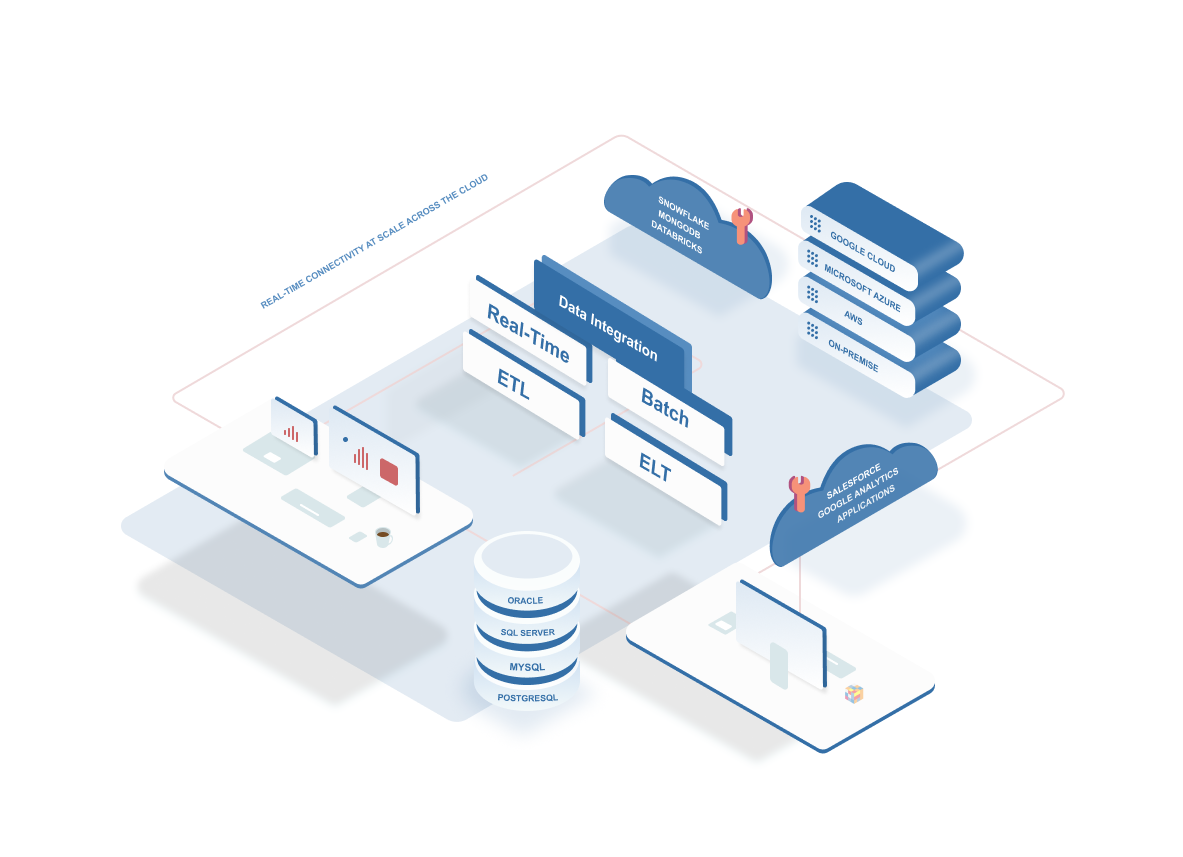
Data is the lifeblood of organizations, yet it often exists in disparate sources including databases, applications, and cloud storage systems. This makes it challenging to understand your data and derive significant insights comprehensively.
ETL and data integration are closely related ideas. A particular kind of data integration called ETL includes obtaining data from several sources, modifying it to meet the needs of the target system, and then loading the modified data into the target system—a data warehouse or data lake, for example.
What is Data Integration?
Data integration is an important aspect of data engineering services, ensuring that different data sources are merged into a coherent structure for better decision-making and analysis.
The process of merging data from multiple sources into a single, logical structure is known as data integration. This provides you with a streamlined picture of the data that can be utilized for reporting, analysis, and decision-making by apps further down the line.
The data integration technique has the following steps:
1. Manual data integration
When data is manually extracted, transformed, and loaded into a single destination, it can be integrated from several sources, including databases and spreadsheets. Smaller datasets and one-time migrations are good candidates for this strategy. It can be an error-prone and labor-intensive strategy for large datasets.
2. Batch data integration
Instead of integrating data in real-time or almost real-time, batch data integration allows you to do so in discrete batches. This technique allows the processing and transfer of data in preset hourly, daily, or weekly periods. When real-time processing is neither necessary nor practical, it is frequently utilized.
3. Data Virtualization
The process of accessing and querying different data sources, including databases, apps, and cloud-based services, as though they were all kept in one central location is known as data virtualization. It builds a virtual layer that condenses the underlying data sources rather than physically transferring or copying data from multiple sources into a central repository.
4. Application Integration
Application Integration allows software programs and systems within your organization to synchronize, facilitating smooth data interchange, communication, and teamwork. It entails building a single ecosystem in which many apps may collaborate effectively and share data in real-time to assist with decision-making and business processes.
What is ETL?
A well-known data integration procedure called extract, transform, and load, or ETL, gathers information from several sources into a standardized dataset that is then loaded into a target system such as a data warehouse or data lake.
It provides a framework for data analytics and machine learning workstreams. ETL makes it possible to clean and arrange data according to a set of business rules to fulfill particular business intelligence requirements, such as modifying data to fit the specifications of machine learning models.
ETL consists of three steps:
1. Extract
Data is retrieved in the extract process from several sources, including files, web APIs, SaaS apps, relational databases, Internet of Things devices, and social media. There are other ways to extract data: SQL, APIs, connectors, scripts, etc.
2. Transform
Processing and modification are performed on the raw extracted data in the staging area to prepare it for the targeted analytical use case. This stage entails removing mistakes and inconsistencies from the data by filtering, cleaning, de-duplicating, and validating it.
3. Load
The converted data is sent from the staging area to the target data warehouse or data mart in this final stage.
Data Integration vs ETL: Differences
The primary differences between data integration and ETL are as follows:
| Features | Data Integration | ETL |
| Scope | Greater flexibility in integrating data from different sources | Particular to workflows in data warehousing |
| Data Volume | Small to large volumes of data | Mostly handle large volumes of data |
| Processes | Comprises loading, quality control, replication, distribution, virtualization, extraction, and data transformation | Includes extracting, transforming, and loading |
| Tools | Specialized integration platforms, data visualization tools, and middleware designed to handle diverse integration needs | Traditional tools optimized for data warehousing tasks like bulk loading |
| Use Cases | Sharing operational data and data management | Data warehousing, business intelligence, and analytics preparation |
Data Integration Use Cases: Applications for Improved Understanding
As businesses strive to eliminate data silos and have a complete understanding of their business operations, data integration has grown in importance across industries. Here are a few of the best instances of data integration:
1. Data Lake Ingestion
You must ingest and arrange various data types into data lakes to execute advanced analytics on big data. Acquiring, transforming, and loading batch and streaming data into data lakes are made easier through data integration.
2. Application Integration
Data integration allows for the easy transmission of data across several applications. For cross-functional processes, it can link cloud and on-premise software such as ERP, CRM, HCM, etc.
3. Legacy Modernization
Data integration carefully incorporates legacy system data into modern platforms and makes it available via APIs. In this manner, the value of the data can be realized without undergoing dangerous overhauls. This data connection facilitates a more seamless transition and lowers risk by paving the way for a phased modernization strategy.
4. Real-time Data Analytics
Analytics systems receive live transactional data and events through data integration, enabling real-time monitoring, alerting, and reporting to facilitate prompt response. It feeds analytics tools with real-time data from messaging apps, databases, and other sources.
5. Unified Client Profile
Information from many sources, such as customer relationship management systems, transactions, website interactions, and support issues, must be merged to create a thorough client perspective. Data integration integrates data from several channels to provide a single client profile. This is what motivates personalized marketing and experiences.
ETL Use Cases: Value Extraction for Simplified Data Transformations
If you know the various uses for ETL, you may optimize processes and arrive at better judgments. Major usage cases where ETL provides business value are as follows:
1. Operational Data Integration
ETL procedures can transfer real-time data from transaction systems into analytics and operational dashboards, to track business events.
2. Enterprise Data Warehousing
It facilitates the management of incremental updates into enterprise data warehouses and the loading of massive amounts of historical data from many sources. This lays the groundwork for BI.
3. Data Quality & Security
ETL tools provide high-quality and data-compliant integration into warehouses by offering features for data masking, validation, and auditing.
4. Testing & QA Datasets
It provides a quick and reusable way to load datasets required for application development, testing, and quality assurance by integrating data from operating systems.
5. Database Administration
ETL processes facilitate the automation of DBA tasks that are repetitive yet essential for excellent database performance, such as index construction, statistics collection, and archiving.
Final Thoughts
Finding what works best for you is more important in the debate between data integration and ETL than whether ETL is superior to data integration or vice versa. The secret here is knowing when to use the flexible bridge-building powers of data integration and when to use the potent data transformation and movement powers of ETL.
Depending on your specific use case and the characteristics of the data environment, you may choose to use data integration or ETL. Although data integration platforms are typically more user-friendly and scalable than ETL, the latter requires more specialized knowledge and frequently has higher setup and maintenance expenses.
However, ETL works better in managing high-volume batch activities like populating enterprise data warehouses. However, data integration works better when handling real-time, low-latency data sources.