
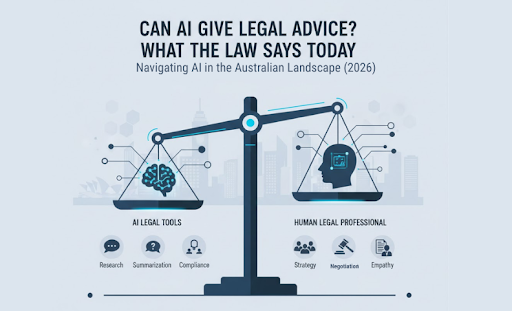
One of the key features australian legal research tools boast today is that they can help ordinary people understand the law without having to go through a stringent legal education. However, whether AI legal tools can give sound legal advice is a highly debatable topic.
This article seeks to guide the readers through existing Australian laws on AI usage in seeking legal advice and to help them pinpoint when and how to seek the help of legal AI tools today.
How Legal AI Tools Give Legal Advice Today
Law students and lawyers alike use AI legal tools to help them with their daily tasks including researching for legal information. Some of the key features of legal AI tools include the following:
- Legal files organization
- Efficient legal research and case summary
- Compliance with current Australian regulations
- Analysis of legal documents and existing jurisprudence
- Simple legal advice
What Counts as Legal Advice?
Legal advice is the “provision of fact-specific legal advice to a potential/existing client in response to a request for assistance to resolve specific legal problems”. Legal advice takes no particular form and may be written or oral.
While legal advice may help clients with their problems temporarily, it may only guide them through what to do thus it is important to seek professional legal help for more complicated and multi-faceted problems.
Other Legal Assistance AI Can Provide
Under the National Legal Assistance Data Standards Manual, there are multiple types of legal services such as the following:
-
Discrete Assistance
Discrete Assistance can compose of services that are intermittently provided as compared to representation services. They are provided only when the client specifically asks for it such as information request, referral, legal advice, and even non-legal support.
-
Ongoing Legal Support Services
Ongoing legal support services is a commitment to the client that the lawyer/legal service provider will be providing continuous legal support but will not be representing them in court.
-
Facilitated Resolution Process
A lawyer/service provider conducts an activity to assist two or more parties to resolve or narrow issues in dispute.
-
Duty Lawyer
The tasks of a Duty Lawyer consist of providing legal services to a client during proceedings at a court or tribunal. A duty lawyer however also does not represent clients in court but are only present there in case clients without representation need legal support.
-
Representation
Lastly, representation services are one of the most well-known types of services and is when a lawyer/service provider takes care of all of the legal services needs of the client on an ongoing basis.
In all these legal services, legal AI tools can help in most of them because they augment routinary legal tasks such as organization and jurisprudence summarization.
How Legal AI Tools are Used in Giving Legal Advice
Since all legal services listed above are not cheap, oftentimes clients would turn to legal AI tools online to help resolve their problems. Questions as simple as
“Can a verbal agreement be enforceable in Australia?”
to more complex ones such as
“I live in Queensland. I bought a new laptop online for $2,200 from JC Wi-Fi. After 3 months of careful use, the laptop started to repeatedly shut down and eventually displayed a white screen. I returned to JC Wi-Fi but they refused to provide a refund nor repair services, stating that their store policy only allows repairs after 30 days.
Under Australian Consumer Law, am I entitled to a refund or repair services for free, and what steps can I take legally since the retailer continues to refuse?”
are answered by legal AI tools by a simple yes/no answer, legal basis, and its resources. However, it is important to note that while legal AI tools can help answer yes/no questions with a single legal problem, it may be more difficult to use for more complex and layered legal issues.
Is It Legal for AI to Give Legal Advice?
As of writing, yes, it is legal for AI to give legal advice in Australia but there are certain guidelines & limitations to follow. Last October 2025, the Department of Industry, Science and Resources and the National AI Centre published new Guidance for AI Adoption (“GfAA”) which supersedes the Voluntary AI Safety Standard (the “VAISS”).
The AI screening tools of GfAA provide protection against AI systems that are not sufficiently secure, those that generate misleading outputs/statements, and those that produce biased and incorrect outputs. Intellectual property laws, the Australian consumer law, and Australian privacy laws govern these protections to help mitigate risks in AI use.
How to Use AI Tools for Legal Advice?
One of the main legal guidelines lawyers/legal service providers must follow are the Legal Profession Uniform Law (Uniform Law) and the Legal Profession Uniform Law Australian Solicitors’ Conduct Rules 2015 (ASCR).
Under these rules, lawyers/legal service providers are expected to:
-
Preserve Client Confidentiality
In using legal AI tools to ask for legal advice, lawyers/legal service providers tend to narrate the information relayed to them by their clients. ASCR r 9 is clear that client confidentiality must be maintained at all times and that lawyers/legal service providers must be ready to review the service agreements provided by their chosen legal AI platform to ensure that the information they will provide will be kept safe. Better yet, they can provide as little information as they can to avoid leaking sensitive information.
-
Provide Independent Legal Advice
While lawyers/legal providers are free to use legal AI tools for research, they must still provide independent legal advice of their own analysis per ASCR r 4.1.4. Legal AI tools are only there to provide guidance and support to lawyers/legal service providers.
-
Maintain Honesty, Transparency and Competence
Lawyers/legal service providers are likewise expected to be transparent about their use of AI in the legal documents or advice they provide to their clients. This allows them to be more trustworthy in the legal advice they give to their clients.
How Can Generative AI Give Legal Advice?
Generative AI is currently being widely adopted in the Australian legal field to draft and review contracts, conduct legal research, and practice document organization among others. Legal service providers such as CoCounsel, Harvey, and CaseNote must take into account the compliance regulations when using generative AI tools to augment their legal research tasks.
As such, it is important to note that while generative AI tools can give legal advice in the form of explaining the law and providing legal resources, lawyers and legal service providers alike must personally be responsible for analyzing and comprehending the resources provided by these legal AI tools to ensure competence and reliability.
Further, legal professionals must only treat legal AI tools as companions in legal tasks and not as replacements for their analytical minds.
Conclusion
While AI can give legal advice in Australia nowadays, it is essential for users and lawyers/legal service providers to be more careful in the type of legal advice they seek. While simple compliance questions can be asked to legal AI tools to augment their knowledge, more complex and sensitive legal problems are best left to legal professionals.
As such, before posing any legal question, make sure you understand when to rely on legal AI tools and when to seek legal professional advice.