
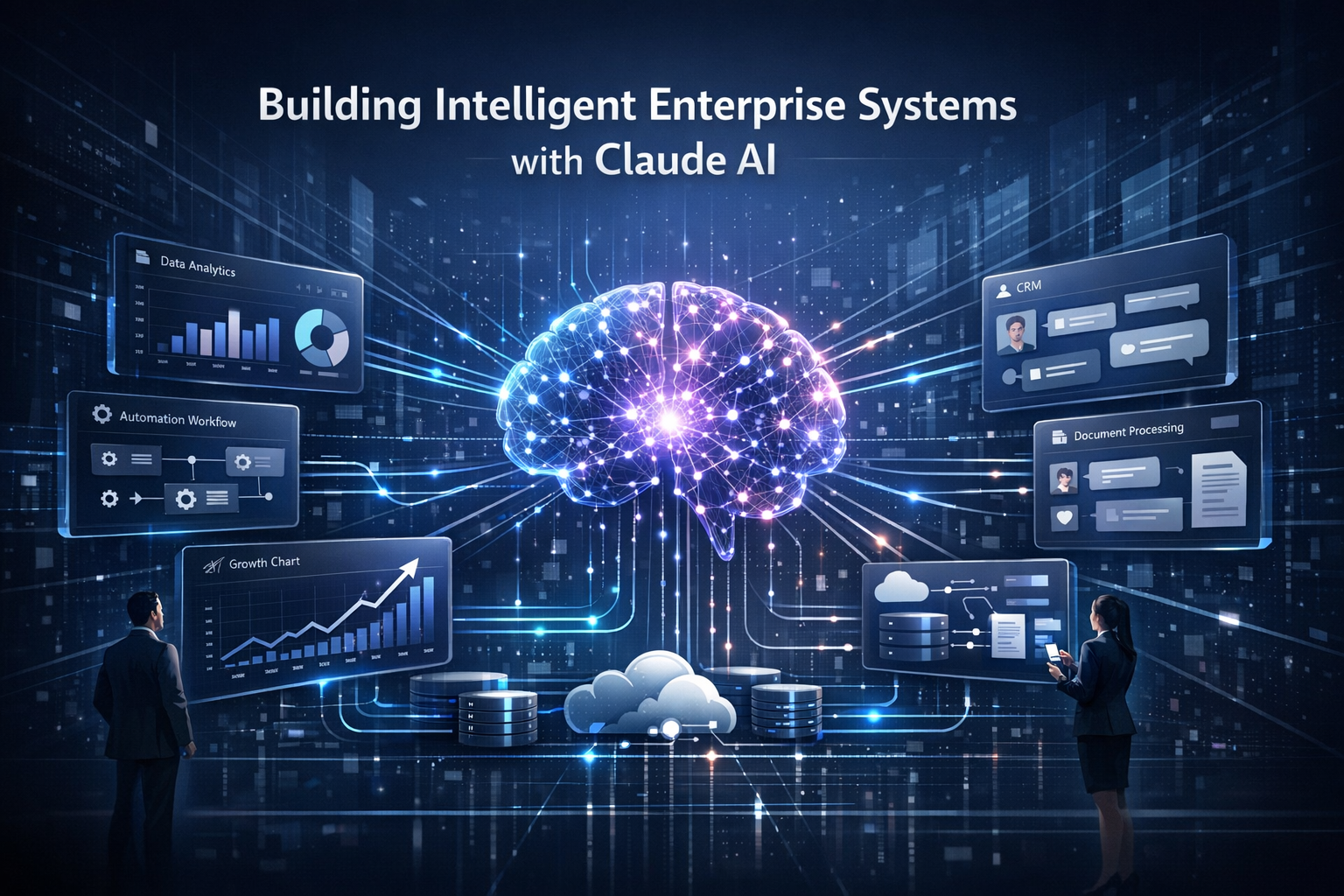
Artificial intelligence has transitioned from an experimental technology into a critical component of modern enterprise infrastructure. Organizations across industries are integrating AI technologies into their operations to improve productivity, automate repetitive tasks, and enable data-driven decision-making. Among the AI models gaining increasing attention in the enterprise technology ecosystem is Claude AI.
Claude AI offers advanced natural language processing capabilities that allow businesses to automate communication, analyze large volumes of information, and create intelligent digital assistants. Unlike earlier automation tools that relied on fixed scripts or rule-based systems, Claude AI can interpret complex prompts, maintain contextual understanding, and generate human-like responses.
For enterprises seeking scalable automation solutions, Claude AI solutions for business represent a significant opportunity to modernize workflows, enhance customer engagement, and support internal productivity. However, the real value of Claude AI emerges when it is strategically integrated into enterprise systems through professional Claude AI integration & development services that align with operational goals.
This article explores how enterprises are leveraging Claude AI, the practical applications of this technology across industries, and the architectural considerations required for successful AI implementation.
The Enterprise Shift Toward AI-Driven Automation
Over the past decade, enterprises have invested heavily in digital transformation initiatives. Cloud infrastructure, data analytics platforms, and integrated software ecosystems have become standard components of modern business environments. Yet many organizations still face operational inefficiencies caused by manual processes and fragmented data systems.
AI technologies are addressing this gap by enabling intelligent automation. Instead of relying solely on human intervention for tasks such as data analysis, document review, or customer communication, enterprises can now deploy AI-powered systems capable of performing these tasks at scale.
Claude AI is particularly suited for enterprise environments because of its ability to process large amounts of text-based information and generate context-aware responses. This capability allows businesses to automate tasks that traditionally required human judgment, including report analysis, knowledge management, and conversational support.
As a result, enterprises are increasingly integrating Claude AI into their technology stacks to enhance efficiency and create more responsive digital systems.
Understanding Claude AI’s Enterprise Capabilities
Claude AI is designed to handle complex reasoning tasks while maintaining a high level of conversational coherence. Its architecture enables it to analyze detailed prompts, extract relevant information from extensive datasets, and provide structured responses that support decision-making processes.
In enterprise contexts, this capability enables several high-value applications. Claude AI can assist employees with research tasks, summarize lengthy documents, interpret customer inquiries, and generate actionable insights from operational data.
For example, an enterprise knowledge management system integrated with Claude AI can provide employees with instant answers to questions related to policies, technical documentation, or project guidelines. Instead of manually searching through multiple resources, employees can interact with the AI assistant and retrieve accurate information in seconds.
Organizations implementing Claude AI solutions for business are leveraging these capabilities to build intelligent digital environments where employees and systems interact more efficiently.
Customer Engagement Through Intelligent AI Assistants
Customer engagement has become a defining factor for business success in the digital economy. Customers expect quick responses, personalized interactions, and consistent support across multiple communication channels.
Claude AI enables enterprises to develop sophisticated conversational systems capable of meeting these expectations. AI-powered assistants can analyze customer messages, identify intent, and provide contextual responses that address specific inquiries.
Unlike traditional chatbots that rely on scripted responses, Claude AI-powered systems can interpret nuanced questions and generate relevant answers dynamically. This significantly improves the quality of automated customer interactions.
Enterprises are deploying AI assistants across websites, messaging platforms, and mobile applications to manage customer inquiries, provide product recommendations, and assist with service-related issues.
By integrating conversational AI technologies through Claude AI integration & development services, businesses can create scalable support infrastructures that maintain high service quality while reducing operational costs.
Transforming Knowledge Management with AI
One of the most significant challenges faced by large organizations is managing and accessing institutional knowledge. Enterprises often maintain extensive documentation, including policies, training materials, compliance guidelines, and technical manuals. However, locating relevant information within these repositories can be time-consuming.
Claude AI can transform knowledge management systems by acting as an intelligent interface for accessing internal information. Instead of navigating complex document structures, employees can simply query the AI assistant and receive accurate responses derived from internal datasets.
This capability is particularly valuable in industries where teams must frequently reference technical documentation or regulatory information. By reducing the time required to locate critical information, AI-powered knowledge systems enhance operational efficiency and support faster decision-making.
Organizations implementing Claude AI solutions for business are increasingly using AI-powered knowledge assistants to improve information accessibility across departments.
AI-Assisted Data Analysis and Strategic Insights
Data analysis plays a central role in enterprise strategy, yet many organizations struggle to convert large datasets into actionable insights. While traditional analytics tools can process numerical data, interpreting the results often requires specialized expertise.
Claude AI introduces a new layer of intelligence by interpreting complex reports and translating data insights into understandable narratives. This allows business leaders to quickly grasp key trends, anomalies, and performance indicators without manually analyzing extensive datasets.
For example, marketing teams can use AI to analyze campaign performance reports, while operations teams can evaluate productivity metrics and supply chain performance. Financial departments can also benefit from AI-generated summaries of financial statements and forecasting models.
Through these applications, enterprises using Claude AI solutions for business can improve strategic planning and accelerate data-driven decision-making processes.
Intelligent Workflow Automation with AI Agents
Another major development in enterprise AI adoption is the use of intelligent agents to automate multi-step workflows. AI agents powered by Claude AI can interact with various systems, retrieve relevant information, and execute predefined tasks with minimal human intervention.
For instance, an AI agent might monitor incoming support tickets, categorize them based on urgency, and assign them to appropriate teams. Another agent could generate periodic operational reports by collecting data from multiple enterprise systems.
These automation capabilities reduce manual workloads and ensure that routine tasks are completed consistently and efficiently.
Enterprises often work with providers offering chatbot development and AI development services to design customized AI agents that align with their specific workflows and operational requirements.
Integrating Claude AI with Enterprise Software Ecosystems
Successful AI adoption depends largely on how effectively the technology integrates with existing enterprise systems. Claude AI can be connected with various software platforms, including customer relationship management systems, enterprise resource planning tools, collaboration platforms, and internal databases.
This integration allows AI systems to access relevant data and perform tasks within existing workflows. For example, integration with CRM platforms enables AI assistants to analyze customer interactions and generate personalized engagement strategies.
Similarly, integrating Claude AI into project management systems allows teams to automate status reporting, task summaries, and progress tracking.
Professional Claude AI integration & development services play a critical role in designing these integrations and ensuring secure communication between AI models and enterprise infrastructure.
Security, Governance, and Responsible AI Deployment
As enterprises adopt AI technologies, maintaining data security and compliance becomes increasingly important. AI systems often interact with sensitive information, making it essential to implement strong governance frameworks.
Organizations deploying Claude AI must establish safeguards such as access controls, encrypted data pipelines, and monitoring mechanisms to ensure responsible usage. AI outputs should also be regularly reviewed to maintain accuracy and prevent potential misuse.
Responsible AI governance includes defining clear policies regarding how AI systems interact with business data and how decisions supported by AI are validated by human oversight.
Enterprises partnering with experienced AI development providers can ensure that their AI implementations adhere to industry standards and regulatory requirements.
Industry Applications of Claude AI
Claude AI’s versatility allows it to support a wide range of industries, each benefiting from its ability to process natural language and analyze complex information.
In healthcare, AI assistants can help manage patient inquiries and streamline administrative workflows. Financial institutions use AI systems for document analysis, risk assessment, and customer service automation.
Retail and e-commerce companies deploy AI-powered chat assistants to enhance product discovery and improve customer engagement. Technology companies leverage AI tools to support developer productivity and technical documentation management.
Across these industries, Claude AI solutions for business are enabling organizations to operate more efficiently while delivering improved digital experiences.
The Strategic Role of AI Development Partners
Although AI technologies are becoming more accessible, implementing enterprise-grade solutions still requires specialized expertise. Businesses must design scalable architectures, manage data integration, and ensure that AI systems operate reliably under real-world conditions.
Professional development partners help enterprises navigate these complexities by translating AI capabilities into practical business applications.
Through customized design, integration, and optimization processes, development teams ensure that AI systems align with organizational goals and support long-term innovation strategies.
Companies investing in Claude AI integration & development services often achieve faster deployment cycles and more effective automation outcomes.
The Future of Enterprise AI with Claude
As AI technologies continue to evolve, enterprises are moving toward increasingly sophisticated automation ecosystems. Future AI systems will likely combine conversational interfaces, intelligent agents, and predictive analytics into unified platforms that support complex decision-making processes.
Claude AI’s ability to understand context and process large volumes of text-based information positions it as a key component of these evolving ecosystems.
Organizations that adopt AI strategically today will be better prepared to leverage emerging technologies and maintain competitive advantages in rapidly changing markets.
Conclusion
Claude AI is redefining how enterprises approach automation, knowledge management, and digital interaction. Its advanced language processing capabilities allow businesses to build intelligent systems that streamline operations, enhance productivity, and improve customer engagement.
However, the successful adoption of AI requires careful planning, secure integration, and alignment with enterprise workflows. Businesses that invest in well-designed Claude AI solutions for business and collaborate with providers offering Claude AI integration & development services can unlock significant operational value.
As AI continues to reshape enterprise technology landscapes, Claude AI is poised to play a central role in enabling smarter, more efficient business operations.