
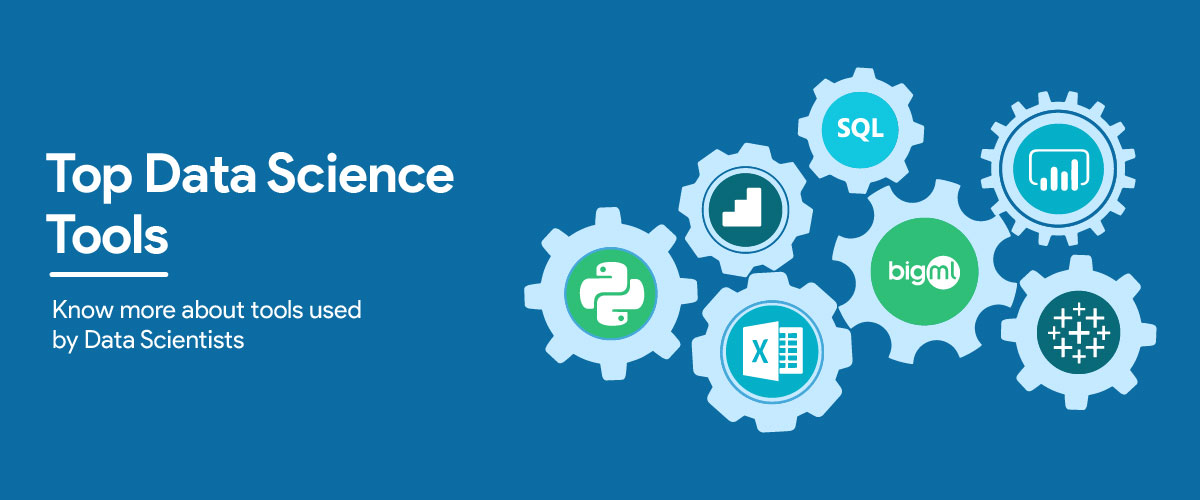
I have always had an interest in data science since my undergraduate studies. But whenever I thought of building projects, I thought it would require a computer, premium software, and an expensive subscription.
However, in 2026, it is not the case, and the reason is that many beginners and even experienced data scientists use free tools for data cleaning, creating visualisations, training machine learning models, and also collaborating on projects.
However, in 2026, free data science tools combine gathering and cleaning data, AI/ML modeling, and visual dashboards. It has made data science more accessible than ever. Whether you are a student, a professional, or an experienced data scientist, you can accomplish a lot even without spending any money.
Let’s get into the best free data science tools in 2026 that will make your journey in the field easy.
Why do free data science tools matter?
Data science is the fastest-evolving field, but many people hesitate to be a part of this field as they don’t want to financially invest. This is because they are not aware of the free tools they can utilise. They can use them and enter the field easily, experiment with datasets, build predictive models, and visualise insights without worrying about the finances.
Moreover, many free tools are supported by active developer communities. They receive updates, extensive documentation, and tutorials too. Furthermore, these tools also promote collaboration and innovation, which makes it easier to share projects and learn from each other.
Top free data science tools
1. Jupyter Notebook:
If you are an aspiring data scientist, then you should learn the Jupyter Notebook tool. It is an interactive document where you can mix code, results, text, visualisations, and experiments with data sets. The biggest strength of this tool is:
- Interactive coding
- Easy visualisation
- Support for Python, R, and Julia
- Excellent documentation
- Simple project sharing
It remains one of the most practical tools if you are cleaning data, performing statistical analysis, or training a machine learning model.
2. Google Collab:
Google Collab is a free and online tool. Also, it is one of the most popular free platforms for data science
It lets you run Python code using just your browser. First of all, you don’t need to download or set up Python on your computer, and you can start coding just by opening a web link. Furthermore, it already has built-in popular data science tools (like Pandas for handling spreadsheets)
The most useful features are:
- Free GPU access.
- Cloud-based notebooks.
- Easy collaboration.
- Automatic saving.
- Integration with Google Drive.
This tool is appreciated by students because of the latest software installation struggles.
3. Python:
Python is the most commonly used programming language in data science. It is used to analyse data and find patterns and insights.
Python is helpful in most of the data science workflows, from collecting and cleaning the data to analysing and visualising it. In addition, it also helps with machine learning, natural language processing, automation, web scraping, and so on. It has a special add-on toolkit called libraries.
4. R programming
Python can be used for many areas. However, R continues to be a free tool for statistical analysis and academic research. It is an open-source programming language; you can simply write text commands and analyse millions of rows of data.
Researchers appreciate it because of its large collection of statistical packages and advanced visualisation capabilities.
It works well in statistical modelling, predictive analytics, academic research, data visualisation, and time series analysis.
You can learn R if you want to pursue a research-intensive field.
5. Visual Studio Code:
Visual Studio Code is a lightweight program that lets you write, edit, and run your code. Moreover, it supports Python, R, SQL, Jupyter Notebook, git integration, and debugging with hundreds of extensions.
Its strengths are:
- lightweight performance
- intelligent code completion
- a built-in terminal
- git support
- extensive customisation
6. Pandas:
Pandas is a Python library. As a powerful software toolkit, it allows for loading, cleaning, and analysing large tables of data using code, and it is designed to work with structured data. It can make a lot of tasks easy such as importing data sets, cleaning messy data, filtering information, combining multiple datasets, performing calculations, and handling missing values.
7. NumPy:
NumPy is actually a foundational tool that allows Python to handle massive amounts of numbers fast. You can consider it as a Python upgrade to handle massive math problems without slowing down your computer. Moreover, for numerical operations, it provides support through array and matrix calculations, linear algebra, random number generation and mathematical functions.
8. Scikit-learn:
Scikit-learn is one of the best free machine learning libraries. It offers pre-made tools to build smart predictions and analyse data. The common applications include:
- Classification’regression
- Clustering
- Recommendation systems
- Model evaluation
- Feature selection
9. Tensor Flow:
Tensor Flow continues to be a crucial free platform if you are interested in deep learning and Artificial Intelligence. It is developed for large-scale machine learning applications; moreover, it supports neural networks, image recognition, speech processing, natural language processing, and recommendation engines. However, if you want help with PGCE primary assignments because you are left with little time as you also work as a data scientist, then connect with professional writers.
10. Tableau Public:
Data visualisation is a major part of data science, and in that regard, Tableau Public plays a major role in communicating insights.
It offers a free version that allows users to create professional-looking dashboards and interactive charts.
Moreover, its drag-and-drop interface is really useful and makes visualisation easier than coding.
11. Power BI free:
Microsoft Power BI free edition is an excellent option for beginners who want to explore business intelligence.
With this tool, you can easily build dashboards, analyse datasets, create interactive reports, and visualise business metrics.
Some other free tools for data science are:
- Apachespark
- Git and GitHub
- Kalle
- Streamlit
- Duckdb
All in all!
Data science tools are more accessible than ever; these free tools provide students and professionals with everything they need to analyse data, build machine learning models, create compelling visualisations, and collaborate on real-world projects. If you really want to move forward in your data science field, then stop worrying about the cost of the software and start with the free data science tools.