
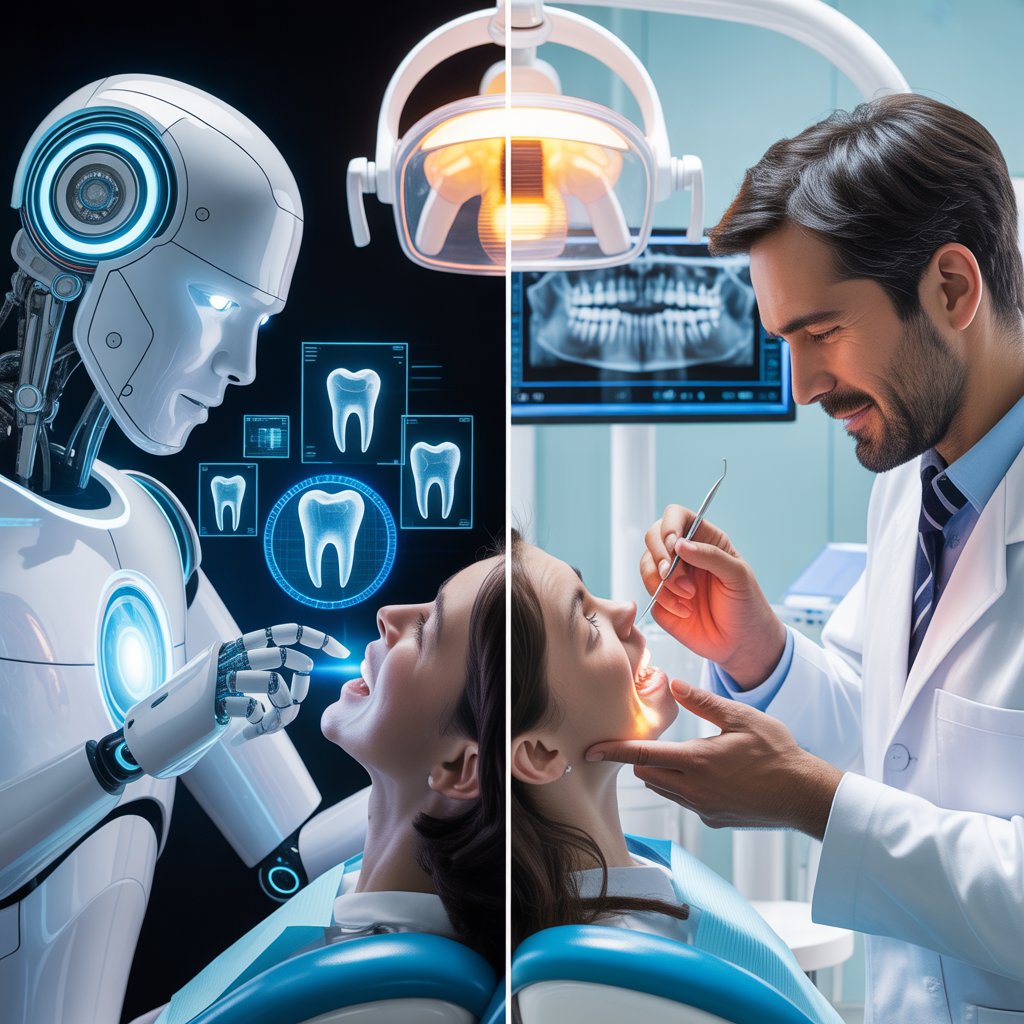
Artificial intelligence is becoming more common in healthcare. Dentistry is no exception. With smart tools, software, and machine learning, AI can now analyze dental X-rays, predict cavities, and even help design treatment plans. But people still trust their dentists for experience, empathy, and judgment. This creates an important question: when it comes to diagnosing dental problems, who does it better — AI or human dentists? The answer is not simple. Both have strengths and weaknesses. Understanding these can help patients and professionals see where AI can help and where the human touch still matters.
The Growing Role of AI in Dentistry
AI systems in dentistry work by studying large sets of dental images. They learn what healthy and unhealthy teeth look like. Once trained, they can find signs of decay, cracks, infections, or bone loss. Some tools can even predict how a cavity might grow or how an implant will settle over time.
Dentists are now using AI in clinics to:
- Read X-rays faster and more accurately
- Track gum health over time
- Identify early signs of oral diseases
- Improve treatment planning for braces or implants
- Keep better digital records
AI is fast, consistent, and never tired. It can analyze thousands of cases in minutes. It helps catch tiny issues that might be easy to miss by the human eye. But that doesn’t mean it replaces a dentist. Instead, it supports their decision-making.
How Human Dentists Diagnose
Human dentists depend on years of education, hands-on practice, and experience. They combine visual exams, X-rays, and patient history to make a diagnosis. But what makes human dentists different from machines is empathy and context.
Dentists understand pain, lifestyle, and habits. They can sense anxiety, comfort a patient, and adjust care accordingly. For example, if a patient grinds their teeth from stress, a dentist considers that during treatment. AI might not understand emotional or behavioral reasons behind oral health problems.
Diagnosis for a human dentist includes more than just detecting a cavity. It involves understanding the person behind the teeth. That’s something AI cannot yet replicate.
Comparing Diagnostic Accuracy
Studies show that AI can match or even outperform human dentists in some tasks. For example, AI tools have detected cavities, root fractures, and early decay with very high accuracy. In one research study, AI found cavities that several human dentists overlooked.
AI’s biggest strength is image recognition. It can spot minor differences in color or density on X-rays that are almost invisible to humans. But AI is only as good as the data it learns from. If the data is limited, the AI might make wrong assumptions.
Human dentists, on the other hand, can interpret complex cases. They know when an X-ray doesn’t tell the full story. They combine multiple clues, talk to the patient, and use judgment based on experience. So while AI might be sharper in detection, dentists still make better final decisions when context matters.
Where AI Excels in Diagnosis
AI stands out in several key areas of dental diagnosis:
- Speed: AI can analyze an X-ray in seconds.
- Consistency: It gives the same results every time without fatigue.
- Early Detection: It can identify problems before they become serious.
- Data Insights: It can track trends across hundreds of patients.
- Support for Training: Dental students can use AI to compare their diagnoses.
AI tools are also improving every year. With deep learning, they can now process 3D scans and CT images. Some systems even predict how diseases might develop based on genetic and lifestyle data.
Where Human Dentists Are Still Better
AI lacks human qualities that are essential in dental care. Here’s where human dentists still have the upper hand:
- Understanding Emotions: They can comfort nervous patients.
- Judging Context: They consider habits, diet, and pain tolerance.
- Complex Decision Making: Some cases need creativity and adaptability.
- Ethics and Empathy: Human care builds trust.
- Holistic Treatment: They see oral health as part of overall well-being.
For example, AI can suggest a crown for a cracked tooth, but a dentist might delay it if the patient is recovering from surgery or can’t afford it yet. Real-life judgment goes beyond what algorithms can calculate.
AI in Dental Imaging
X-rays and imaging are the strongest areas of AI in dentistry. AI software can detect cavities, bone loss, and abscesses with remarkable precision. It also helps dentists plan procedures like implants or orthodontics more safely.
AI imaging tools can:
- Compare new scans with old ones automatically
- Highlight suspicious spots
- Calculate bone density or tooth alignment
- Reduce human error in interpretation
Still, AI systems need human supervision. A misinterpreted scan could lead to overtreatment or missed disease. That’s why the best results come when dentists and AI work together.
AI as a Partner, Not a Replacement
AI is not meant to replace dentists. It’s a tool that improves their work. Just like calculators help with math, AI helps with pattern recognition and prediction. But dentists remain essential for final evaluation and patient care.
When AI and dentists collaborate, patients benefit the most. The dentist gets reliable data faster, and AI learns from human corrections to improve accuracy. This partnership makes dental care more precise and efficient.
The Role of AI in Preventive Dentistry
AI is not only for treatment. It’s also becoming a strong tool for prevention. By analyzing dental data, AI can predict future risks such as gum disease or tooth loss.
Some clinics now use AI to monitor brushing habits through smart toothbrushes. Others use predictive software to recommend early checkups. These systems can help patients take action before problems appear.
This preventive focus saves time, money, and discomfort. And it encourages healthier routines that last long-term.
Can AI Understand Pain and Emotions?
Pain is personal. AI doesn’t feel it. A human dentist can look at your face and know you’re uncomfortable. They can adjust the tools or take a break. AI can’t do that.
AI can measure stress levels through sensors or tone of voice, but it doesn’t truly understand them. Emotional intelligence is something only humans bring to care. That’s why patients still prefer to talk to a real dentist about their fears, pain, and options.
The Ethical Side of AI in Dentistry
Using AI in healthcare raises questions about data privacy and responsibility. Dental images and patient histories are sensitive information. If an AI system misdiagnoses a patient, who is responsible — the software or the dentist using it?
Dentists must make sure AI tools meet medical standards. They also need to keep data secure and explain to patients how their information is used. Ethics will always play a key role, and that’s something only humans can ensure.
Cost and Accessibility
AI tools can reduce costs in the long run, but the initial setup is expensive. Not every clinic can afford AI software, scanners, and data systems. This may create a gap between large urban practices and small local clinics.
In cities like Miami, where technology adoption is fast, some practices already use AI for diagnosis. If you visit a dentist Miami, you might see AI-powered imaging tools as part of your exam. In smaller towns, traditional methods may still be the norm.
Training and Education
Dental schools are now teaching students how to work with AI systems. Future dentists will need to understand both clinical and digital skills. They will learn how to read AI data, spot errors, and make better judgments using technology.
This doesn’t mean students rely less on human skill. It means they’ll use AI as a helper, not a replacement. The goal is balance, technology plus human care.
What Patients Think
Most patients like the idea of accuracy and early detection. But some are unsure about machines making health decisions. They want a dentist to explain results and guide them.
When used correctly, AI gives patients more confidence. It can show clear images and explain risks visually. But people still trust human words more than computer screens. Transparency from the dentist is key.
The Future: Collaboration Over Competition
The future of digital dentistry is not about AI versus humans. It’s about collaboration. AI can handle the data and details; dentists can handle people and care.
In coming years, AI may become more advanced. It might even predict emotional stress or link oral health to other body systems. But no matter how smart the technology becomes, human dentists will still lead the process.
Conclusion
AI is improving the way dental care works. It helps with faster, more accurate diagnoses and supports preventive care. But human dentists bring empathy, ethics, and understanding that machines can’t match. The best dental care happens when both work together, AI provides precision, and dentists provide compassion.
AI may one day become even more advanced, but it will never replace the human connection between a dentist and a patient. The future of dental care is teamwork between people and technology, not competition.
Village of Dentistry is a state-of-the-art dental clinic in Miami, FL, dedicated to providing high-quality dental care with advanced technology, same-day procedures, and personalized treatments. Our experienced dentists, oral surgeons, and dental hygienists offer comprehensive services, including dental implants and cosmetic dentistry. We prioritize patient comfort and satisfaction, ensuring every treatment plan is tailored to individual needs. Whether you need routine care, restorative solutions, or specialized procedures, our team is here to help. Experience top-tier dentistry in Miami with compassionate care designed to exceed your expectations.