

Restaurant inventory management has become one of the most critical operational challenges in the hospitality industry. In 2026, rising food costs, supply chain disruptions, labor shortages, and changing customer demand are forcing restaurants to rethink how they manage inventory. Traditional inventory tracking methods are no longer enough for fast-moving restaurant operations.
This is where AI-powered inventory optimization is transforming the restaurant industry. Artificial intelligence enables restaurants to automate inventory tracking, improve forecasting accuracy, reduce food waste, optimize purchasing decisions, and maintain healthier profit margins.
From quick-service restaurants and cloud kitchens to enterprise restaurant chains, AI inventory systems are helping operators make faster, smarter, and more data-driven inventory decisions.
What Is AI-Powered Inventory Optimization?
AI-powered inventory optimization uses artificial intelligence, predictive analytics, machine learning, and automation to improve how restaurants manage ai in food supply chains inventory, purchasing, stock levels, and supply chain operations.
These systems analyze operational data such as:
-
Sales trends
-
Customer demand patterns
-
Seasonal fluctuations
-
Supplier performance
-
Ingredient consumption
-
Waste data
-
Menu popularity
-
Delivery schedules
AI systems then generate intelligent recommendations that help restaurants maintain optimal inventory levels while reducing waste and operational inefficiencies.
Why Restaurants Need AI Inventory Optimization in 2026
Inventory management directly impacts restaurant profitability. Overstocking leads to spoilage and waste, while understocking creates customer dissatisfaction and lost revenue.
Restaurants today face several operational challenges:
-
Rising food costs
-
Supply chain instability
-
Demand unpredictability
-
Labor shortages
-
Perishable inventory risks
-
Multi-location inventory complexity
-
Manual tracking inefficiencies
AI agents for inventory optimization helps restaurants respond to these challenges with greater accuracy and agility.
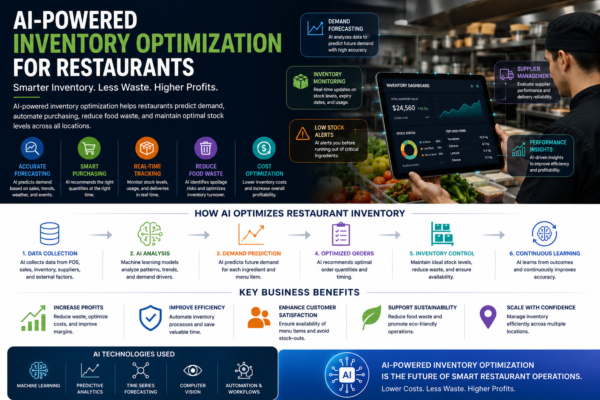
How AI Is Transforming Restaurant Inventory Management
Real-Time Inventory Tracking
AI systems continuously monitor inventory movement across restaurant operations.
This enables restaurants to:
-
Track ingredient usage in real time
-
Monitor stock depletion automatically
-
Detect inventory anomalies
-
Improve stock visibility
-
Reduce manual inventory counting
Real-time tracking improves operational control and reduces inventory blind spots.
Predictive Demand Forecasting
One of the biggest advantages of AI inventory systems is predictive forecasting.
AI models analyze historical and real-time data to predict future demand based on:
-
Seasonal trends
-
Day-of-week patterns
-
Weather conditions
-
Local events
-
Consumer behavior
-
Promotional campaigns
-
Holiday demand fluctuations
Restaurants can better align purchasing decisions with expected customer demand.
Reducing Food Waste With AI
Food waste is one of the largest sources of operational loss in restaurants.
AI-powered inventory optimization helps reduce waste by:
-
Predicting ingredient consumption accurately
-
Monitoring expiration timelines
-
Detecting over-ordering patterns
-
Optimizing purchasing frequency
-
Recommending inventory adjustments
This enables restaurants to improve sustainability while protecting profit margins.
Automated Purchasing Recommendations
AI inventory systems can automatically recommend purchasing decisions based on operational needs.
These systems evaluate:
-
Current stock levels
-
Supplier lead times
-
Demand forecasts
-
Ingredient usage rates
-
Pricing fluctuations
-
Historical ordering patterns
Restaurants can avoid over-purchasing while ensuring critical ingredients remain available.
AI and Multi-Location Restaurant Inventory Management
Managing inventory across multiple restaurant locations creates significant operational complexity.
AI-powered systems provide centralized visibility into:
-
Inventory performance across locations
-
Regional demand variations
-
Supplier coordination
-
Distribution efficiency
-
Waste tracking
-
Stock transfer optimization
Restaurant chains can standardize inventory management while adapting to local operational needs.
Intelligent Menu Optimization
AI systems also help restaurants optimize menus based on ingredient profitability and demand patterns.
AI can identify:
-
High-performing menu items
-
Low-margin dishes
-
Ingredient inefficiencies
-
Seasonal menu opportunities
-
Demand-based pricing opportunities
This allows restaurants to align inventory strategy with revenue optimization goals.
AI-Powered Supplier Management
Restaurants rely heavily on supplier reliability and pricing consistency.
AI inventory platforms help monitor:
-
Supplier delivery performance
-
Cost fluctuations
-
Order accuracy
-
Supply chain disruptions
-
Vendor risk factors
Restaurants can make better supplier decisions while minimizing operational disruptions.
AI for Inventory Cost Optimization
Food inflation and operational costs continue to impact restaurant profitability.
AI helps optimize inventory costs through:
-
Smarter purchasing decisions
-
Reduced waste
-
Better stock forecasting
-
Automated replenishment planning
-
Dynamic inventory balancing
This improves cost control without compromising customer experience.
AI and Restaurant Analytics
Modern inventory systems provide restaurants with advanced operational analytics.
These insights include:
-
Inventory turnover rates
-
Ingredient profitability
-
Waste analysis
-
Demand forecasting accuracy
-
Supplier performance metrics
-
Purchasing trends
-
Operational inefficiencies
Restaurant operators gain deeper visibility into inventory performance and business operations.
AI Inventory Optimization for Cloud Kitchens
Cloud kitchens and delivery-first restaurant models rely heavily on operational efficiency.
AI-powered inventory systems help cloud kitchens:
-
Predict delivery demand
-
Optimize ingredient procurement
-
Reduce spoilage
-
Coordinate multiple virtual brands
-
Improve inventory turnover
-
Automate replenishment workflows
This supports higher scalability and faster operational execution.
Benefits of AI-Powered Inventory Optimization for Restaurants
Reduced Food Waste
AI forecasting and inventory tracking minimize spoilage and overstocking.
Improved Profit Margins
Better purchasing decisions and waste reduction improve operational profitability.
Smarter Purchasing Decisions
Restaurants can align purchasing strategies with real-time demand forecasts.
Increased Operational Efficiency
Automation reduces manual inventory management tasks and administrative workload.
Better Demand Forecasting
AI enables more accurate inventory planning across changing customer patterns.
Enhanced Supply Chain Visibility
Restaurants gain better visibility into supplier performance and inventory movement.
Scalability Across Locations
Multi-location restaurants can manage inventory more consistently and efficiently.
Challenges Restaurants Must Address
Although AI inventory optimization delivers major benefits, implementation requires proper planning.
Common challenges include:
-
Integration with POS and ERP systems
-
Data quality and consistency
-
Staff adoption and training
-
Legacy infrastructure limitations
-
Supplier system integration
-
Real-time synchronization issues
Restaurants that invest in strong operational data foundations achieve better AI outcomes.
The Future of AI Inventory Management in Restaurants
The next generation of restaurant inventory systems will become increasingly autonomous and intelligent.
Future innovations include:
-
AI inventory agents
-
Autonomous purchasing systems
-
Predictive supply chain coordination
-
Computer vision inventory monitoring
-
AI-driven dynamic pricing
-
Real-time kitchen inventory automation
AI will continue evolving from operational support technology into a strategic business intelligence layer for restaurants.
Why Restaurants Are Investing in AI Inventory Optimization
Restaurants are adopting AI because inventory inefficiencies directly impact profitability, customer experience, and operational scalability.
AI-powered inventory optimization enables restaurants to:
-
Reduce operational costs
-
Improve forecasting accuracy
-
Minimize food waste
-
Increase efficiency
-
Strengthen supply chain resilience
-
Improve menu profitability
-
Scale operations intelligently
As restaurant operations become more data-driven, AI inventory systems are becoming essential infrastructure for modern hospitality businesses.
Final Thoughts
AI-powered inventory optimization ai agents is reshaping restaurant operations in 2026 by helping businesses improve forecasting, reduce waste, automate purchasing decisions, and optimize inventory performance.
From predictive demand planning and real-time tracking to intelligent purchasing automation and supplier analytics, AI is enabling restaurants to operate with greater precision and profitability.
Restaurants that adopt AI-driven inventory management today will be better positioned to improve operational efficiency, maintain stronger margins, and compete successfully in an increasingly complex hospitality market.