

AI has been a game changer in several sectors, and it is no different for software development. With companies completely depending on software for business growth, efficiency, and customer satisfaction, the assimilation of AI inside software development processes provides a unique opportunity for innovation.
Many times, however, challenges come along with those promises and necessitate organizations to navigate them to reap AI’s wealth fully. This blog looks at what AI presents in software development, the problematic facets of appropriately implementing the changes, and how organizations can create a happy compromise to maximize the benefits.
AI in Software Development-The Market Overview
AI in software development is now at the fastest growth stage as its adoption is growing rapidly throughout industries. The worldwide AI in software development market size is supposed to grow approx. USD 287.4 Bn by 2033.
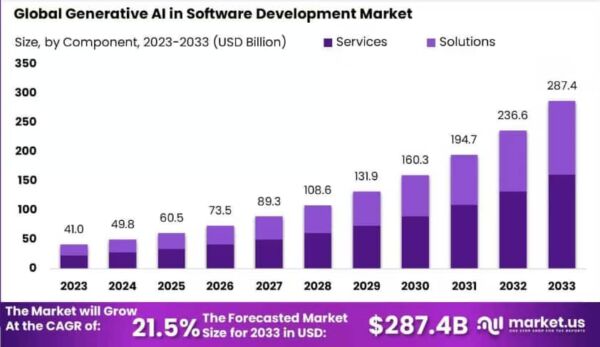
Such rise has been attributed to advancements in machine learning and natural language processing that have revolutionized how software is created and utilized.
IT services, healthcare, finance, e-commerce, and gaming are the major industries providing the demand for the markets. Major investments from technology, start-ups, and open-source communities will keep the groundwork for the future of software development.
Opportunities Offered By an AI in Software Development
Top software development companies are using AI to unlock unparalleled possibilities in innovation and efficiency. Here are some of them:
-
Enhanced Productivity and Efficiency
AI-based tools can perform certain monotonous and tiring activities that developers otherwise need to do themselves: They free developers pretty much completely for more complex and higher value activities.
AI-driven code generators and debuggers, for example, may save development time entirely by allowing immediate identification and resolution of problems. Automation of routine tasks eliminates human mistakes and produces higher quality.
-
Intelligent Code Assistance
AI like GitHub Copilot and TabNine gives intelligent code suggestions to allow programmers code quickly and with more efficiency. For example, gleaning from the huge existing code repositories, such tools provide context-wise considerations saving much time and effort during the development process.
-
More Efficient Software Testing
Software testing is vital for a quality outcome that requires resources to significantly test. Test case generation, test execution, and most importantly, prediction of possible failures can be undertaken by completely AI-driven test tools.
Moreover, machine learning algorithms can analyze defects from previous occurrences and, thus, future typical defect types with proactive solutions to enhance overall reliability.
-
Predictive Analytics Best for Decision-Making
AI is capable of processing the great amount of information available to derive really actionable insights from it in relation to software development undertakings. Predictive analysis would enable project managers to foresee risks, allocate resources wisely, and accurately anticipate timelines, thereby ensuring that projects remain within budget or even track.
-
Pushing up the User Experience through Personalization
Now, AI enables businesses to take their applications for software products personalized to users. Algorithms decipher and analyze how users prefer to act within apps, boosting satisfaction and engagement.
-
Continuous Integration and Delivery (CI/CD)
With the advent of AI, CI-CD pipelines could automate the repetitive tasks of integrating codes, testing, and deploying code. AI systems are designed to help detect the bottlenecks in CI/CD processes and recommend ways to improve throughput to allow faster and more reliable delivery of software.
-
Cost Reduction
Machine learning will greatly help automate many repetitive jobs, minimize chances of errors, and optimize processes to a greater extent, as it has a significant contribution to minimizing software development costs. Such reductions become interesting, especially for small businesses that curtail their investments while still gaining huge profits.
Key Challenges in Implementing AI in Software Development
There are a lot of challenges a custom software development company faces while implementing AI. Here are some of them:
-
Dependency on Data and Quality
To perform optimally, an AI system relies on high-quality data: the volume of data gathered must be huge and resource-intensive, and complex to clean and manage. Bad data results in poor predictions, bad algorithms, and inferior outcomes.
-
Gap in Skills
It takes specialized skills in machine learning, data science, and AI engineering to implement AI in software development. Most companies are unable to find such talent or their retention rate is not up to the mark, thereby hindering the implementation of AI for such organizations.
-
Expensive Starting Investment
Even though AI can help significantly cut business costs, having high initial outlays for purchasing AI tools, infrastructure, and training, some organizations may find it daunting to set up. The justifications for these expenses become clearer through thorough cost-benefit analyses.
-
Ethics & Bias Issues Found
AI systems may use already biased dishing-out information from their training data to produce some unfair or discriminatory results in application software. They must learn excellent ethical guidelines and audit AI systems frequently to avoid such.
-
Integration with Legacy Systems
Nevertheless, incorporating AI into existing software development processes and infrastructure can prove difficult. There are other reasons such as legacy and the extensiveness of customization that make the last two slow and clear the way for a better high cost of AI adoption.
-
Regulatory and Compliance Issues
Artificial intelligence (AI) and software outcomes usually border on sensitive data — thus, privacy and compliance with regulations like GDPR and CCPA are two major areas of concern. Thus, organizations need to make sure that their AI scenarios also comply with the laws.
-
Too Much Reliance on AI
Though much of software development can now be automated through AI, an over-reliance on it for effective development without any human intervention may compromise its creative ideas and ultimately produce substandard work. The balance between automation and humans should be maintained.
Final Thoughts
AI is changing the landscape of software development processes such that they become faster, smarter, and sharper, as well as well set up to innovate at scale, trim down costs, and offer great software solutions to businesses.
It is a long journey to AI adoption though, with numerous challenges, from data quality and ethical issues to costs and system integrations. Organizations must think about it strategically. If you want to implement it in your business, you can hire software developers in India from a trusted company like ScalaCode.