
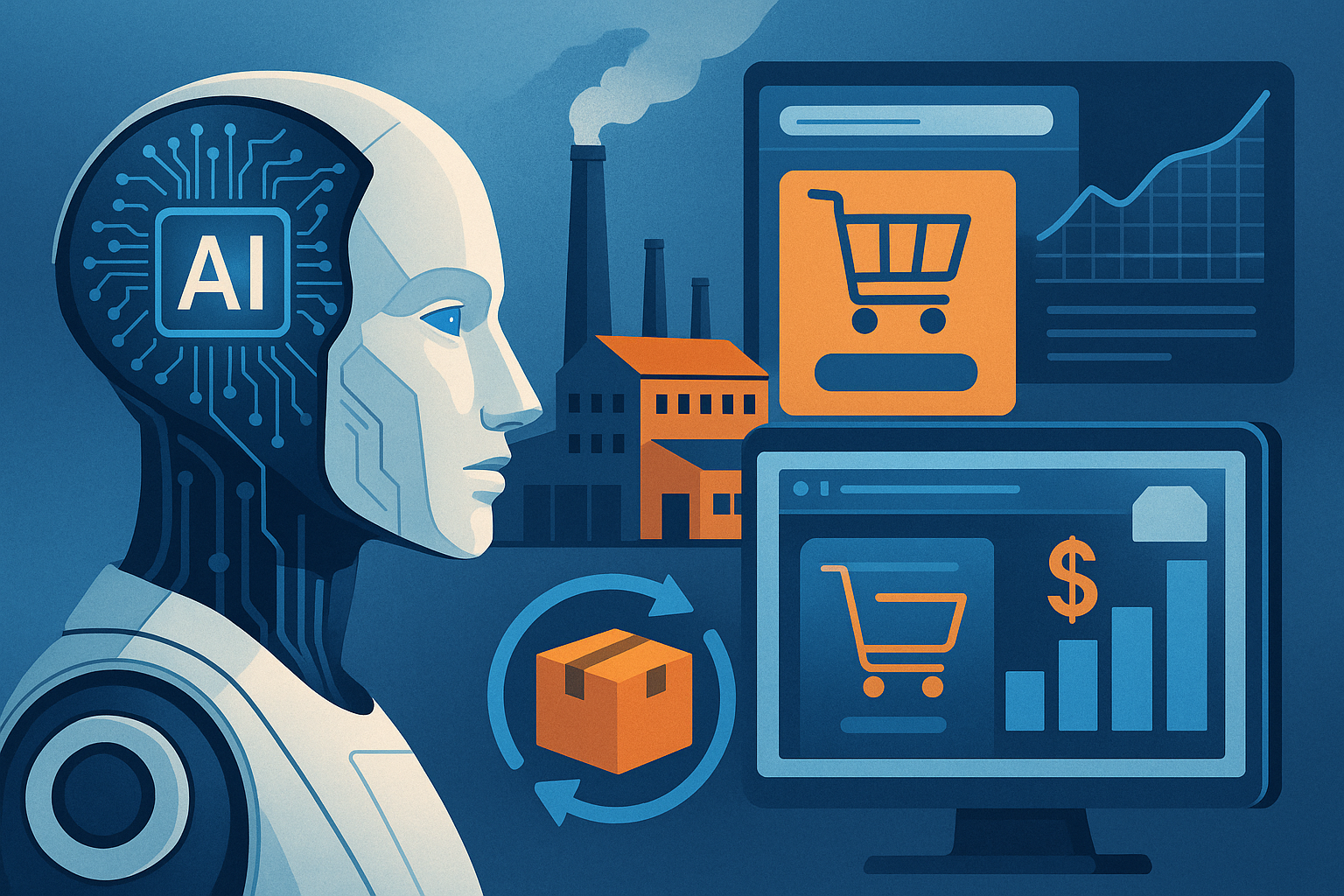
The manufacturing industry is rapidly evolving with artificial intelligence. Once reliant on manual processes and slow forecasting, it is now driven by intelligent systems that predict, optimize, and enhance real-time decisions. Today’s manufacturing eCommerce leverages AI to enable smarter operations, greater efficiency, and personalised B2B experiences.
This article explores how AI is revolutionizing manufacturing eCommerce from predictive inventory management to smart pricing and why adopting these technologies is becoming a strategic imperative rather than a competitive advantage.
The New Face of Manufacturing eCommerce
Manufacturing businesses have traditionally lagged behind other industries in digital adoption. But that’s changing fast. According to Statista, the global manufacturing eCommerce market is projected to exceed $8.8 trillion by 2030, driven by automation, AI, and digital supply chains.
Manufacturers are realizing that traditional sales cycles and offline distribution channels can’t keep pace with global competition and dynamic customer demands. This is where AI-driven eCommerce solutions for manufacturing play a crucial role. From predictive analytics to intelligent pricing models, AI enables manufacturers to anticipate market changes, optimize operations, and personalize customer interactions all within a unified digital ecosystem.
The Shift From Traditional to AI-Driven Manufacturing eCommerce
Until recently, most manufacturing operations relied on spreadsheets, manual inventory checks, and rigid pricing models. However, these systems struggled to scale or adapt to rapid shifts in demand. AI changes that equation.
AI-powered platforms can process thousands of data points from production schedules and supplier timelines to customer purchase patterns to provide real-time insights and automation. Modern eCommerce development integrated with AI allows manufacturers to:
- Forecast product demand across regions.
- Automate supplier communications and order routing.
- Adjust pricing dynamically based on costs and competition.
This transformation is not just technological it’s strategic. Companies like Siemens and Bosch have already integrated AI into their eCommerce systems to enhance global operations and improve responsiveness, setting the standard for the rest of the industry.
Predictive Inventory Management: The AI Advantage
Inventory inefficiencies are one of the biggest cost drains for manufacturers. Overstocking ties up capital, while stockouts damage credibility and sales. AI provides the predictive intelligence to solve both problems.
Predictive inventory management uses machine learning algorithms to analyze demand histories, seasonal trends, and supply chain variables to accurately forecast future stock needs. According to a 2024 McKinsey report, manufacturers using AI for predictive inventory saw a 35% reduction in excess inventory and a 50% decrease in stockouts.
AI-driven inventory optimization ensures that the right products are available at the right time—reducing waste and improving fulfillment. This kind of automation is now a core function of advanced eCommerce solutions for manufacturing, helping companies balance operational efficiency with customer satisfaction.
Smart Pricing Engines: How AI Transforms B2B Pricing Models
Pricing in manufacturing has always been complex. Factors like raw material costs, shipping fees, and client contracts make it difficult to maintain profitability while remaining competitive. AI-driven dynamic pricing changes this.
Through real-time data analytics, AI can automatically adjust product pricing based on variables such as market demand, material availability, competitor pricing, and customer segment. Deloitte’s 2024 survey found that businesses using AI-driven smart pricing systems saw up to a 25% increase in profit margins and faster deal closures.
For manufacturers, this means every client can receive tailored quotes or volume-based discounts—without manual intervention. When implemented through modern eCommerce development frameworks, AI-driven pricing engines can integrate directly with ERP systems and customer portals, creating a seamless digital selling experience.
Personalizing the B2B Buyer Experience
B2B customers now expect the same level of personalization they experience in B2C eCommerce. A Salesforce study revealed that 70% of B2B buyers expect personalized interactions. AI makes this possible even in complex manufacturing environments.
Using behavioral data, AI systems can predict what a customer is likely to order next, recommend complementary products, or send customized reordering alerts. Chatbots powered by AI can handle inquiries, quote requests, and post-sale support—reducing response times by up to 60%, according to IBM research.
This integration of AI-driven personalization with eCommerce solutions for manufacturing not only improves customer retention but also helps manufacturers build stronger, data-backed relationships with their clients.
AI and Supply Chain Optimization
The global manufacturing supply chain is more interconnected and more fragile—than ever. AI offers the visibility and adaptability enterprises need to mitigate risks and streamline operations.
By combining AI with IoT sensors, manufacturers can track materials, monitor equipment, and predict disruptions in real time. Accenture’s 2024 report indicates that AI-powered logistics optimization can reduce delivery delays by 30% and cut transportation costs by 15%.
Integrating AI into Managed eCommerce Services ensures that supply chain intelligence connects directly with eCommerce workflows—allowing instant adjustments to inventory, pricing, or fulfillment when conditions change.
Case Study: How AI Transformed a Mid-Size Manufacturer
Consider a mid-size auto parts manufacturer struggling with inventory inefficiencies and delayed order fulfillment. After implementing AI-based predictive inventory and smart pricing through a custom eCommerce solution for manufacturing, the company achieved:
- 45% reduction in overstocked items.
- 30% faster order fulfillment due to real-time demand forecasting.
- 22% improvement in revenue within six months.
The AI system continuously analyzed production and sales data to recommend optimal pricing and order quantities, resulting in lower operational costs and improved customer satisfaction.
Overcoming the Challenges of AI Adoption in Manufacturing eCommerce
While the benefits of AI are clear, adoption still comes with challenges. Many manufacturers face:
- Legacy system integration issues.
- Lack of skilled data scientists.
- High initial setup costs.
- Concerns about data privacy and transparency.
However, with the right eCommerce development partner, these barriers can be minimized. Experienced providers offer modular AI implementation models, allowing gradual integration without disrupting existing workflows. Moreover, managed eCommerce services can handle continuous updates, maintenance, and security ensuring that manufacturers stay ahead of the curve.
The Future of AI in Manufacturing eCommerce
The next frontier of AI in manufacturing goes beyond automation. Emerging trends such as Generative AI, autonomous supply chain systems, and AI-driven digital twins will define the next decade.
According to Gartner, over 75% of industrial manufacturers will deploy AI-based digital twins by 2030 for real-time monitoring and predictive maintenance. Similarly, AI’s integration into customer-facing portals will enable fully automated quoting, ordering, and delivery systems.
For manufacturers investing early in AI-driven eCommerce solutions, the result will be faster response times, greater cost efficiency, and a measurable competitive edge.
Conclusion: The Road to Smart Manufacturing eCommerce
AI is not just a technological upgrade—it’s a complete shift in how manufacturers think about operations, pricing, and customer engagement. With predictive inventory management, dynamic pricing, and personalized buyer journeys, AI-powered eCommerce solutions for manufacturing are transforming every layer of industrial commerce.
As global competition intensifies, manufacturers who embrace AI will not only optimize costs and efficiency but also create smarter, more responsive business ecosystems. The future of manufacturing eCommerce isn’t just automated—it’s intelligent, adaptive, and built for exponential growth.