
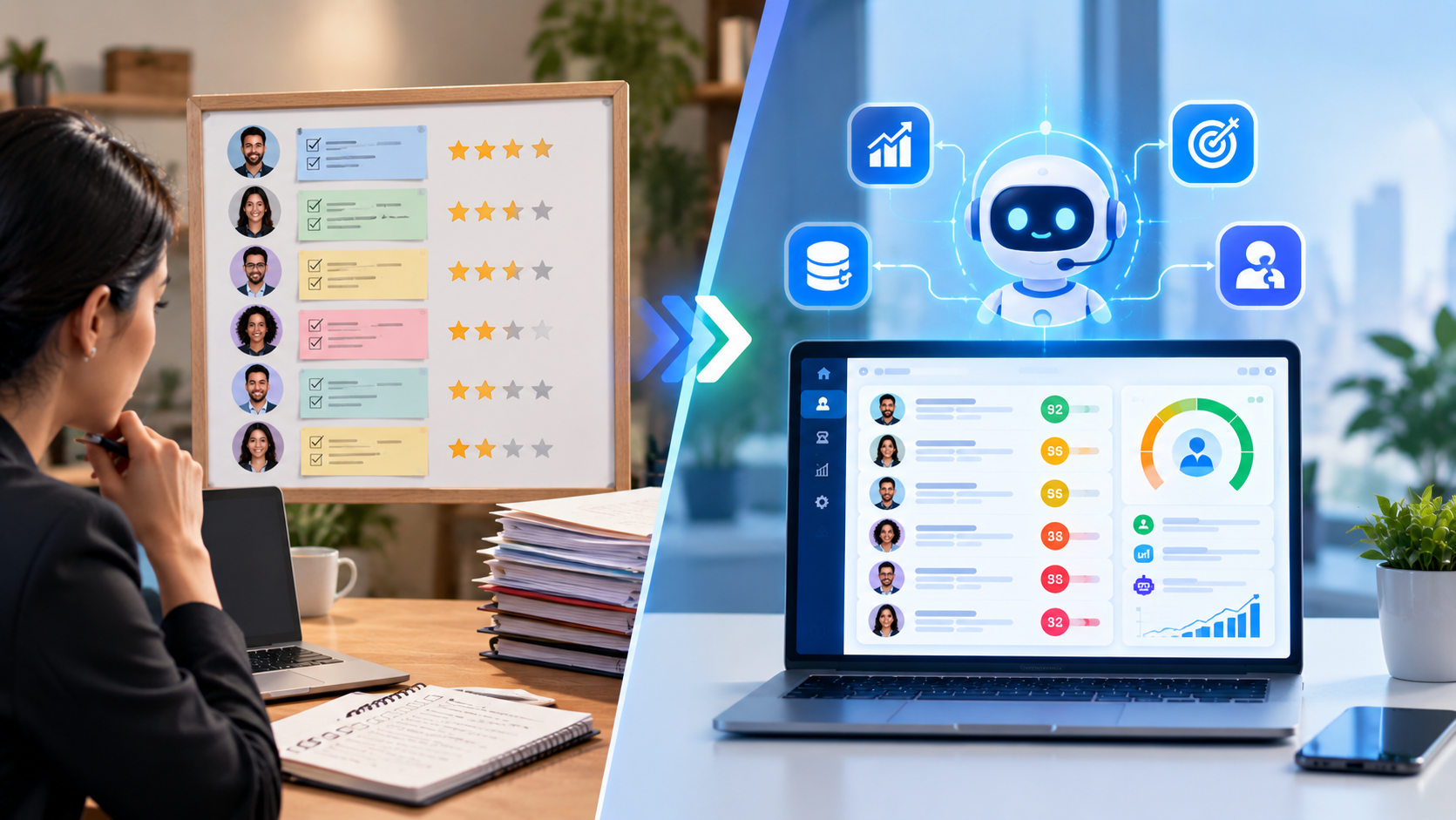
Sales teams relying on static lead scoring models are starting to notice a pattern: leads marked “hot” by the scoring system often go cold by the time a rep calls, while genuinely ready buyers sit buried under a point-based formula that hasn’t been updated in two years. This gap between scoring accuracy and real buyer behavior is pushing businesses to rethink how lead qualification actually works. The shift toward AI agents—systems that act, decide, and adapt rather than just calculate—is changing what lead management software in India needs to deliver by 2027. This article breaks down how traditional lead scoring differs from AI agent-driven qualification, what’s actually changing in CRM strategy, and how businesses should prepare their sales process for this transition.
Direct Answer: By 2027, AI agents will replace static, point-based lead scoring with autonomous systems that continuously evaluate buyer intent, take qualifying actions, and adjust scoring logic in real time. CRM strategy must shift from manually maintained scoring rules to AI-managed, self-correcting qualification workflows.
What Is Traditional Lead Scoring and Why It’s Reaching Its Limits
Traditional lead scoring assigns numerical points to leads based on predefined criteria—job title, company size, email opens, form submissions—and totals these points to determine priority. This model works only as well as the static rules behind it, which means it struggles to adapt when buyer behavior, market conditions, or product positioning change faster than the scoring rules are updated.
Traditional lead scoring typically relies on two categories of criteria:
- Demographic/firmographic fit — job title, industry, company size, location
- Behavioral engagement — email opens, website visits, content downloads, webinar attendance
Each criterion is assigned a point value by a sales or marketing team member, and leads crossing a cumulative threshold get passed to sales. The core limitation here is that this model is manually configured and rarely revisited. A scoring rule built two years ago—say, awarding 10 points for downloading a pricing PDF—may no longer correlate with conversion if the sales motion, pricing structure, or buyer persona has shifted since then.
This creates three recurring problems:
- Scoring decay — point values become outdated as buyer behavior evolves, but nobody notices until conversion rates quietly drop
- False positives — leads that hit the score threshold through low-intent actions (like repeated newsletter opens) get passed to sales despite no real buying signal
- No adaptability — the system can’t distinguish between a lead browsing out of curiosity and one actively comparing vendors, because it only counts actions, not context
Traditional scoring isn’t becoming useless overnight, but its rigidity is increasingly mismatched with how fast buyer journeys move in 2025 and beyond.
What Are AI Agents in the Context of CRM and Lead Qualification?
AI agents are autonomous software systems embedded in a CRM that can independently interpret buyer signals, make qualification decisions, and take follow-up actions—such as routing a lead, sending a personalized message, or flagging a deal for human review—without needing a human to manually configure every rule in advance.
Unlike a scoring model that simply calculates a number, an AI agent reasons through context. It doesn’t just register that a lead visited the pricing page three times—it correlates that action with the lead’s company size, recent email replies, and comparable historical deals to assess actual purchase intent. This is the core distinction driving change in lead management software in India and globally: agents act on data, while traditional scoring only measures it.
Key characteristics that define an AI agent in this context include:
- Autonomous decision-making — the agent decides the next best action without waiting for a human to approve each step
- Context awareness — it evaluates multiple data points together rather than scoring each action in isolation
- Self-adjusting logic — the model updates its own understanding of what signals indicate intent, based on actual conversion outcomes
- Action-taking capability — beyond flagging a lead, the agent can send a follow-up, update a CRM field, or escalate to a rep automatically
This matters because it shifts the CRM from a passive record-keeping tool into an active participant in the qualification process.
Core Differences Between AI Agents and Traditional Lead Scoring
The core difference between AI agents and traditional lead scoring is that scoring models calculate a static number based on fixed rules, while AI agents interpret context, adapt their criteria over time, and independently take qualifying actions. This changes lead qualification from a passive, number-based filter into an active, decision-making process.
| Factor | Traditional Lead Scoring | AI Agents |
|---|---|---|
| Decision basis | Fixed point values set manually | Contextual analysis of multiple signals together |
| Adaptability | Requires manual rule updates | Continuously adjusts based on outcome data |
| Action capability | Flags a lead; human takes next step | Can independently trigger follow-up actions |
| Speed to insight | Calculated after data is logged | Evaluates signals in real time as they occur |
| Handling of ambiguous leads | Treated the same as clear-cut cases | Can request more data or escalate for human judgment |
| Maintenance burden | High — needs regular manual review | Lower — self-corrects based on conversion feedback |
This comparison highlights why businesses evaluating lead management software in India for 2027 planning need to look beyond “does it have lead scoring” and ask “does it have adaptive, agent-driven qualification.” The two are no longer functionally equivalent.
How AI Agents Actually Qualify and Act on Leads
AI agents qualify leads by continuously analyzing behavioral, firmographic, and conversational data together, assigning a dynamic intent assessment, and then executing a next-best action—such as routing to sales, triggering a nurture sequence, or requesting additional data—without manual intervention at each step.
The practical workflow typically unfolds like this:
- Lead data enters the CRM through a form, chat interaction, email reply, or third-party integration.
- The AI agent cross-references multiple signals simultaneously—not just the latest action, but patterns across the full interaction history (e.g., three pricing page visits combined with a reply to a sales email).
- Intent is assessed contextually, factoring in how similar historical leads with comparable behavior patterns actually converted.
- The agent selects a next action: routing the lead directly to a rep, sending a tailored follow-up message, requesting enrichment data, or holding the lead in nurture if intent is unclear.
- Outcomes feed back into the model, refining how future, similar behavior patterns get interpreted.
The critical difference from traditional scoring is step four. A scoring model stops at producing a number; an AI agent acts on that assessment, often without waiting for a rep to log in and manually review the queue.
Example scenario — Problem → Approach → Implementation → Outcome:
- Problem: A B2B software company’s sales team was spending hours daily reviewing a scored lead list, only to find that many “high-score” leads were unresponsive when contacted, while some lower-scored leads converted quickly when reps happened to reach them.
- Approach: The company moved to an AI agent-based qualification layer within their CRM, allowing the system to weigh recent engagement recency and conversational tone, not just cumulative point totals.
- Implementation: The agent was configured to auto-route leads showing strong recent-intent signals directly to reps, while holding ambiguous leads in an automated nurture sequence pending further signals.
- Outcome: Reps began spending their time on leads the system had already contextually validated, rather than manually sorting through a flat scored list each morning.
What Changes in Your CRM Strategy for 2027
Preparing a CRM strategy for 2027 means shifting from manually maintained scoring rules to AI-managed qualification logic, restructuring sales workflows around agent-triggered actions, and redefining the sales rep’s role from lead screener to relationship closer. This requires both technology changes and process changes within the sales organization.
Specific strategic shifts businesses should plan for include:
- From static rules to adaptive models — scoring criteria should no longer be treated as a “set once” configuration but as a living system that updates based on conversion feedback.
- From rep-led triage to agent-led routing — sales development reps shift away from manually sorting lead lists toward handling only the leads an agent has already contextually validated.
- From isolated data points to unified signal analysis — CRM strategy must prioritize integrating behavioral, firmographic, and conversational data into one system the agent can reason across, rather than siloed tools that each hold a fragment of the picture.
- From quarterly scoring reviews to continuous model monitoring — teams need visibility into how the AI agent’s qualification logic is performing, not just a one-time audit of point values.
- From generic nurture tracks to dynamic, intent-based sequencing — leads held for nurturing should receive different follow-up based on the agent’s specific read on their hesitation, not a single generic drip campaign.
For businesses selecting or upgrading lead management software in India, this means evaluating platforms on their ability to support continuous learning and autonomous action—not just whether they offer configurable scoring fields.
Common Challenges in Making the Transition
The most common challenges in shifting from traditional scoring to AI agent-based qualification are data quality gaps, sales team distrust of automated decisions, and the difficulty of auditing why an agent made a particular qualification call. Addressing these requires transparency tools, phased rollout, and consistent feedback loops between sales outcomes and the AI model.
| Challenge | Practical Solution |
|---|---|
| Incomplete or inconsistent lead data | Implement automated data enrichment before data reaches the agent’s decision layer |
| Sales reps distrust “black box” AI decisions | Use CRM platforms that show the reasoning behind each qualification decision, not just a final score |
| Difficulty auditing agent decisions | Maintain decision logs showing which signals triggered each action, reviewable by sales ops |
| Over-automation reducing human judgment | Set clear escalation thresholds for high-value or ambiguous accounts requiring rep review |
| Legacy CRM lacking agent capability | Plan a phased migration or integration layer rather than a disruptive full-system replacement |
Sales teams that have relied on point-based scoring for years often resist agent-driven qualification simply because they can’t see the “why” behind a decision. Platforms that expose reasoning—showing which specific signals drove a lead’s prioritization—tend to see faster adoption than those that present only a final verdict.
How to Prepare Your Lead Qualification Process for This Shift
Preparing for AI agent-based lead qualification involves auditing your current scoring criteria, consolidating fragmented data sources, and piloting agent-driven workflows alongside existing processes before full adoption. This phased approach reduces risk while building internal confidence in the new system’s decision-making.
A practical preparation sequence:
- Audit your current scoring model to identify which criteria are genuinely predictive versus outdated assumptions no longer tied to actual conversions.
- Consolidate your data sources—behavioral, firmographic, and conversational data need to sit in one accessible system for an AI agent to reason across effectively.
- Select a CRM or lead management software in India that explicitly supports agent-based decisioning, not just enhanced scoring dashboards.
- Run a parallel pilot, allowing the AI agent to make qualification recommendations alongside your existing scoring model before fully switching over.
- Define clear escalation rules for when the agent should hand off to a human rep rather than act independently.
- Review decision logs regularly during the pilot phase to catch misclassifications early and refine the model’s weighting.
This phased approach matters because switching abruptly from a fully manual system to full agent autonomy without a transition period tends to create exactly the kind of distrust that undermines adoption.
Key Takeaways
- Traditional lead scoring relies on static, manually set point values, which lose accuracy over time as buyer behavior and market conditions shift.
- AI agents differ fundamentally by interpreting context across multiple data points and independently taking qualifying actions, rather than just producing a score.
- CRM strategy for 2027 needs to shift sales team roles from manual lead triage toward handling only agent-validated, high-intent leads.
- Transparency into an AI agent’s decision-making process is critical for sales team adoption—”black box” scoring erodes trust faster than it builds efficiency.
- A phased, parallel-pilot approach to adopting agent-based qualification reduces risk compared to an abrupt full-system switch.
- Businesses evaluating lead management software in India should prioritize platforms supporting continuous, adaptive learning over static configurable scoring fields alone.
Conclusion
The shift from traditional lead scoring to AI agent-driven qualification isn’t a minor software upgrade—it’s a fundamental change in how sales organizations decide which leads deserve human attention. Static point systems built on manually maintained rules are increasingly out of step with how quickly buyer behavior changes, while AI agents offer a more adaptive, context-aware alternative that acts rather than just calculates. For businesses planning their CRM strategy toward 2027, the priority should be selecting lead management software in India that supports this shift toward autonomous, continuously learning qualification—paired with a sales process that redefines the rep’s role around the leads the system has already validated. The businesses that prepare for this transition now will spend less time sorting through lead lists and more time closing the deals that genuinely matter.