
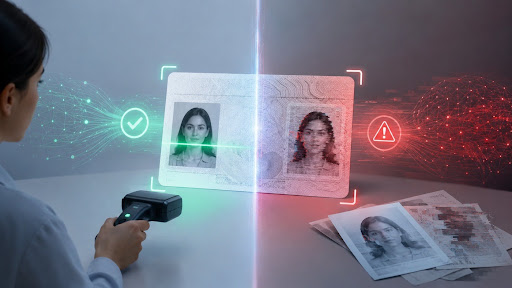
There are two common approaches to generative AI: It’s going to make things faster and smarter or everything that’s been built will be broken within a few years. With the task of document verification, both these things are true at the same time, and that is what we have to discuss.
In the same week, Generative AI is one of the most powerful tools a document verification solution can leverage and the one that poses the greatest challenge for it. To create anything that will last beyond this year, one must understand the “why” of both.
A Tool That Doesn’t Pick a Side
Generative AI is not designed to be a fraud tool, and it’s not designed to be a defence tool. It’s just technology and the first to make use of it gets the benefit. So that advantage is changing hands all the time, and that’s why it’s a double-faced headline. One week, it is assisting in the reduction of fraud. The next time it is assisting someone to create a fake ID in minutes.
What Generative AI Genuinely Made Better
On the positive end, document verification is now truly faster and more flexible with the help of generative AI. It can read messy paper-based scans that older systems could not handle. It can handle a new document layout from a country it has not encountered much before, rather than follow the “one-off” rule coding method that would otherwise require a person to do it manually for each individual layout. It can differentiate between a name field and an address field even if a document is laid out in an unusual manner. It can also provide simple explanations for why something appears suspicious, making life a lot easier for the final decision checker, a human being.
The Same Skill Set, Working Against You
But the same skills that make it great to read documents make it great to generate them. What used to require a lot of design skills and printing expertise can be done fairly easily now with some prodding and time. Fake images can be created to be similar to a fake identity. Details can be incorporated into a template without a trace of being handmade. But it takes an expert days to forge, a day for the amateur, and that allows a lot more people to get in on the action, not only the organised gangs who used to control everything.
Business Paperwork Is Caught in the Same Tug of War
Business documents are subject to the same pull and push, and, in all honesty, it may be worse in business. Generative AI is making it easier for a real business to be incorporated and read incorporation documents and ownership records in seconds, versus hours. Meanwhile, it is assisting fraudsters in creating fraudulent documents for the registration of companies that appear structurally correct from the top of the document to the bottom. Looking right is no longer the key part of a Know your business solutions, as both sides are now able to look right.
That’s why it’s crucial to have a know-your-business solution that goes beyond the looks. It must check to see if a business actually exists somewhere beyond the paperwork itself – and not take a document at face value, simply because the formatting seems to pass the test. Once both teams have the same number of tools, looks become irrelevant.
The Cost Gap Nobody Talks About Enough
Then there’s the cost issue lurking beneath it all, the least discussed of which. Creating a believable fake document is a lot more affordable in the recent couple of years. No printing press or graphic designer or many years of practice are required these days. With a bit of experimentation, you can accomplish a surprising amount with a laptop. The cost of putting up the defence side is not lower, it’s higher. Requires more computational resources, more retraining, more people to look at edge cases, and more maintenance of products to keep up. And one of the biggest problems in this field today, but no one seems to talk about it, is the difference in the cost of fraud versus the cost of defence, both of which are driven by the same technology on both sides of the table.
Why a Document Checker Has to Get Warier, Not Just Faster
This alters how a document checker should be suspicious. The appearance of a clean and consistent document was a good sign for a long time. With generative AI creating a clean, consistent aesthetic on something that isn’t real, a document checker must change its perspective. Attractiveness is no longer taken for granted if someone is too perfect. It’s sometimes the first thing that you want to question.
What This Means for Document Validation Going Forward
But document validation must also continue to evolve, with the tools that enable fraud also continuing to improve at their own rate. Last year’s rules can silently go wrong; nobody will know until the numbers are out of line. Systems should keep training on new instances of both real and fake kyc documents and must benefit from non-comprehensible signals, such as the way a document is submitted, metadata, and cross-checking with external records, not just its appearance on the screen.
All of this does not imply that the overall experience with document verification has been harmed by generative AI. It added depth to it. These tools became more intelligent, but so did the threat, and if only one of those things happened, then gaps would creep into the dark. Any business or platform with any scale dealing with kyc documents should realize that this is not a problem that can be solved and then forgotten. It’s a constantly evolving landscape, and being ‘on the right side of the equation’ involves recognising that both ends of the generative AI spectrum are equally real, not just the one making the news look good.