
 Most businesses have more data than they can process. The problem is not volume. It is that data sits in silos, arrives inconsistently, contains errors nobody catches, and takes longer to process than the decisions it is supposed to support.
AI solves this by being fast, consistent, and available at a scale human teams cannot match. The businesses getting real value from AI are not chasing advanced models. They are fixing data problems they have had for years and never properly addressed.
Here is where that is happening across industries.
Automated Data Governance and Compliance
Compliance used to mean quarterly audits and a dedicated team manually reviewing data repositories. Under GDPR and CCPA, that approach no longer works. The data moves too fast and the consequences of missing something are too significant.
AI makes governance continuous. Modern AI governance tools scan repositories in real time, automatically classify sensitive data, and flag anomalies before they become compliance violations. When new data enters the system, it gets classified immediately rather than during the next scheduled review.
For any business operating across multiple jurisdictions, this matters. A company processing customer data in both the EU and California faces overlapping regulations with different requirements. AI governance systems handle that complexity automatically without requiring manual tracking.
Predictive Analytics for Smarter Business Decisions
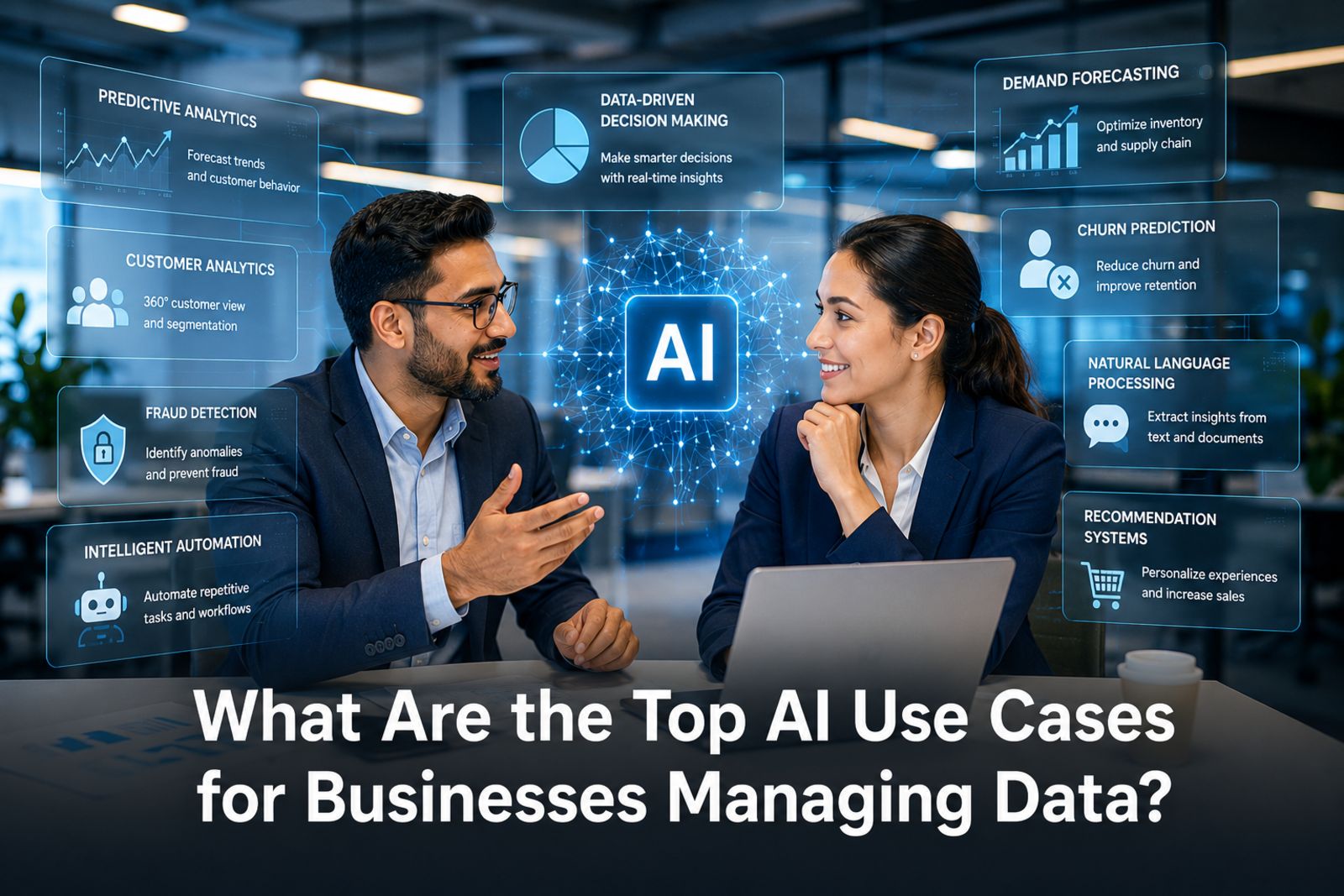
Most business analytics describes what already happened. Revenue last quarter. Customer churn last month. Predictive analytics shifts the focus forward and uses historical data to model what is likely to happen next.
Machine learning models analyze patterns in historical datasets and identify signals that precede specific outcomes. A retail business forecasts demand ahead of seasonal peaks and adjusts inventory before shortages occur. A financial services company models credit risk based on behavioral patterns traditional scoring methods miss. A logistics operation predicts delivery delays before they occur and reroutes proactively.
Predictive analytics works best when it sits on top of a clean, well-structured data pipeline. That connection between data quality and prediction accuracy is something teams consistently underestimate before they build.
Data Cleansing and Quality Management
Bad data produces bad decisions. Duplicate records, inconsistent formats, missing values, and typos all compound over time. Manual cleansing is slow and does not scale. AI-powered cleansing runs across entire datasets in the time it takes a person to review a single file.
The algorithms identify duplicates by comparing records across multiple fields simultaneously, catching the same customer entered under two slightly different names. They flag missing values, apply imputation rules, and standardize formats automatically.
Natural Language Processing for Data Access
The gap between the people who have questions and the people who can query databases is one of the most common friction points in data-driven organizations. A marketing manager wants to know which customer segment drove the most revenue last quarter. Getting that answer currently requires submitting a request, waiting for a query, and reviewing results that may not answer the original question.
NLP closes that gap. Natural language query tools let non-technical users ask questions in plain conversational language and get accurate results pulled directly from the underlying data without writing a single line of SQL.
When only a small team can extract insights, the rest of the organization makes decisions based on instinct or waits. NLP turns data into a resource the whole organization can use.
AI-Powered Document Intelligence
Businesses run on documents. Contracts, invoices, insurance claims, and medical records all arrive as unstructured data. Extracting useful information from them manually is one of the most time-consuming tasks in any operations team.
Also Read: AI Integration and the Human Side of Transformation
Document intelligence uses optical character recognition, NLP, and machine learning to read, classify, and extract structured data from unstructured documents automatically. An insurance company processes thousands of claims weekly. A legal team reviews hundreds of contracts for specific clauses. A finance department reconciles invoices at scale. The extracted data feeds directly into CRMs, ERPs, and compliance platforms and gets used immediately.
Anomaly Detection and Real-Time Monitoring
Anomaly detection watches data in real time and flags behavior that falls outside expected parameters without needing a human to define every scenario in advance.
In fintech, this is how fraud detection works. The model learns normal transaction patterns and flags deviations based on unusual amounts, locations, or timing. In IT operations, it monitors system metrics and flags performance issues before they cause downtime. In supply chain, it catches inventory discrepancies before they cause shortages.
The difference between rule-based monitoring and AI-powered detection is adaptability. Rules catch what you anticipated. Machine learning catches what you did not.
Conclusion
Most businesses do not need all of these at once. The right starting point is the use case that addresses the most painful problem in your current data operation. Start with a Proof of Concept before committing to a full build. A well-scoped PoC tests whether a specific AI application works with your data, your infrastructure, and your compliance requirements before the cost and risk of full implementation.
CMARIX provides AI consulting, PoC development, AI integration, and full AI software development to enterprises. If your business manages data at scale and the current process involves too much manual work or too many errors, the right conversation starts with identifying which use case solves that problem first.