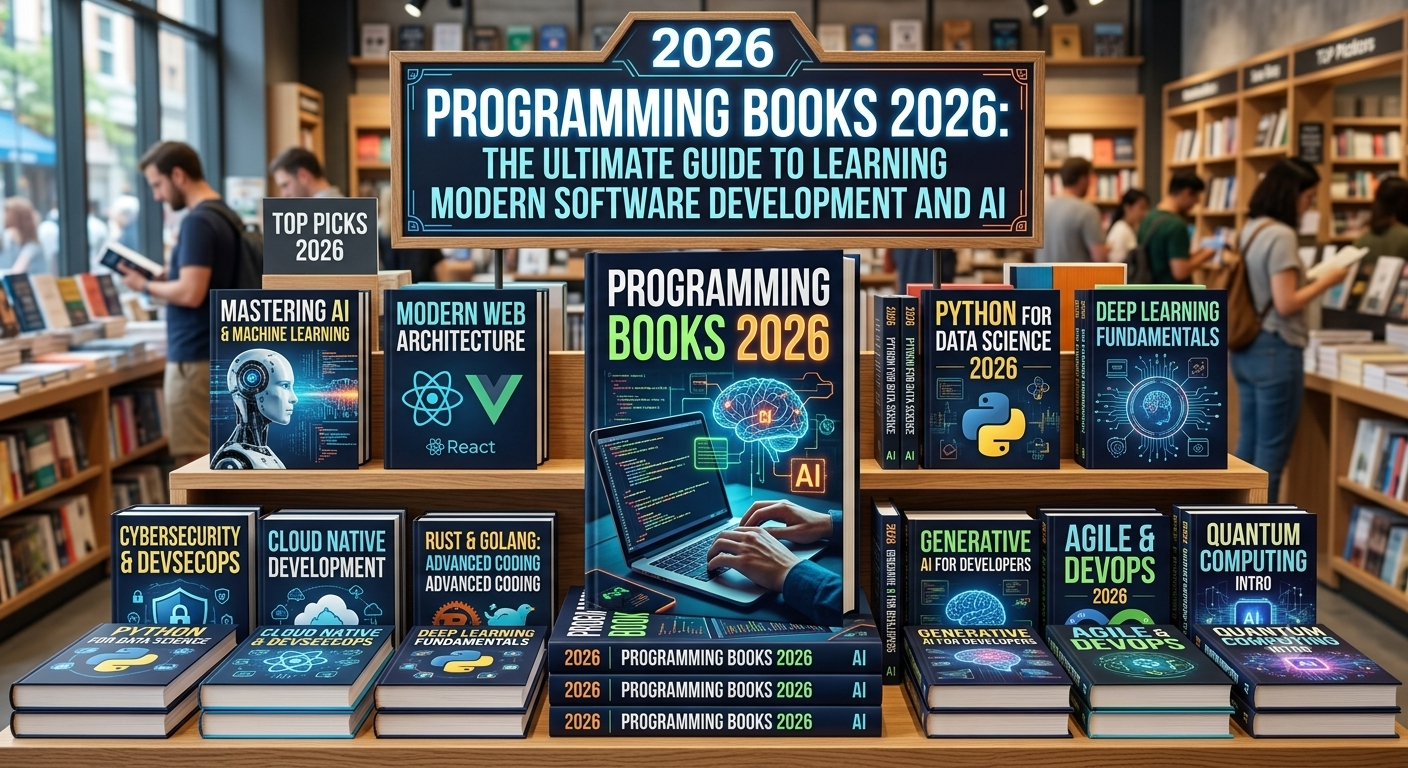
Programming continues to evolve rapidly, and 2026 is shaping up to be another important year for developers, students, and technology professionals. While online courses, tutorials, and AI-powered learning tools have become popular, programming books remain one of the most reliable ways to build strong technical foundations. Books provide structured learning, deeper explanations, and long-term understanding that quick tutorials often miss.
Whether someone is starting their coding journey or improving advanced software engineering skills, the right programming books can accelerate growth. Modern programming books now focus not only on syntax but also on problem-solving, architecture, real-world development practices, and adapting to AI-assisted coding environments.
This guide explores why programming books still matter in 2026, what topics modern developers should prioritize, and how to choose books that match current industry demands.
Why Programming Books Still Matter in 2026
Many learners wonder whether programming books are still relevant in an era dominated by videos and AI tools. The answer is yes. Books offer a complete learning experience that follows a logical path instead of fragmented lessons.
Programming books are usually written by experienced developers and educators who organize concepts in a way that builds understanding step by step. Instead of simply showing how to make code work, books explain why specific approaches exist and when to use them.
Another advantage is focused learning. Videos and short tutorials can encourage jumping between topics too quickly. Books help readers stay disciplined and develop stronger conceptual knowledge.
In 2026, developers increasingly combine books with practical coding and AI assistance to create a balanced learning strategy.
The Evolution of Programming Education
Programming education has changed significantly over the past decade. Earlier learning resources focused heavily on memorizing syntax and understanding individual programming languages. Today, the emphasis is on building complete software solutions.
Modern programming books teach broader concepts including system design, software architecture, cloud computing, testing, performance optimization, and collaborative development practices.
Artificial intelligence has also influenced learning methods. Instead of replacing programming education, AI now acts as a support tool that helps explain concepts, generate examples, and assist debugging. Books complement these tools by teaching deeper reasoning and decision-making skills.
Developers in 2026 are expected to understand both coding fundamentals and how to work efficiently with intelligent development tools.
Essential Topics Covered in Programming Books 2026
Programming books released and recommended in 2026 focus on practical and future-ready knowledge. Software engineering fundamentals remain important because strong foundations make adapting to new technologies easier.
Programming languages continue to play a major role. Readers often study languages such as Python, JavaScript, TypeScript, Java, C#, Go, and Rust depending on career goals. However, language knowledge alone is no longer enough.
Books now emphasize algorithmic thinking and efficient problem solving. Understanding data structures and computational logic allows developers to create scalable applications and improve performance.
Cloud development has become another major topic. Modern books explain how applications operate across distributed systems and cloud environments while maintaining security and reliability.
Software testing and debugging are also receiving more attention. Developers are expected to write maintainable code and identify issues early during development cycles.
Security practices have become essential rather than optional. Programming books increasingly teach secure coding habits to protect applications and user data.
How to Choose the Right Programming Book
Choosing the right programming book depends on experience level and learning goals. Beginners benefit most from books that explain concepts clearly and include practical exercises.
Intermediate developers should look for books that focus on building projects and understanding software architecture. These resources help bridge the gap between learning syntax and creating production-level applications.
Advanced programmers often gain more value from books covering system design, scalability, performance optimization, and engineering principles.
It is also important to evaluate how recently a book was updated. Technology changes quickly, and books that include modern frameworks, current development workflows, and AI-assisted programming practices may offer more relevant guidance.
Reading style matters as well. Some books are theory-heavy while others emphasize projects and real-world implementation. Selecting a format that matches personal learning preferences improves consistency and results.
Building an Effective Learning Routine
Owning programming books is not enough. Progress depends on consistent practice and applying concepts through projects.
A strong approach is to divide learning sessions into reading and implementation phases. Readers can study a concept, write sample code, and then expand it into a small project.
Taking notes and summarizing ideas improves retention. Revisiting previous chapters also strengthens understanding because programming concepts build upon one another.
Creating personal projects remains one of the best ways to transform theoretical knowledge into practical skill. Even simple applications can reveal gaps in understanding and encourage deeper learning.
In 2026, combining books with coding practice, documentation reading, and AI-supported experimentation creates an effective development workflow.
The Role of Programming Books in Career Growth
Programming books support long-term career development because they encourage deeper thinking and professional discipline.
Employers increasingly value developers who understand software principles rather than relying entirely on automated tools. Books help build this expertise by teaching architecture, clean coding methods, and strategic problem solving.
Reading technical books also improves communication skills because developers learn industry terminology and structured thinking. These abilities become valuable during interviews, teamwork, and technical leadership roles.
For freelancers and independent developers, books provide insights into creating scalable and maintainable products that meet professional standards.
As the technology industry evolves, continuous learning becomes a competitive advantage.
Future of Programming Learning Beyond 2026
Programming education will continue changing as AI and automation become more advanced. However, foundational learning is unlikely to disappear.
Books will probably become more interactive and integrated with digital environments, offering code examples, exercises, and adaptive learning experiences. Even with these changes, the core value of structured knowledge will remain important.
Developers who combine books, practical projects, community learning, and modern development tools will be better prepared for future opportunities.
Success in programming is not determined by how many resources someone consumes but by how effectively they apply what they learn.
Conclusion
Programming books in 2026 continue to play an important role in helping developers build reliable, long-term skills. They provide structured learning, deeper understanding, and practical knowledge that supports both beginners and experienced professionals.
As software development becomes more complex and AI tools become more common, books remain a powerful resource for mastering concepts that extend beyond writing code. Choosing the right books, following a consistent learning routine, and applying knowledge through projects can create lasting success in modern programming careers.