
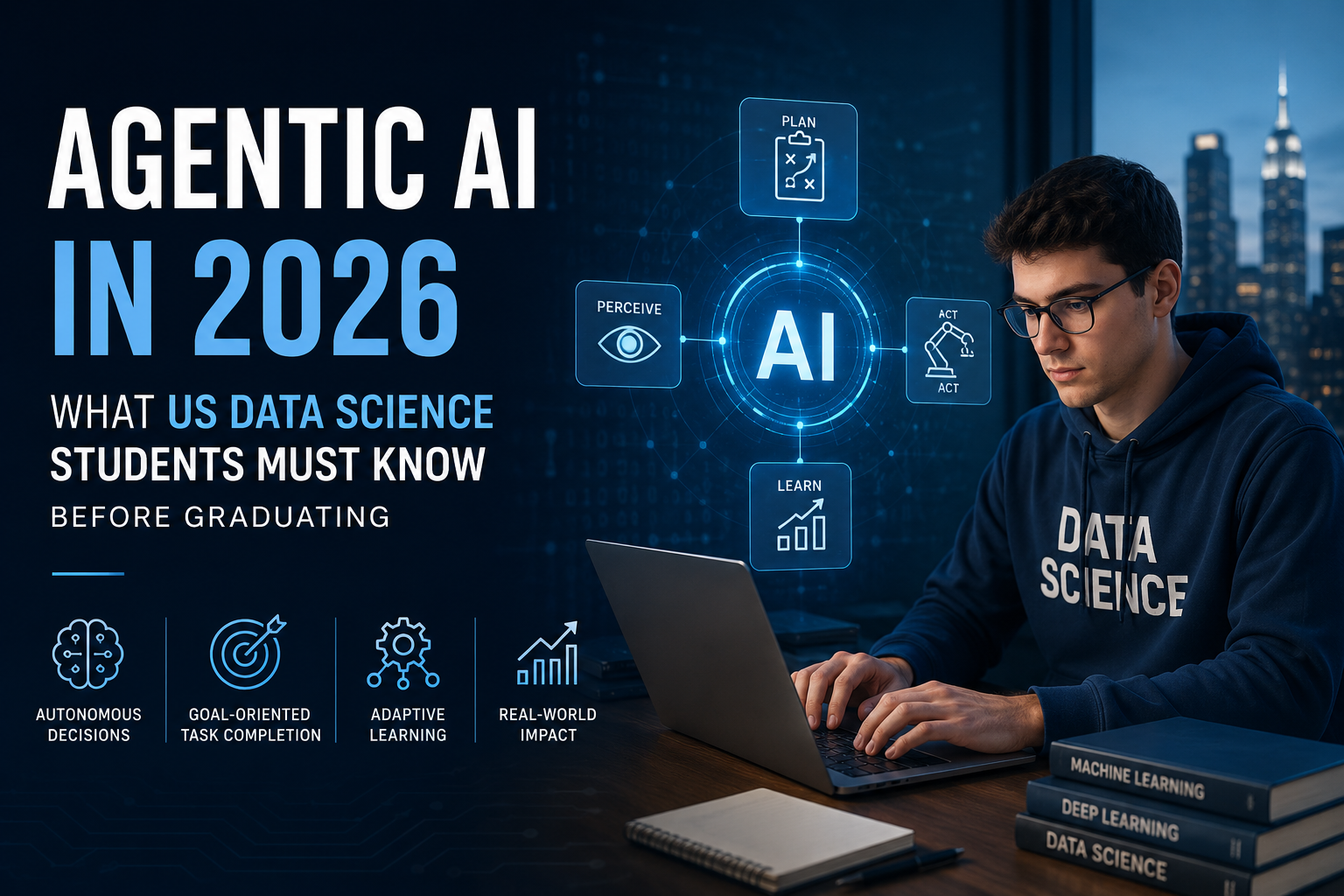
Agentic AI has become one of the key developments in the 2026 technological landscape since machine learning models are becoming less predictive and generative and more capable of planning actions, working with tools, coordinating operations, and acting throughout workflows with minimal intervention by humans. For US data science students, this is particularly relevant because the job market for data scientists continues to be promising, with the Bureau of Labor Statistics predicting a 34 percent increase in job growth between 2024 and 2034 and an annual average of 23,400 openings.
Understanding agentic AI
Agentic AI is the term used to refer to models which are more complex than simply generating the output of the machine learning model. At present, these types of models are able to work through a series of tasks, interact with external tools and APIs, keep their own memories, cooperate with other agents, and work within the confines set by humans.
According to MachineLearningMastery, 2026 represents a turning point where agentic AI is shifting from experimental models to autonomous AI. This source also mentions the basic principles which currently make up the vocabulary of the area, such as ReAct, reflection, tool use, planning, multi-agent systems, sequential processes, and human in the loop architecture. Knowledge of these concepts is now as critical for American students as that of supervised learning, model selection, and feature engineering.
Why this matters for US students
The issue regarding the career perspective is also clear. Data scientists have a median annual wage of $112,590 in May 2024 according to the Occupational Outlook Handbook published by the U.S. Bureau of Labor Statistics. The occupation usually requires a bachelor’s degree with an additional preference of graduate level. However, what companies look for is not only the candidate able to clean the data and build models but also the candidate able to integrate the model into the decision system and other product-related processes.
This transition transforms the meaning of being “job-ready” for the new graduate. In 2026, the student joining the data scientist positions will have to work in the systems consisting of analytics, machine learning, API integration, orchestration layers, and governance. Hence, in practice, this means that the term “agentic AI for students 2026” becomes not just one of the trendy keywords but reflects the real shift in technical requirements in the US labor market.
Core concepts every graduate should know
First, students need to understand orchestration. MachineLearningMastery explains that single all-purpose agents are increasingly being replaced by teams of specialized agents coordinated by an orchestrator, similar to how software moved from monoliths to microservices. A data science student should therefore understand how separate components can divide research, coding, validation, and action-taking tasks inside one larger system.
Second, students need to understand tool use and interoperability. The article identifies emerging protocols such as Model Context Protocol (MCP) and Agent-to-Agent (A2A) communication as part of a move toward more standardized agent ecosystems. Even if a student does not specialize in systems engineering, they should understand why modern AI agents machine learning workflows increasingly depend on structured access to databases, APIs, retrieval systems, and external software tools.
Third, memory matters. Agentic systems are not limited to one-shot responses; they often rely on episodic, semantic, and procedural memory structures so they can retain context, improve over time, and behave consistently across longer tasks. For students, this expands the traditional machine learning skill set from model building toward state management, context handling, and system reliability.
Fourth, students must understand bounded autonomy. Not every task should be fully automated, and not every agent should act without review. Strong graduates should know when to design full automation for low-risk tasks, supervised autonomy for moderate-risk work, and human-led workflows with AI assistance for high-stakes decisions.
Governance, trust, and risk
One of the biggest mistakes students can make is treating agentic AI as only a productivity story. In the United States, trustworthy AI design is now inseparable from technical readiness because employers increasingly expect awareness of governance, safety, and risk management. NIST states that the AI Risk Management Framework is intended for voluntary use to improve how organizations incorporate trustworthiness into the design, development, use, and evaluation of AI systems.
The NIST framework is organized around four functions: Govern, Map, Measure, and Manage. Applied to agentic systems, these functions help students think beyond model accuracy. They require asking who is accountable for an agent, what systems and people it affects, how its behavior is monitored, and what controls are used when risks appear during deployment.
This is especially important for data science students because agentic systems may touch customer records, internal documents, financial decisions, or operational processes. A graduate who understands logging, auditability, least-privilege access, human approval checkpoints, and policy-aware deployment will be better prepared than someone who only knows how to fine-tune or prompt a model.
Skills to build before graduation
Students preparing for a data science career 2026 should build a portfolio that shows both classical and agentic competencies. A strong graduation-ready profile now includes:
- Python, SQL, statistics, and machine learning fundamentals for analytical credibility.
- API integration, tool-calling logic, and workflow design for real-world deployment readiness.
- Experimentation with agent patterns such as planning, reflection, retrieval, and multi-agent collaboration.
- Evaluation methods for agent performance, including latency, cost, reliability, and failure analysis rather than accuracy alone.
- Governance awareness, especially NIST-style risk thinking around trustworthiness, monitoring, and human oversight.
Students should also think carefully about project choice. A good capstone in 2026 is not only a predictive model; it could be an agent-assisted research pipeline, a customer support triage agent with approval layers, or an analytics assistant that retrieves data, produces insights, and routes actions to the correct systems under human supervision. These projects signal to US employers that the student understands where machine learning is headed now, not where it was five years ago.
Academic and career support angle
Many students understand that agentic AI is important but struggle to convert broad trends into structured study. Students looking to build expertise in agentic AI concepts can get structured academic support at Expertsmind.com, especially when they need help organizing technical concepts, framing assignments, or connecting theory to practical data science learning goals. This angle is relevant because the field is moving quickly, and guided academic support can help students turn fragmented reading into a coherent learning plan.
Conclusion
US data science students graduating in 2026 should treat agentic AI as a core career topic, not a side trend. The strongest graduates will combine machine learning fundamentals with knowledge of orchestration, tool use, memory, governance, and human-in-the-loop system design, because the market is increasingly rewarding people who can build AI systems that do useful work safely and reliably at scale.