
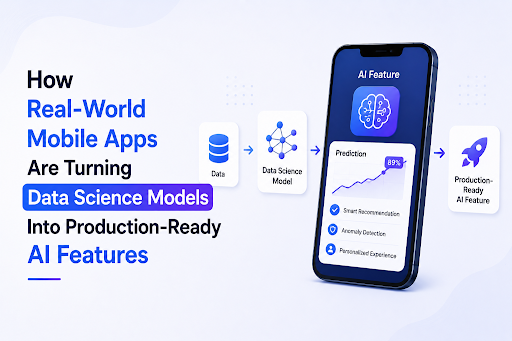
For years, data science lived in notebooks. Models were trained, demos were impressive, and then most of them never made it to real users. That gap is finally closing. In 2026, real-world mobile apps are turning data science models into production-ready AI features that millions of users interact with every day, from personalized feeds to fraud detection to AI copilots.
This shift from AI experiments to AI products is what separates the winners and the laggards in 2026. Here is how it is happening and why every business needs to take it seriously.
The Shift From AI Experiments to Real Mobile App Features
A few years ago, AI was mostly a research function. Today, it is a product function. Businesses are no longer happy with AI proofs of concept that sit in slide decks. They want AI features that ship, scale, and convert inside their mobile apps.
This is the rise of AI-native mobile applications, where data science models are not bolted on as an afterthought but built directly into the core user experience. Scalable, real-time AI integration is now the baseline for any serious mobile product.
What Does “Production-Ready AI” Mean in Mobile Apps?
A working model is not the same as a production-ready feature. The gap between the two is huge.
Production-ready AI in mobile apps means the model is:
- Scalable to millions of users without breaking
- Fast enough to deliver results in real time
- Secure and compliant with data regulations
- Continuously monitored for accuracy and drift
- Constantly retrained and improved
Deploying a data science model into a live app is fundamentally different from running it in a notebook. It requires solid AI app architecture, MLOps, and engineering discipline.
How Data Science Models Power Modern Mobile App Features
Data science is no longer hidden in the back-end. It is powering features users touch every day:
- Recommendation engines for content, products, and services
- Predictive analytics for behavior and outcomes
- AI chatbots and virtual assistants
- Computer vision features like image recognition and AR
- Voice recognition and speech-to-text systems
- Real-time personalization engines
Every one of these started as a data science model. In 2026, they are full-blown product features driving engagement, retention, and revenue.
The AI Development Pipeline for Mobile Applications
Building production-ready AI features follows a clear pipeline:
- Data collection and preprocessing to ensure clean, usable training data
- Model training and validation with accuracy benchmarks
- API integration that connects the model to the mobile app
- Cloud deployment and edge AI depending on latency needs
- Continuous monitoring and updates to keep performance high
This is the AI development lifecycle that turns a research model into a real product feature. Skipping any step results in unreliable AI that users quickly stop trusting.
Real-Time AI Features Users Experience Every Day
Most users do not realize how much AI they interact with daily. In 2026, real-time AI features include:
- Personalized content feeds in social and entertainment apps
- Smart notifications timed to user behavior
- AI-powered search that understands intent, not just keywords
- Fraud detection and anomaly alerts in finance apps
- Predictive text, autocomplete, and voice assistants
These features feel small, but they are the result of large data science models running smoothly in production at scale.
How MLOps Is Helping Businesses Scale AI Features Faster
MLOps is the engineering layer that makes production AI possible. It is what allows businesses to ship and scale machine learning features the same way they ship software.
Modern MLOps stacks deliver:
- Automated model deployment pipelines
- Real-time performance monitoring
- Continuous training and version control
- Drift detection and automated retraining
- Faster iteration cycles for AI products
Without MLOps, AI features break silently. With MLOps, they improve continuously. This is why scalable machine learning systems are now a core investment for any serious AI-driven business.
Edge AI vs Cloud AI in Mobile Applications
Where the AI model runs matters more than ever. In 2026, mobile apps use a mix of edge AI and cloud AI depending on the use case.
Edge AI runs models directly on the device. Benefits include:
- Lower latency for real-time features
- Offline functionality
- Better privacy since data stays on the device
- Reduced cloud costs
Cloud AI is still essential for large-scale training, heavy compute, and centralized intelligence.
Most modern AI mobile apps now use hybrid architectures, where edge AI handles real-time interactions and cloud AI handles training and updates.
AI Personalization Engines Driving User Engagement
Personalization is the single biggest area where data science models are delivering ROI in 2026. AI personalization engines now understand user behavior patterns at a depth that static rules could never match.
This drives:
- Higher engagement through relevant content
- Better retention through personalized journeys
- Stronger conversions through context-aware offers
- Higher customer lifetime value across categories
From shopping to healthcare to travel, AI personalization is the difference between a forgettable app and a daily habit.
Generative AI Features Becoming Standard in Mobile Apps
Generative AI has crossed from novelty to necessity. In 2026, most modern apps include some form of generative AI feature:
- AI-generated summaries and content
- GPT-powered assistants inside the app
- AI-generated images, voice, and video
- Conversational AI for support and discovery
- Personalized AI workflows for individual users
Users now expect to chat, summarize, generate, and create directly inside apps. Brands that do not offer this feel outdated fast.
Industries Successfully Deploying AI Features in Mobile Apps
Production AI is delivering results across categories:
- Healthcare apps using predictive diagnosis and remote monitoring
- FinTech apps detecting fraud and personalizing financial products
- Real estate apps recommending properties and predicting prices
- Travel apps generating personalized itineraries
- E-commerce apps driving intelligent product discovery
- EdTech apps personalizing learning paths
The pattern is clear. AI features are no longer differentiators. They are the new baseline.
Challenges of Deploying AI Models in Real-World Mobile Apps
Production AI is not easy. The most common challenges include:
- Data privacy and regulatory compliance
- Model drift and declining accuracy over time
- High infrastructure and compute costs
- AI bias and ethical concerns
- Balancing AI performance with battery and bandwidth
Businesses that plan for these from day one ship faster, cheaper, and more reliably than those that treat AI as a feature add-on.
Security and Monitoring for Production AI Systems
Production AI must be observable, secure, and explainable. Modern AI systems in mobile apps now include:
- Real-time performance monitoring and observability
- Anomaly and failure detection
- Secure AI APIs and encrypted data flows
- AI governance and compliance frameworks
- Explainable AI for transparency in critical decisions
This is what builds long-term user trust, especially in sensitive industries like finance and healthcare.
Future Trends: The Next Generation of AI-Powered Mobile Apps
The next wave is already taking shape:
- Autonomous AI agents handling end-to-end tasks inside apps
- Multimodal AI combining text, voice, image, and video
- AI copilots for both consumers and businesses
- Federated learning for privacy-first AI training
- Hyper-personalized mobile ecosystems built around individual users
The AI mobile app of 2027 will not just respond to users. It will anticipate them.
Why Businesses Must Build Production-Ready AI Features Now
The gap between AI-native businesses and traditional ones is widening every quarter. Companies that have moved their data science models into production are growing faster, retaining better, and innovating quicker than competitors stuck in experimentation mode.
Building production-ready AI features today means:
- A clear competitive advantage in your category
- Better user engagement and retention
- Lower operational costs through automation
- Faster innovation cycles
- A future-ready product built for the next decade
AI is no longer a side project. It is a core part of mobile product strategy.
Now is the time to turn data science models into production-ready AI features and build mobile apps that scale intelligence, not just users.
FAQ
How are data science models used in mobile apps? They power features like recommendations, fraud detection, personalization, voice recognition, and predictive analytics inside the app.
What are production-ready AI features? AI features that are scalable, secure, monitored, and reliable enough to serve real users at scale, not just demos.
How do businesses deploy AI models into apps? Through a pipeline of data preparation, model training, API integration, cloud or edge deployment, and continuous monitoring.
What is MLOps in mobile app development? MLOps is the practice of automating, monitoring, and managing machine learning models in production environments.
What industries benefit most from AI-powered apps? Healthcare, FinTech, real estate, travel, e-commerce, EdTech, and logistics are seeing the biggest gains.
What is edge AI in mobile applications? Edge AI runs models directly on the user’s device, enabling low-latency, offline, and privacy-friendly AI features.
How much does AI app development cost? It varies based on features, AI integrations, and scale, but cloud platforms and pre-trained models have made it more accessible than ever.
What challenges exist in deploying machine learning models? Data privacy, model drift, compute costs, AI bias, and balancing performance with device constraints.