
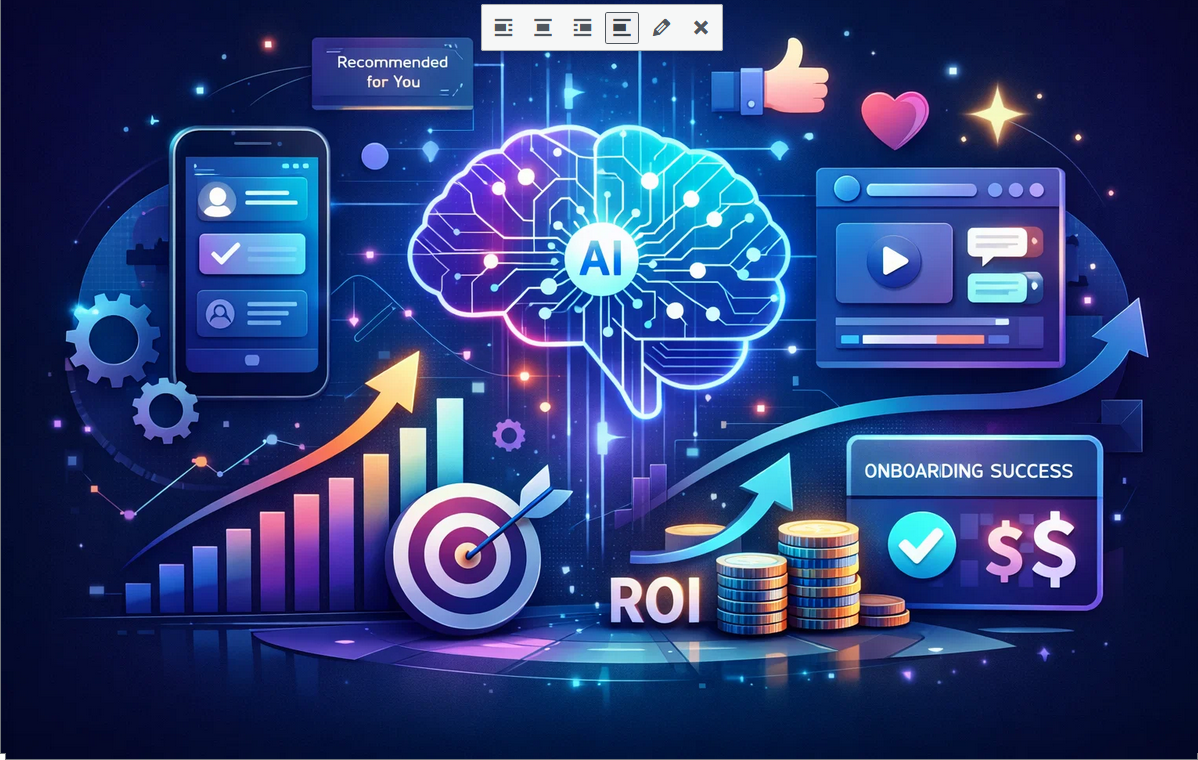
In the rapid-fire digital world of today, user retention is not only nice but the most important thing, getting users to stick with your product is everything. Ineffective design translates into non-engagement and thus money pile up due to poor advertising—nowhere to go but AI-based UI/UX design. It has taken over the scenario of how sectors create interfaces that are user-friendly, thus increasing adoption and producing ROI in reality. The teams initially changed UI/UX services due to my personal experience and then gradually brought back the old ones. The process would be better explained by dividing it into steps.
The Rise of AI in UI/UX: Why It Matters Now
Think back to the early days of web design—doing A/B tests over and over, making decisions based on intuition, and designers working overnight. AI completely alters that scenario. The likes of Figma’s AI plugins and Adobe Sensei not only analyze user data but also predict what will work beforehand based on continuous testing even before a launch. The change is not just a claim made by the vendors. A 2024 report from Forrester stated that the companies which employed AI driven designs achieved 30% faster time-to-market. Faster feedback loops and lesser guesswork are the benefits even if you are a startup or an enterprise.
Key AI Tools Reshaping Design Workflows
- Heatmap Predictors: AI imitates the user’s eye-tracking, detecting where the attention is no longer focused.
- Personalization Engines: They are similar to Netflix ones, and they are making changes in layouts according to users’ actions.
- Auto-Layout Generators: Applications that propose adaptation of designs for various devices.
Designers are not going to be replaced by these tools; they are going to be empowered. The combination of this with professional UI/UX Services results in polished outcomes that are scalable.
Boosting Product Adoption: Making Users Stay, Not Stray
Adoption isn’t merely downloads—it’s actually daily active users. AIl-empowered UI/UX perfectly accomplishes this one by giving rise to user-friendly, addicting, and addicting experiences. Let’s not forget Duolingo? Their AI customizes the lessons dynamically, and as a result, less than 10% of the students drop out. This is not a coincidence.
Personalization at Scale: The Adoption Killer App
AI has access to user data and uses it in such a way that it will be able to design user interfaces suited just for them. The fitness app can show runners all the metrics in a hardcore way and the yogis will get the calming visuals. The outcome is that the users think that they are recognized, and the engagement increases by 40 to 60 percent according to the latest Nielsen figures.
- Dynamic Onboarding: AI compresses the tutorials for the power users and provides the newbies with step-by-step instructions.
- Frictionless Navigation: The predictive search bars recognize the needs of the users, which results in a reduction of the search time by 50%.
- Accessibility Boosts: It automatically adjusts the contrast for color-blind users, thus increasing the size of the audience.
I have been an advisor to e-commerce companies where AI-optimized checkouts have reduced cart abandonment by 25%. The users are on board because the whole process feels effortless to them.
Real-World Wins: From Startups to Giants
Take Spotify. Their AI-empowered “Discover Weekly” is not only playlists, but it is also a great user interface that changes your home screen according to your moods. Adoption skyrocketed; they reached 600 million users by the middle of 2025. Smaller competitors? A SaaS tool I was involved with integrated AI for dashboard adjustments, which led to a doubling of customer retention in three months.
But the downside is that artificially generated content can sometimes come across as it was made by a machine. The origin of the UI/UX Services is to come in; human specialists will turn AI recommendations into brand-consistent jewels through polishing.
Driving ROI: Hard Numbers Behind the Magic
The return on investment isn’t vague; it is simple: the money that comes in minus the money that goes out. The design powered by AI cuts down costs and at the same time increases revenue. McKinsey estimates 3-5 times returns for those who use AI in product dev.
Cost Savings You Can Bank On
Development consumes money allocated for budgets. Artificial Intelligence is taking over low-skilled jobs:
- Prototyping Speed: Produce 100 designs in a couple of hours, not in weeks—thereby cutting down the design time by 70%.
- User Testing Automation: AI chatbots conduct surveys, thus taking the place of expensive focus groups.
- Backend Synergy: While the frontend attracts attention, the smart teams hire backend developers early to ensure that AI features (like real-time personalization) operate without crashes.
The combination of AI UI/UX with strong backend support helps to avoid bottlenecks. In some cases, I have witnessed that bringing in specialized backend developers at the beginning helped prevent the projects from exceeding the budget by 20%.
Challenges and How to Overcome Them
AI is not infallible. If there are biases present in the training data, designs might be directed to specific groups of people. Relying too much on AI results in cold and unfeeling user interfaces.
Smart Strategies for Success
- Human-AI Hybrid: Employ UI/UX Services to evaluate AI’s output—guarantee emotional impact.
- Ethical Guardrails: Enrich models with varied datasets; evaluate with actual users.
- Backend Backbone: Recruit backend programmers who are proficient in AI integrations (like Node.js for scalable APIs). This will enable your UI to be responsive even during high traffic.
- Iterate Relentlessly: Begin with a minor—AI-optimization of one screen, measurement, and then expansion.
Tip for budget: Great savings can be made if backend experts are hired via freelancing platforms and one can find many professional candidates charging not more than $50 an hour.
The Future: AI as Your Design Co-Pilot
Gartner anticipates that 80% of the companies will rely on AI for UI/UX by 2026. The fast adopters are the ones who gain the biggest—more users, higher profits.
Are you interested? Check the design you have now. Try some of the free tools, such as Uizard or Framer AI, for your experiments. After that, get your UI/UX Services and backend team to help you grow. The main point is that AI-powered UI/UX is not a phenomenon; it is a requirement. Make it good, see the users come, and profit will be the next step.