
Artificial intelligence is slowly but surely altering the landscape of contemporary applications, thus more organizations are choosing to incorporate AI microservices and APIs into their systems to achieve improved, quicker, and more personalized interactions with users. On the other hand, the AI-powered backend must be highly fast, scalable, and efficient to handle all model executions, real-time data processing, and API calls along with millions of concurrent requests.
In this case, Node.js is the technology with the edge.
Node.js is already widely adopted for AI systems—not to say that it works for machine learning models, but the fact is that it is the most efficient way of integrating AI services, embracing microservices, and serving heavy I/O workloads with unparalleled performance.
Throughout this write-up, we will look into the situation in which one should use Node.js for AI-powered microservices and APIs and the reasons for it being a smart choice for modern, data-rich applications.
Why Node.js Fits AI-Backed Architectures
AI-based technologies relish data transfer at lightning speed, real-time processing and effective inter-service communication even when services are distributed. Node.js combines the advantages of event-driven architecture and scalability in these areas and therefore it is not a surprise that most companies hire Node.js developers for the development of AI-centric microservices and APIs.
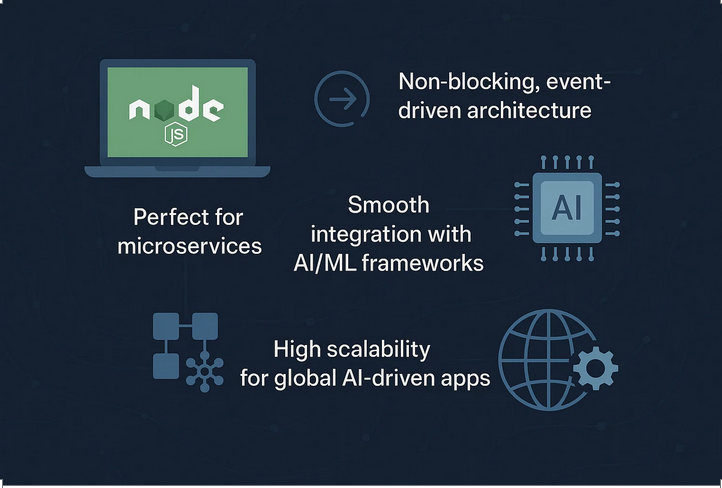
1. Non-blocking, event-driven architecture
AI applications frequently require:
- High-frequency API calls
- Real-time data streams
- Requests for external ML models
- Database searches
- Notifications from queues or event buses
2. Perfect for microservices
Usually, AI systems are decomposed into microservices such as:
- User authentication and profiles
- Suggestions engine
- Conversational agent or natural language processing
- Business intelligence and user interface
- Data input service
- Alert service
Node.js empowers the teams to create small, quick, and isolated microservices that can grow without any hassle.
3. Smooth integration with AI/ML frameworks
Node.js APIs are capable to connect in a smooth and efficient way with:
- Services for ML on Python (Flask, FastAPI, Django)
- TensorFlow Serving
- TorchServe
- AI APIs powered by the Cloud (AWS, Azure, Google AI)
Consequently, Node.js becomes an excellent intermediary layer taking the frontend to AI models operated in other locations.
4. High scalability for global AI-driven apps
Since Node.js is capable of managing a massive number of simultaneous requests without breaking the sweat, it has become the best fit for:
- AI-assisted eCommerce recommending
- Simultaneous fake transaction detection
- Continuous bot conversation
- Personalization systems powered by AI.
When Node.js Is the Best Choice for AI Microservices
1. When Your AI System Requires Real-Time Responses
- Backed-up AI functionalities like:
- Chatbots
- Product recommendations
- Predictive analytics
- Real-time anomaly detection
Node.js has the ability to process several input streams concurrently which makes it a very suitable option for the delivery of AI services with extremely low latency.
2. When you wish AI-powered microservices to be easily scalable.
Independent scaling of AI components is a common case during traffic spikes.
Node.js microservices offer:
- Independent scaling of every AI function
- Simple containerization (Docker/Kubernetes)
- Improved fault tolerance
- Shorter deployment cycles
This modularity is a key factor for the progress of AI platforms. Building scalable AI modules is one of the reasons why many companies prefer to hire Node.js developer teams.
3. When Your AI Application Depends on High-Volume I/O
AI solutions generally depend on:
- Numerous database reads and writes
- File handling
- Receiving and sending data from devices or applications in real-time
- Making calls to outside APIs
Node.js is a framework that has the capability of performing tasks that are mostly dependent on I/O in an efficient manner.
In case your company has an in-house software development team, they can use Node.js to improve the data exchange between your AI systems and APIs.
4. When You Require Lightweight APIs for AI Orchestration
Node.js is an excellent choice for crafting:
- REST APIs
- GraphQL APIs
- Gateway APIs
WebSocket APIs with real-time communication
Such APIs can coordinate the usage of AI models and get back their predictions in fractions of a second. Numerous companies seek the services of Node.js developer specialists to create these agile and strong AI entry points.
5. When You Need a Dedicated Development Team for AI Integration
Your business is going to be an AI transformation journey? Then, a backend team is often needed to:
- Create microservice architecture
- Add AI/ML pipelines
- Create data ingestion layers
- Control API performance and scaling
A powerful dedicated development team working with Node.js will make sure that your AI features operate without any hitches, while your data science team is busy with model optimization.
Use Cases Where Node.js Works Exceptionally Well
Node.js is an excellent choice for AI-supported applications such as:
- AI-Charged Chatbots and Virtual Assistants
Node.js together with Natural Language Processing APIs guarantee prompt, instantaneous conversational systems. - Recommendation Systems
Custom-made product recommendations or suggestions in a marketplace. - Fraud Detection in Real-Time
Banking applications that anticipate fraud through predictive AI models. - Smart Dashboards and Analytics
Node.js APIs for live data streaming + AI insights. - Intelligent IoT Applications
IoT devices that communicate real-time data to AI models through Node.js microservices.
Final Thoughts
Node.js is not suitable for training large machine learning models, but it is still one of the most recommended technologies to run microservices and APIs backed by AI. Being fast, scalable, and event-driven are the qualities that make Node.js the perfect application backend for AI-driven tasks that need instant replies and perfect synchronisation with machine learning services.
In case you intend to develop an AI-friendly product or update your infrastructure, adopting Node.js for your microservices and API layers will result in excellent performance, reduced hosting expenses and the possibility to expand your AI systems together with business growth.