
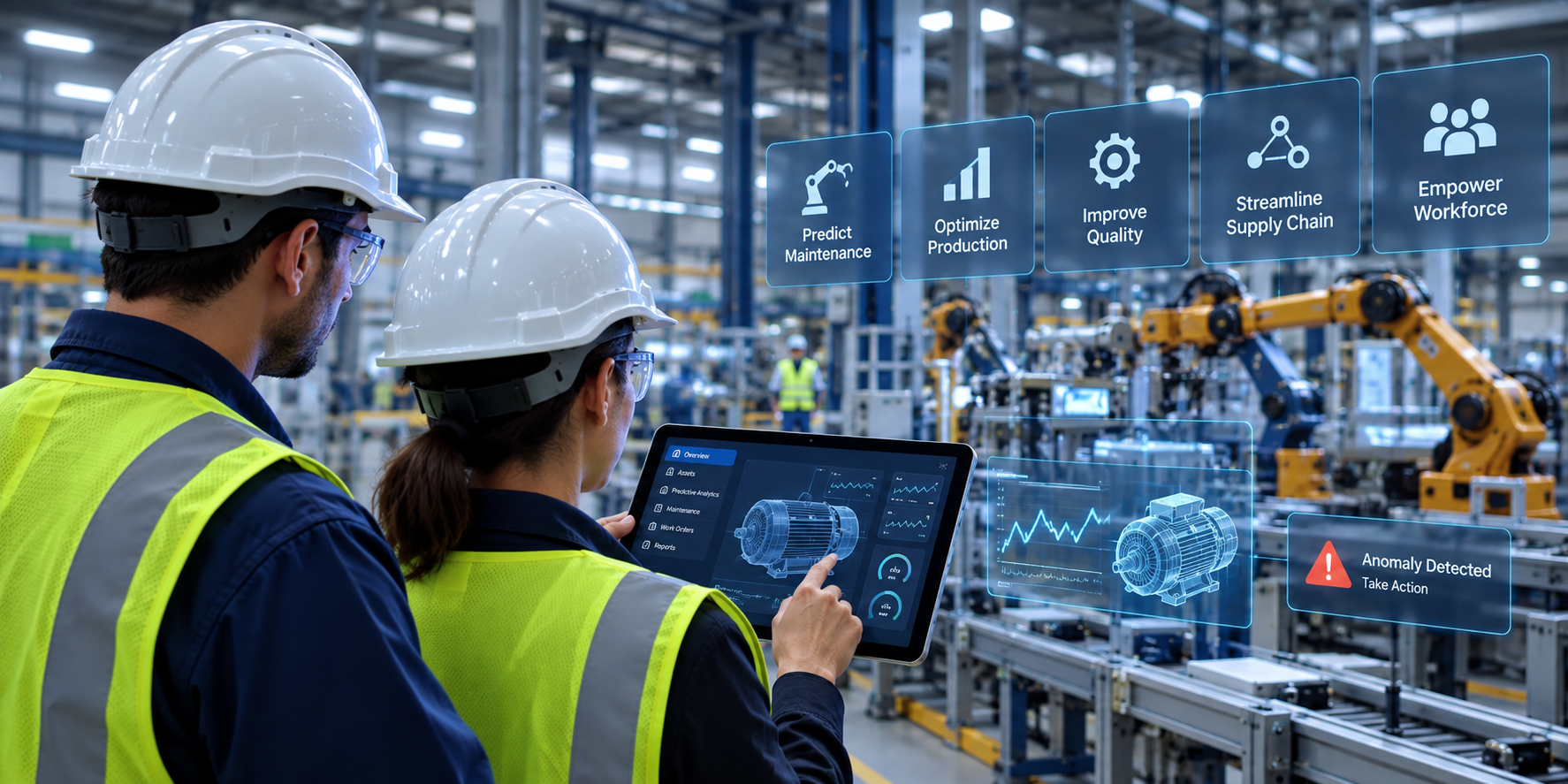
Manufacturers are moving beyond isolated AI experiments toward production-ready systems that can improve maintenance, quality, production planning, supply chain operations, and workforce productivity. But implementing AI inside a manufacturing environment is more complex than developing a standalone model.
Enterprise AI may need to connect with ERP, MES, CMMS, QMS, SCADA, IoT platforms, historians, production databases, and legacy applications. Manufacturers therefore need an AI implementation partner that combines AI engineering with enterprise integration, manufacturing knowledge, security, governance, and post-deployment support.
If you are evaluating the best enterprise AI implementation partner for manufacturers, the following companies are strong options to consider in 2026.
1. Intellectyx
Intellectyx is an Enterprise Agentic AI innovation and delivery partner focused on designing, building, and operating production AI systems that deliver measurable business outcomes.
For manufacturers, Intellectyx supports AI initiatives across predictive maintenance, production optimization, quality management, supply chain intelligence, enterprise knowledge AI, computer vision, and AI agents for manufacturing workflows.
A key strength is the ability to connect custom AI capabilities with existing enterprise and manufacturing environments rather than introducing another disconnected AI application. Implementations can involve ERP, MES, CMMS, QMS, operational data, and other business systems.
Intellectyx also supports the complete implementation lifecycle, from AI readiness and use-case discovery through PoC development, integration, production deployment, monitoring, and AgentOps.
Best for: Manufacturers looking for custom enterprise AI, Agentic AI, system integration, and PoC-to-production implementation.
2. Accenture
Accenture is one of the largest global technology and consulting organizations and has extensive capabilities across AI, data, cloud, automation, digital engineering, and manufacturing transformation.
Its manufacturing capabilities make it particularly relevant to large enterprises undertaking broad AI transformation programs involving multiple plants, business functions, and technology platforms.
Accenture can support manufacturers with areas such as intelligent operations, supply chain optimization, predictive analytics, generative AI, automation, digital twins, and enterprise AI transformation.
Best for: Global manufacturers undertaking large-scale, multi-year AI transformation programs.
3. Siemens
Siemens brings a different advantage to manufacturing AI because of its extensive background in industrial automation, engineering, manufacturing software, and operational technology.
Its portfolio spans factory automation, industrial data, digital twins, engineering software, and AI-enabled manufacturing capabilities.
For organizations where AI needs to operate particularly close to machines, production lines, engineering systems, and factory automation, Siemens can be a strong implementation option.
Best for: Industrial manufacturers combining AI with automation, engineering, digital twins, and factory operations.
4. IBM Consulting
IBM Consulting combines enterprise consulting with IBM’s broader capabilities in AI, hybrid cloud, automation, data, security, and asset management.
For manufacturers, these capabilities can support predictive maintenance, asset intelligence, supply chain operations, enterprise knowledge management, process automation, and AI modernization.
IBM can be particularly relevant for organizations with complex enterprise architectures where AI needs to operate across hybrid environments and established business systems.
Best for: Large manufacturers with complex enterprise and hybrid-cloud environments.
5. Deloitte
Deloitte combines strategy and operational consulting with technology implementation capabilities across AI, data, cloud, cybersecurity, and enterprise transformation.
This combination can be useful when manufacturers are not simply implementing an AI application but redesigning the business processes, governance structures, and operating models surrounding AI.
Deloitte can support manufacturers across intelligent operations, supply chain transformation, predictive analytics, automation, generative AI, and broader digital-manufacturing initiatives.
Best for: Manufacturers that need AI implementation combined with business transformation and governance.
6. Capgemini
Capgemini has substantial capabilities across intelligent industry, engineering, AI, cloud, data, and enterprise technology.
Its manufacturing work includes smart factories, connected operations, digital twins, predictive maintenance, supply chain transformation, and industrial data.
Capgemini may be particularly suitable for large organizations seeking to connect AI initiatives with wider digital-manufacturing and engineering transformation programs.
Best for: Manufacturers pursuing smart-factory and connected industrial transformation.
7. Cognizant
Cognizant provides AI, cloud, data, IoT, digital engineering, automation, and enterprise application services across large organizations.
Its combination of technology modernization and industry implementation experience can support manufacturers that need AI integrated with existing operational and enterprise systems.
Potential applications include predictive analytics, intelligent automation, production optimization, supply chain intelligence, and connected manufacturing.
Best for: Manufacturers combining AI implementation with broader application and technology modernization.
8. EPAM Systems
EPAM Systems has strong capabilities in software engineering, product development, data platforms, cloud architecture, and AI engineering.
This engineering background can make EPAM attractive for manufacturers that require highly customized AI applications or need to build AI into broader digital products and enterprise platforms.
Rather than focusing solely on AI models, an engineering-led implementation can address the application, integration, data, and platform layers required to operationalize AI.
Best for: Manufacturers requiring complex custom engineering around their AI implementation.
9. LeewayHertz
LeewayHertz specializes in custom AI development and has expanded its capabilities around generative AI, AI agents, machine learning, and enterprise AI applications.
For manufacturers, the company can support targeted AI applications such as intelligent automation, predictive systems, enterprise AI agents, and custom AI workflows.
It may be worth considering for organizations looking for a more specialized AI development partner rather than a large global consulting organization.
Best for: Targeted custom AI and AI-agent development projects.
10. Hitachi Digital Services
Hitachi Digital Services combines digital engineering and technology services with the broader Hitachi organization’s industrial background.
Its capabilities around IoT, data, connected assets, cloud, analytics, and industrial environments make it relevant for manufacturing organizations exploring operational AI.
The company can be particularly relevant where equipment data, asset performance, industrial IoT, and enterprise technology need to work together.
Best for: Industrial IoT, connected assets, and data-intensive manufacturing transformation.
Comparison of Enterprise AI Implementation Partners for Manufacturing
|
Company |
Best Fit |
Key Manufacturing AI Focus |
|
Intellectyx |
Custom enterprise AI |
Agentic AI, predictive maintenance, quality, production optimization |
|
Accenture |
Global transformation |
Enterprise AI, intelligent operations, supply chain |
|
Siemens |
Industrial operations |
Automation, digital twins, factory AI |
|
IBM Consulting |
Complex enterprises |
AI, asset intelligence, hybrid cloud |
|
Deloitte |
Transformation + governance |
AI strategy, operations, enterprise transformation |
|
Capgemini |
Smart manufacturing |
Intelligent industry, engineering, connected factories |
|
Cognizant |
Technology modernization |
AI, IoT, data, automation |
|
EPAM |
Custom engineering |
AI applications, platforms, data engineering |
|
LeewayHertz |
Focused AI development |
AI agents, GenAI, custom AI |
|
Hitachi Digital Services |
Industrial data |
IoT, connected assets, industrial analytics |
What Should Manufacturers Look for in an AI Implementation Partner?
The right partner should be evaluated on more than AI development capability.
Manufacturing AI has to work inside an operational environment where production continuity, data reliability, system integration, security, and human decision-making matter.
Manufacturers should evaluate whether a potential partner understands manufacturing workflows and can integrate AI with systems such as ERP, MES, CMMS, QMS, SCADA, IoT platforms, and industrial data sources.
Production experience is equally important. Ask how the company handles AI monitoring, evaluation, model performance, security, permissions, human approvals, and ongoing optimization after deployment.
For Agentic AI specifically, manufacturers should understand how the partner controls what an AI agent can access, which actions it can perform, when human approval is required, and how agent behavior is monitored.
Which Manufacturing AI Use Cases Should an Implementation Partner Support?
An experienced enterprise AI implementation company should be able to identify where AI can create measurable operational value rather than recommending AI simply because the technology is available.
Predictive maintenance is one strong opportunity. AI can analyze equipment condition and maintenance history to identify developing problems before they result in unplanned downtime.
Quality management is another. Computer vision and machine learning can identify defects, while AI can analyze process and production information to help determine why quality issues are occurring.
Production optimization can use machine, cycle, scheduling, and process data to identify bottlenecks and opportunities to improve throughput.
Manufacturers can also apply AI to demand forecasting, inventory optimization, procurement, supply chain risk, engineering knowledge, workforce assistance, and production planning.
Increasingly, AI agents for manufacturing can add another layer by working across these systems and helping coordinate multi-step operational workflows.
How Much Does Enterprise AI Implementation Cost for Manufacturers?
There is no standard price because manufacturing AI implementations vary significantly in scope.
A focused AI PoC development targeting one production problem will cost considerably less than an enterprise implementation spanning multiple systems, production lines, facilities, and AI agents.
Cost is usually influenced by data readiness, number of integrations, AI model complexity, real-time requirements, industrial system connectivity, security requirements, number of workflows, deployment architecture, and ongoing monitoring.
Manufacturers should therefore avoid selecting an implementation partner primarily based on the lowest development estimate.
A better question is whether the project has a measurable business case.
If an AI solution can meaningfully reduce downtime, scrap, quality losses, inventory costs, or production inefficiencies, its value should ultimately be evaluated against those improvements.
How Should Manufacturers Choose the Right AI Implementation Partner?
Start with the business outcome rather than the vendor.
Define the manufacturing problem you want to solve and establish the current baseline. That could be hours of unplanned downtime, defect rates, production throughput, maintenance costs, forecast accuracy, inventory levels, or another measurable operational KPI.
Then ask each potential partner how they would approach that specific problem.
A strong partner should be able to explain what data is needed, which systems need integration, how an AI PoC would be structured, how success would be measured, what would be required for production deployment, and how the solution could eventually scale.
Be cautious when the conversation focuses heavily on AI models before the partner understands your manufacturing workflow.
The technology matters, but implementation is ultimately about connecting AI to the process where business value is created.
Conclusion
There is no single best enterprise AI implementation partner for manufacturers for every organization.
Accenture, Deloitte, IBM Consulting, Capgemini, and Cognizant can be strong choices for large global transformation programs. Siemens stands out when industrial automation, engineering, and factory technology are central to the initiative. EPAM can be attractive for engineering-intensive custom implementations, while specialized AI companies can provide a more focused development approach.
Intellectyx is particularly relevant for manufacturers looking to build custom AI and Agentic AI solutions around specific operational problems and move them from PoC to production.
The deciding factor should be whether the partner can understand your manufacturing problem, work with your existing data and systems, prove measurable value through a focused implementation, and operate the AI reliably after deployment.