
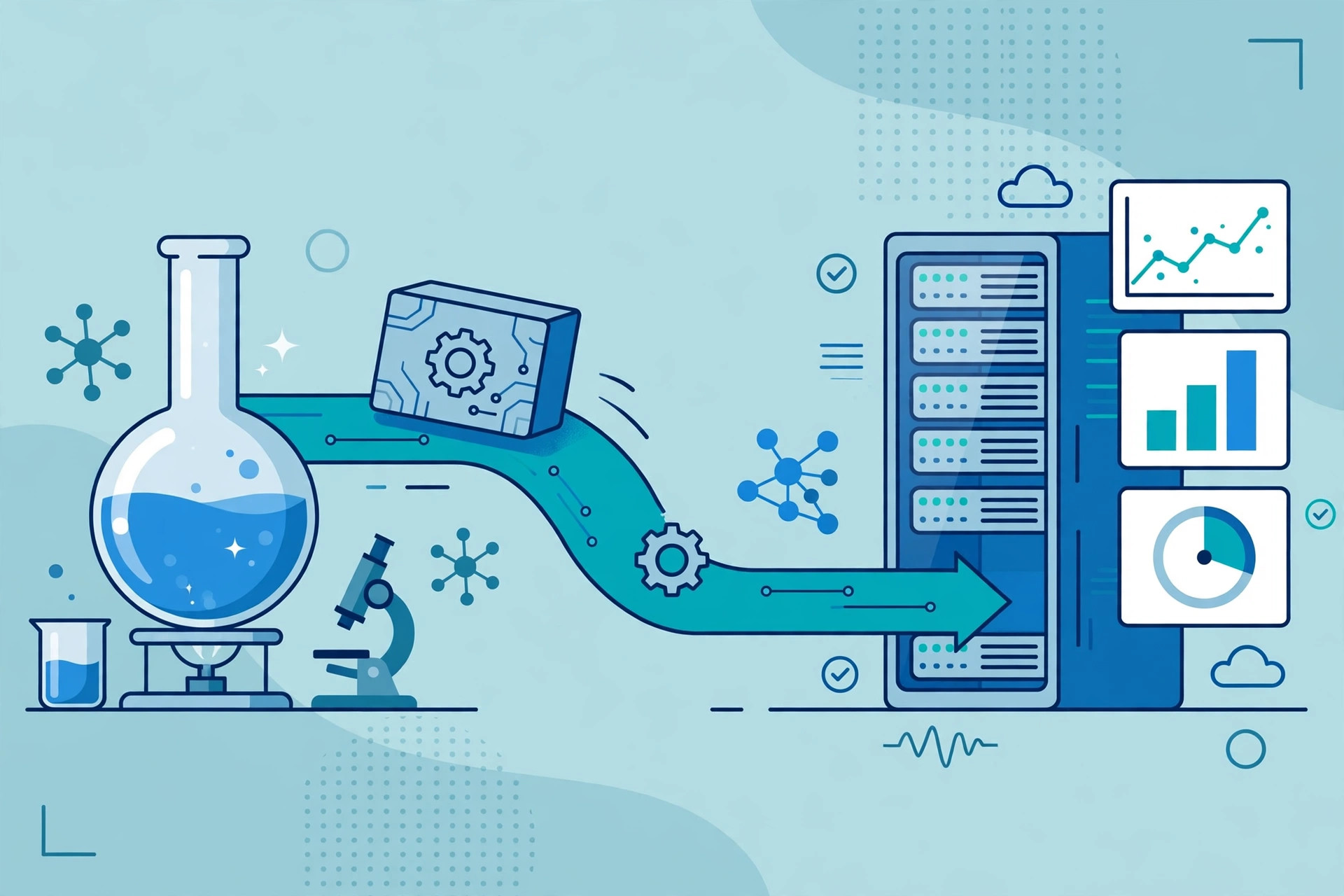
Machine learning model deployment is the process of taking a trained model out of a notebook or experiment environment and running it where real users, applications, and data can use its predictions. Deployment is where a model stops being a research result and starts being a product, with uptime, latency, cost, and failure modes that a team has to own.
Many models never survive this step. Industry surveys and practitioner reports have repeated the same finding for years: a large share of trained models are never put into production, and many that are deployed quietly degrade until someone notices the business metric slipping. The gap is rarely the algorithm. It is the unglamorous engineering around the model: packaging, serving, monitoring, versioning, and rollback. This guide walks through how deployment actually works, the main patterns teams choose between, and the operational habits that keep a model useful after launch day.
What is machine learning model deployment?
Machine learning model deployment is the set of steps that packages a trained model, exposes its predictions through an interface other systems can call, and keeps that service healthy over time. It includes the model artifact, the code that loads it, the infrastructure it runs on, and the monitoring that watches it.
A useful way to see the scope is to compare training with serving. Training is a batch job run by a small team on historical data, where an extra hour of compute is an inconvenience. Serving is a live system: requests arrive at unpredictable rates, inputs are messier than the training set, and a slow or wrong answer lands directly on a user. The discipline that covers this gap is sometimes called MLOps, by analogy with DevOps. Teams that understand machine learning as a full life cycle, not just a training exercise, budget for deployment from the start instead of treating it as the final afternoon of the project.
How does deployment differ from training a model?
Deployment differs from training in its goals, its data, and its failure costs. Training optimizes accuracy on historical examples. Deployment optimizes reliability on future examples that nobody has seen, labeled, or cleaned.
Three differences matter most in practice. First, the data changes character: production inputs arrive one at a time or in streams, contain missing values and new categories, and drift away from the training distribution as the world changes. Second, the constraints change: a model that takes four seconds to answer may be a fine experiment and a broken product. Third, the audience changes: training errors are visible to the data science team, while deployment errors are visible to customers, regulators, and revenue dashboards. This is why experienced engineers describe the real question as not how AI works in a notebook, but how it behaves at 3 a.m. under load with a malformed input, and they design for that moment first.
What are the main model deployment patterns?
The main deployment patterns are batch prediction, real-time API serving, streaming prediction, and edge deployment. Most production systems combine at least two of them, because different decisions run on different clocks.
Batch prediction runs the model over a large dataset on a schedule, for example scoring every customer nightly for churn risk and writing the results to a table. It is the simplest pattern to operate and the right choice whenever decisions tolerate hours of delay. Real-time API serving wraps the model in a web service that answers a request in milliseconds, which is what fraud checks, recommendations, and search ranking need. Streaming prediction scores events as they arrive through a message pipeline, suiting monitoring and personalization systems that react within seconds. Edge deployment ships a compressed model onto a device, such as a phone or a camera, where it runs without a network call, trading model size for privacy and latency. Choosing between them is an engineering decision about latency, volume, and cost, not a statement about which pattern is most advanced.
What is model serving, and what does the serving stack include?
Model serving is the runtime layer that receives inputs, runs them through the model, and returns predictions. A minimal serving stack includes a model artifact in a portable format, a feature pipeline that prepares inputs the same way training did, an inference service, and logging that records inputs, outputs, and model version for every prediction.
The feature pipeline is the part teams underestimate. A model trained on features computed one way will silently misbehave if production computes them another way, a failure known as training-serving skew. The classic example is a feature defined as “purchases in the last 30 days” that the training job computed from a warehouse table and the live service computes from an event stream with different cutoffs. Nothing crashes; the predictions just get worse, and nobody knows why. Mature teams compute features from one shared definition, often through a feature store, and they log the exact feature values used for each prediction so a bad week can be replayed and diagnosed later.
Packaging choices sit underneath: containers for the service, an artifact format such as ONNX or a framework-native save, and infrastructure that can scale replicas up and down. None of this is exotic, which is the point. Deployment rewards boring, well-understood components, because the model itself already supplies enough novelty for one system.
How do teams release a new model version safely?
Teams release a new model version safely by testing it offline, shadowing it against live traffic, rolling it out to a small share of requests, and keeping the previous version ready for instant rollback. Each step exists to convert a risky launch into a measurable experiment.
Offline evaluation compares the candidate against the current model on held-out data, including slices for important segments, because an average improvement can hide a regression for the customers who matter most. Shadow deployment then runs the candidate on real inputs without showing its answers to users, revealing latency problems and input surprises at zero user risk. A canary release sends a small percentage of traffic to the new model while dashboards compare error rates and business metrics against the control group. Only after the canary holds do teams ramp to full traffic. Rollback stays one action away throughout, because the defining property of a model release is that its true quality is unknown until real data grades it.
Versioning discipline ties this together. Every prediction should be traceable to a model version, a training dataset version, and a code version. When a metric moves, the first question is “what changed?”, and a team that cannot answer it in minutes will spend days guessing.
How do teams monitor a model after deployment?
Teams monitor a model after deployment on three layers: system health, input health, and prediction quality. System health covers latency, error rates, and resource use. Input health covers the data itself. Prediction quality covers whether the outputs remain accurate, which is the layer teams most often forget.
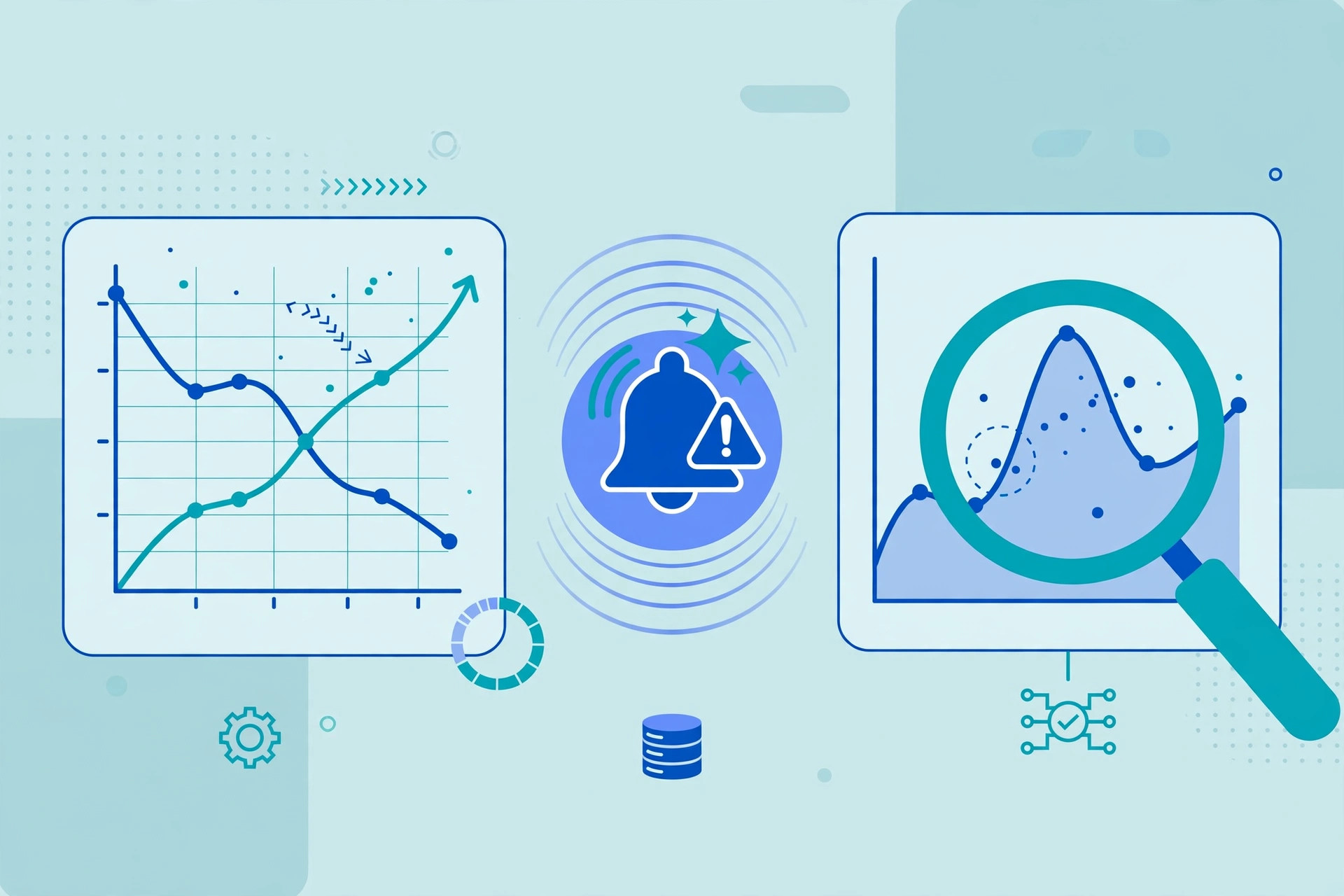
Input monitoring watches for drift: statistical changes in the distribution of incoming features compared with training data. A sudden drift usually means an upstream system changed, while slow drift means the world is moving, for example customer behavior shifting with a season or a market. Prediction monitoring watches output distributions and, where labels arrive later, true accuracy on the delayed ground truth. A churn model can be scored weeks later when retention is known; a fraud model gets feedback within days through chargebacks. The monitoring plan must be built around that label delay, otherwise the team is flying blind for exactly the period when a new model is riskiest.
Alerting deserves the same design care as the model. An alert that fires daily gets ignored; an alert tied to a business-relevant threshold, with a named owner and a written response playbook, gets acted on. The playbook matters because the correct response to drift is rarely “retrain immediately”; it is first to check whether the pipeline broke, then whether the world changed, and only then to schedule retraining with fresh data.
What breaks models after launch?
The failures that break models after launch are usually mundane: an upstream schema change, a feature pipeline bug, a dependency upgrade, a traffic spike, or slow data drift. Deliberate attacks and exotic edge cases exist, but production post-mortems are dominated by plumbing.
A schema change is the classic silent killer. A partner system renames a field, an empty string replaces a null, a currency column switches units, and the model receives garbage that still parses as valid input. Contract tests between the model service and its data producers catch this class cheaply. Dependency problems follow close behind: the serving environment upgrades a library and the model’s behavior shifts subtly, which is why production images are pinned and tested like any other release artifact. Finally there is feedback loop contamination, where the model’s own outputs shape the data it later trains on, for example a recommendation system that only ever sees clicks on items it chose to show. Teams that retrain without accounting for that loop amplify their own biases a little more each cycle.
Organizations that productize models as part of larger platforms, for example through custom software development that wraps a model inside a client application with its own users and permissions, meet these problems at the boundary between the model team and the product team. The fix is organizational as much as technical: one named owner for the model in production, with authority over both its pipeline and its release calendar.
How much does model deployment cost to run?
The running cost of a deployed model has four parts: compute for inference, storage and pipeline infrastructure, monitoring and retraining, and the engineering time to operate it. Inference compute gets the attention, but operating time is usually the largest line over a model’s life.
Compute cost depends on the pattern. Batch scoring on a schedule is cheap and predictable. Real-time serving must be provisioned for peak traffic, so a model answering a million requests a day costs far less per request than the same model kept warm for a hundred requests a day, where idle capacity dominates. Optimization techniques such as quantization, distillation into a smaller model, and request batching cut inference cost substantially for high-volume services. Retraining cost depends on cadence: a model retrained weekly on modest data is a routine expense, while a large model retrained monthly can rival its original training budget over a year. The honest way to price deployment is per decision: total monthly operating cost divided by predictions served, compared with the value of a correct prediction. Models that cannot justify that ratio get simplified, batched, or retired.
Conclusion
Model deployment is where machine learning becomes engineering: package the model with its feature logic, serve it through a pattern that matches the decision’s clock, release it in stages with rollback ready, and monitor inputs and predictions as seriously as uptime. Teams that build those habits find that models stop being fragile experiments and become ordinary, dependable parts of the product, which is exactly what a deployed model should be.
FAQs
How long does it take to deploy a machine learning model?
A simple batch model on existing infrastructure can reach production in days. A real-time service with monitoring, staged rollout, and compliance review typically takes several weeks. Most of the time goes to pipelines, testing, and approvals rather than to the model itself.
What is the difference between model deployment and model serving?
Deployment is the whole process of moving a model into production and keeping it there, including packaging, release strategy, and monitoring. Serving is one part of it: the runtime layer that answers prediction requests. All serving is part of deployment, but deployment covers much more.
How often should a deployed model be retrained?
Retraining should follow measured drift and performance decay, not a fixed calendar. Some models hold accuracy for a year; others decay in weeks because their environment changes fast. Monitoring data should trigger the retraining decision, with a scheduled review as a backstop.
Can a model be deployed without cloud infrastructure?
Yes. Models run on premises, on private servers, and on edge devices such as phones and cameras. The pattern choices and monitoring duties stay the same; only the infrastructure changes. Edge deployment is common where latency, connectivity, or privacy rules out a cloud call.