
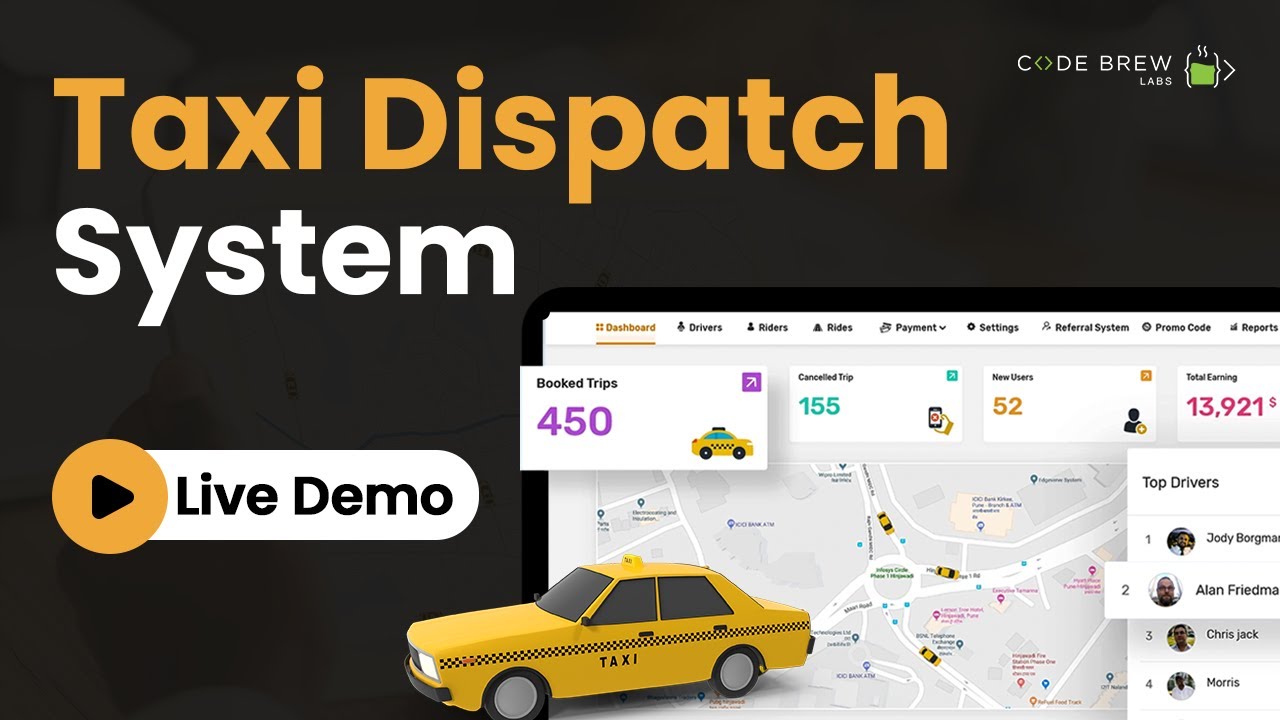
Taxi dispatch is one of the most operationally demanding parts of a modern ride-hailing platform. Every booking creates a chain of decisions: which driver should receive the request, how quickly can that driver reach the customer, what happens if the driver rejects the trip, and how should the platform respond if demand suddenly increases?
Traditional dispatch systems are good at handling predefined rules. But taxi operations are becoming more dynamic. Traffic changes every few minutes, customer demand moves between locations, drivers become available at different times, and unexpected cancellations can quickly disrupt the balance between supply and demand.
This is where AI agents could introduce a major shift.
Instead of using AI only for recommendations or predictions, businesses can build agents capable of monitoring operational data, reasoning through different situations, interacting with platform systems, and taking approved actions automatically. In a taxi environment, an AI agent could continuously observe dispatch conditions and help determine what should happen next.
The important point is that agentic AI does not have to replace the existing dispatch engine. It can work alongside mapping systems, booking infrastructure, driver applications, pricing engines, databases, and business rules.
This creates a more adaptive dispatch operation that can respond to changing conditions rather than simply following the same rules for every booking.
1. Why AI Agents Matter for Taxi Dispatch Operations
For businesses investing in taxi app development services, dispatch automation is becoming an important part of building a scalable platform. A taxi application can have an attractive customer interface and sophisticated driver application, but poor dispatch logic can still result in long waiting times, inefficient driver utilization, and frequent cancellations.
Traditional dispatch usually follows a predefined sequence.
A customer requests a ride. The system identifies available drivers. It calculates distance or estimated arrival time, applies matching rules, and sends the request to a selected driver.
This works well when operating conditions are predictable.
However, city transportation is rarely predictable.
Consider a situation where several hundred customers request rides after a concert. The closest drivers may already be occupied. Some drivers may be stuck in traffic. Others may be finishing trips nearby. A simple nearest-driver algorithm may not have enough context to determine the best operational response.
An AI agent can evaluate a broader set of signals.
It can look at current demand, available supply, traffic, driver status, trip completion times, historical patterns, and platform rules before recommending or executing an action.
This gives dispatch operations an additional layer of intelligence.
The goal is not to make every decision autonomous. Instead, businesses can decide which tasks AI agents are allowed to handle and where human approval is still required.
2. From Rule-Based Dispatch to Agentic Dispatch
Traditional dispatch systems are primarily rule-driven.
For example, a platform may have a rule saying:
“If a driver is within a certain distance of the pickup location, send the booking request.”
Another rule might determine what happens when the driver rejects the trip.
These rules are useful because they are predictable and easy to audit. The problem appears when many variables interact simultaneously.
An AI agent can work differently.
Instead of following only one predefined rule, it can gather information from several systems and evaluate the current situation.
For example, imagine three available drivers:
Driver A is physically closest but is traveling through heavy traffic.
Driver B is slightly farther away but has a much faster estimated arrival route.
Driver C is farther away but is about to complete another trip close to the customer’s location.
A traditional system may prioritize Driver A.
An intelligent agent can evaluate the broader context and determine whether Driver B or Driver C would create a better operational outcome.
This is the difference between simply automating a rule and automating a decision-making process.
3. How AI Agents Could Monitor Driver Supply and Demand
One of the strongest use cases for AI agents is supply-demand monitoring.
Taxi demand changes throughout the day. Business districts may generate high demand during working hours, airports may experience concentrated demand around flight arrivals, and residential areas may become busier during evening periods.
A conventional system may respond after requests start arriving.
An AI agent can monitor the conditions continuously.
It can analyze:
- Current booking requests
- Driver availability
- Drivers completing existing trips
- Historical demand patterns
- Location-based demand
- Traffic conditions
- Cancellation activity
- Expected demand increases
Suppose the platform notices that ride requests are increasing around an airport while the number of available drivers is declining.
The agent could recognize the developing imbalance before customers begin experiencing excessive waiting times.
Depending on the permissions provided to the agent, it could notify operations staff, recommend driver repositioning, trigger approved driver notifications, or adjust dispatch priorities.
This becomes particularly valuable for large fleets.
Instead of operations teams manually watching multiple dashboards, AI agents can continuously monitor the network and surface situations requiring attention.
4. AI Agents and the Taxi Booking App Revenue Model
Dispatch efficiency is closely connected to the Taxi booking app revenue model because operational decisions can influence how many rides a platform completes, how efficiently drivers are utilized, and how much revenue is generated from available fleet capacity.
For example, if a platform repeatedly assigns drivers inefficiently, customers may experience longer waiting times and cancel their bookings.
That cancellation does not only create a poor customer experience. It can also represent lost transaction revenue.
Similarly, if drivers spend too much time traveling without passengers, the platform may generate fewer completed trips from the same fleet.
AI agents can help improve this relationship by continuously evaluating operational efficiency.
An agent could monitor idle drivers, unfulfilled requests, cancellation patterns, and demand zones. If it identifies an imbalance, it can recommend actions that improve fleet utilization.
The agent could also support revenue-related workflows without directly controlling pricing.
For example, if a particular area consistently has high demand but insufficient driver supply, the system can alert the pricing or operations system. The business can then apply its existing pricing policies.
This separation is important.
The AI agent should provide intelligence and coordination while business owners retain control over pricing rules, commissions, driver incentives, and other revenue decisions.
5. Intelligent Driver Matching
Driver matching is one of the most obvious areas where agentic AI can improve dispatch.
The traditional approach often focuses heavily on proximity.
But distance alone does not determine the quality of a dispatch decision.
An AI agent can consider multiple factors simultaneously.
It can evaluate the driver’s current location, estimated arrival time, vehicle category, traffic conditions, current trip status, customer requirements, driver workload, and expected availability.
This allows the system to select a driver based on operational suitability rather than simply physical distance.
The agent can also account for future conditions.
Suppose a driver is finishing a trip two minutes away from a new customer. The driver may not technically be available yet, but the system can estimate when the current trip will end and whether that driver could become a suitable candidate.
This creates a more predictive approach to dispatch.
Instead of asking only, “Who is available now?”
The platform can also ask, “Who is likely to become available soon and can efficiently serve this request?”
6. Predictive Driver Repositioning
A major challenge in taxi operations is deciding where drivers should be.
Drivers naturally move according to their current trips, but demand does not always follow the same pattern.
An AI agent can help bridge this gap.
Suppose historical and real-time data indicates that a business district is likely to experience increasing demand within the next 20 minutes.
The agent can identify drivers who are finishing trips nearby and determine whether repositioning them would improve supply.
It could send recommendations through the driver application.
For example, instead of waiting in a low-demand area, a driver might receive a suggestion to move toward a nearby high-demand zone.
The platform can also use predefined thresholds to prevent excessive repositioning.
This matters because driver recommendations need to make commercial sense. Sending drivers long distances toward uncertain demand could increase fuel usage and frustration.
The AI agent should therefore consider both expected demand and repositioning costs.
7. Automating Dispatch During Demand Surges
Demand surges are difficult because conditions can change rapidly.
A concert, sporting event, festival, airport delay, weather event, or public gathering can create hundreds or thousands of ride requests within a short period.
Human operations teams may struggle to respond quickly enough.
AI agents can continuously monitor demand intensity and supply availability.
When demand begins increasing, an agent could:
- Identify areas experiencing shortages
- Find nearby available drivers
- Monitor drivers finishing trips
- Recommend repositioning
- Prioritize suitable vehicles
- Alert operations teams
- Monitor cancellations
- Track customer waiting times
The important advantage is coordination.
Different systems may already contain this information, but AI agents can help bring those signals together.
A dispatch agent could communicate with the booking system, driver management system, mapping service, and analytics infrastructure to build a current picture of the network.
This can make surge response faster and more coordinated.
8. Handling Driver Rejections and Reassignments
A driver rejecting a booking can create a chain reaction.
The system has to find another driver while the customer’s waiting time continues to increase.
An AI agent can manage this process more intelligently.
Instead of simply sending the request to the next closest driver, it can analyze why the previous match failed and evaluate the remaining options.
For example, if several drivers in the same area are rejecting a specific trip because the pickup location is difficult to access, the agent can recognize the pattern.
It may then look for drivers approaching the area from a different route.
The agent can also monitor repeated rejection patterns at the fleet level.
If one zone consistently produces high rejection rates, the platform may need to review its dispatch rules, driver incentives, pickup instructions, or service boundaries.
AI agents can therefore help identify operational problems rather than simply processing individual bookings.
9. AI-Powered Cancellation Management
Cancellations are unavoidable in taxi platforms.
Customers may cancel because the driver is taking too long. Drivers may cancel because of traffic, incorrect pickup information, or other operational reasons.
An AI agent can coordinate the response.
When a driver cancels, the agent can immediately evaluate available alternatives.
It can check the customer’s waiting time, nearby drivers, estimated arrival times, vehicle requirements, and demand conditions.
If a suitable replacement exists, the agent can initiate reassignment according to platform rules.
If no appropriate driver is available, it can escalate the case or trigger a customer communication workflow.
The agent can also identify cancellation patterns.
If customers in one area frequently cancel because drivers cannot reach the pickup point efficiently, the platform may need to investigate its location data or pickup instructions.
This turns cancellation data into operational intelligence.
10. Managing Different Vehicle Categories
Taxi businesses increasingly operate multiple vehicle categories.
A platform may support economy vehicles, premium cars, larger vehicles, accessible transportation, or other specialized categories.
Matching becomes more complicated when customers have specific requirements.
An AI agent can consider vehicle type as part of the broader dispatch decision.
Suppose a customer requests a larger vehicle and only a few suitable drivers are available.
The agent can monitor the supply of that category and determine which driver is operationally suitable.
It can also identify areas where a particular category is consistently under-supplied.
This information can support fleet planning.
The business may discover that it needs more premium vehicles in a business district or more larger vehicles near an airport.
In this way, dispatch AI can contribute to strategic fleet decisions as well as individual bookings.
11. AI Agents for Airport and Event-Based Dispatch
Certain locations require specialized dispatch logic.
Airports are a good example.
The platform may need to manage designated pickup zones, driver queues, passenger demand, flight schedules, and changing traffic conditions.
An AI agent can monitor these variables and coordinate dispatch operations.
Similarly, event venues can create highly predictable but intense demand spikes.
If a stadium event is scheduled to finish at 10 PM, the platform can prepare for the expected increase in requests.
An agent can monitor driver supply near the venue and compare it with expected demand.
When conditions change, it can adjust recommendations.
This type of automation can reduce dependence on manual intervention while allowing operations teams to retain oversight.
12. Connecting AI Agents With the Existing Taxi App Architecture
AI agents should not operate as isolated systems.
They become much more useful when connected to the existing taxi application infrastructure.
A modern taxi platform may include:
- Customer mobile application
- Driver mobile application
- Admin dashboard
- Dispatch engine
- Backend APIs
- GPS and location services
- Mapping infrastructure
- Payment gateway
- Notification services
- Customer support system
- Analytics infrastructure
- Database systems
The AI agent can sit above or alongside these components.
It can retrieve operational information through APIs and send approved commands back to the appropriate systems.
For example, the agent might retrieve driver availability from the dispatch system, traffic information from a mapping service, and booking information from the backend.
It can then evaluate the situation and initiate an approved dispatch action.
This architecture makes AI adoption more practical.
Businesses do not necessarily need to replace their entire platform. They can gradually introduce agentic capabilities into specific operational workflows.
13. AI Agents and Customer Support During Dispatch Problems
Dispatch problems often become customer support problems.
If a driver cancels, the customer wants to know what happens next.
If traffic causes a delay, the customer needs an updated expectation.
If no driver is available, the platform needs to communicate that situation clearly.
An AI agent can connect operational decisions with customer communication.
For example, if a driver cancels, the dispatch agent can trigger reassignment while a customer communication system provides an appropriate update.
This can reduce the gap between what the backend knows and what the customer sees.
The same approach can also support customer service teams.
If a customer contacts support about a delayed ride, the support system could retrieve the current operational context instead of relying only on static booking information.
This creates a more connected customer experience.
14. Human Oversight Still Matters
AI agents should not be given unlimited control over taxi operations.
Dispatch decisions can affect customers, drivers, revenue, and safety.
Businesses therefore need clear boundaries.
An AI agent may be allowed to automatically assign a driver or trigger a notification, while more sensitive actions could require approval.
Important controls can include:
- Defined agent permissions
- Escalation rules
- Action limits
- Audit logs
- Human approval thresholds
- Fallback dispatch logic
- Data access controls
- Error handling
- Monitoring
Every important agent action should be traceable.
If an agent makes an unexpected decision, operations teams should be able to determine what information it used and what rule or workflow allowed the action.
This is essential for building trust in agentic dispatch systems.
15. Measuring AI Dispatch Performance
Businesses should not introduce AI simply because it is technologically interesting.
The system needs measurable business outcomes.
Important metrics include average customer waiting time, driver utilization, completed rides, cancellation rate, driver acceptance rate, reassignment frequency, empty driving distance, and supply-demand balance.
For example, if AI reduces customer waiting time from eight minutes to five minutes while maintaining healthy driver utilization, that provides a meaningful operational improvement.
The business can also measure how often AI agents successfully resolve situations without human intervention.
Another important measurement is the number of incorrect or unnecessary decisions.
An agent that automates 90% of dispatch decisions but creates frequent operational problems may not be useful.
The objective should be controlled automation.
16. What the Future of AI-Based Taxi Dispatch Could Look Like
The next stage of taxi dispatch may involve multiple specialized AI agents working together.
A demand agent could monitor where customers are likely to request rides.
A driver agent could monitor fleet availability.
A dispatch agent could handle driver matching.
A support agent could manage customer communication.
An operations agent could monitor unusual situations and escalate them.
These agents could exchange information while operating within the platform’s central rules and permissions.
This could create an intelligent transportation operations layer.
However, the underlying infrastructure will remain important.
AI agents still require reliable data, real-time location information, secure APIs, scalable backend systems, strong authentication, and accurate business rules.
Agentic AI is therefore not a replacement for good taxi application architecture.
It is an intelligence layer that can make that architecture more adaptive.
Conclusion
AI agents could change taxi dispatch from a mostly rule-driven process into a continuously adaptive operation.
Instead of simply finding the closest available driver, an intelligent system can consider traffic, demand, driver availability, trip completion times, vehicle categories, cancellation patterns, and future supply requirements.
It can identify problems before they become major operational issues, coordinate information across multiple systems, and automate approved decisions.
The most valuable opportunity is not simply reducing human work. It is creating a dispatch operation that can understand changing conditions and respond quickly.
For businesses planning advanced taxi platforms, Triple Minds can support the development of AI-enabled taxi solutions that connect intelligent dispatch workflows with mobile applications, backend systems, APIs, real-time location infrastructure, and operational dashboards.
The future of taxi dispatch will likely combine traditional algorithms with agentic AI rather than completely replacing one with the other. Reliable rule-based systems can provide stability, while AI agents can provide adaptability and contextual decision-making.
When those technologies are designed together, taxi businesses can move toward a dispatch model that is faster, more responsive, and better equipped to manage the complexity of real-world transportation.
The result is not simply an automated taxi dispatch system. It is an intelligent operational network capable of continuously responding to customers, drivers, demand, and changing city conditions.