
An ecommerce team monitoring a few hundred products can probably manage data collection with a small setup. The situation changes completely when the requirement grows to hundreds of thousands or millions of product pages across retailers, marketplaces, categories, and regions. Prices change, products go out of stock, new SKUs appear, product descriptions are updated, and the same catalog may need to be checked repeatedly. Trying to process that volume through a single server or a manual workflow quickly creates bottlenecks.
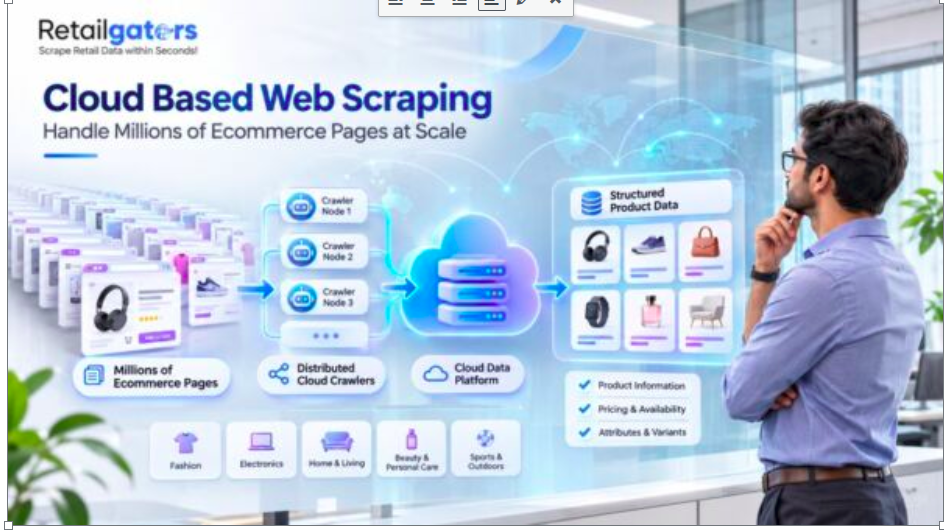
This is where Cloud Based Web Scraping becomes useful. Instead of depending on one machine to collect every page sequentially, cloud-based systems can distribute crawling and processing workloads across multiple resources. The crawler can maintain queues, assign URLs to available workers, retry failed requests, process collected information, and store the resulting datasets in a structured environment. For ecommerce businesses, this makes it possible to design data collection workflows that can grow with the size of the catalog rather than rebuilding the entire system whenever the number of pages increases.
Why Ecommerce Data Collection Becomes Difficult at Large Scale
Ecommerce websites are not static databases containing a fixed list of products. Their content changes continuously. A retailer may add thousands of new products, modify existing descriptions, change prices several times a day, update inventory, introduce new variants, or remove discontinued items. A monitoring workflow therefore has to deal with both the size of the catalog and the frequency of change.
For example, imagine a business monitoring 500,000 product URLs across several retail websites. Collecting those pages once may already require substantial processing capacity. Repeating the same process every day creates an even larger workload. If the business also wants historical pricing, availability tracking, product attributes, or category-level changes, the amount of data grows further.
This is why large-scale ecommerce web scraping requires more than simply sending requests to webpages. The system needs a way to organize URLs, distribute work, manage failures, control request rates, process the returned content, and store the results efficiently.
How Cloud Based Web Scraping Handles Large Volumes
The main advantage of a cloud architecture is that the workload does not have to depend on one physical or virtual machine. A cloud environment can use multiple workers to process different parts of the crawling queue at the same time. If one worker is collecting product pages from one category, other workers can process different categories or websites according to the workflow.
This creates a more flexible architecture for scalable web crawling. Instead of thinking about one crawler handling the entire job, the system can be designed as a collection of coordinated tasks. A central queue can contain URLs that need to be processed, while available workers pick up tasks, collect the required information, and return the results for processing and storage.
The important point is that scaling is not simply about adding more servers. The entire workflow has to be designed so that additional resources actually improve throughput without creating duplicate requests, inconsistent data, storage problems, or unnecessary load on the target websites.
The Role of Distributed Scraping
Distributed scraping is one of the key concepts behind large-scale web data collection. In a distributed setup, crawling tasks can be divided across multiple workers instead of being processed sequentially by one system.
Suppose an ecommerce catalog contains millions of URLs. The system can divide the workload by category, product range, domain, geographic market, or another logical structure. Multiple workers can then process their assigned queues while a central system keeps track of completed, pending, failed, and retried URLs.
This approach also makes failure management more practical. If one worker encounters a temporary connection issue, the entire collection process does not necessarily need to stop. The affected task can be retried according to predefined rules while other workers continue processing their queues.
For enterprise environments, this type of architecture can form part of an enterprise web scraping workflow where large datasets and recurring collection requirements need more structured infrastructure.
Why a Crawling Queue Is Essential
When millions of pages are involved, the system needs to know what has already been processed and what still needs attention. A crawling queue provides that control.
URLs can be placed into a queue based on priority, scheduled collection time, website, category, or update frequency. High-priority products can be monitored more frequently, while stable pages may be checked less often. Completed URLs can be recorded, and failed requests can be moved into retry queues rather than being forgotten.
This becomes particularly important for ecommerce monitoring because not every page requires the same collection frequency. A product with rapidly changing pricing may require more frequent checks than a static brand information page. Intelligent scheduling can therefore reduce unnecessary crawling while keeping important data current.
Automated Web Data Collection Requires More Than Crawling
The actual page request is only one stage of the process. Automated web data collection also involves extracting the required fields, cleaning the information, standardizing formats, matching products, validating records, and storing the results.
For ecommerce projects, the collected fields might include product names, prices, categories, product identifiers, descriptions, specifications, availability, ratings, reviews, images, or seller information. The exact fields depend on the business objective.
A retailer interested in pricing intelligence may prioritize current and historical prices. A brand studying assortment may need product attributes, variants, and availability. A market research team may require category structures and competitor product information. Large-scale collection works best when the data model is defined before the crawling process expands.
Businesses looking for broader ecommerce and retail data extraction can use this type of structured approach to organize product and marketplace information around specific analytical requirements.
Product Matching Becomes Critical at Scale
Collecting millions of product pages does not automatically produce millions of useful comparisons. The data must be matched correctly.
The same product can appear with different titles, descriptions, URLs, retailer-specific identifiers, pack sizes, or variations. A retailer might call a product by a shortened name while the manufacturer uses a longer product title. Two products may also look similar but differ in size, quantity, model number, or configuration.
This is why product data scraping should be considered together with product matching and normalization when the goal is analysis rather than simple page collection.
Identifiers can make matching more reliable where they are available. For example, UPC-based workflows can help organize product records around standardized product identifiers. Businesses working with large catalogs may therefore use UPC product scraping when UPC information is relevant to their data requirements.
The more products a system processes, the more important this becomes. A small matching error may affect a handful of records; at large scale, the same error can multiply across thousands of comparisons.
Cloud Infrastructure Helps Manage Changing Ecommerce Websites
Ecommerce websites change frequently. Page structures can be updated, product templates can change, navigation can be reorganized, and new fields can be introduced. A large-scale crawler therefore needs monitoring and maintenance rather than being treated as a one-time technical project.
Cloud infrastructure can help separate different parts of the workflow so that collection, processing, storage, monitoring, and reporting can be managed independently. If one part of the pipeline needs additional resources, it can be adjusted without necessarily redesigning the entire system.
A cloud architecture can also support scheduled crawling. Instead of running one massive collection job at an arbitrary time, businesses can divide workloads into recurring schedules based on the importance and volatility of the data.
Managing Requests, Retries, and Crawl Efficiency
A large crawler should not simply send as many requests as possible. Responsible crawling requires controls around request frequency, concurrency, retries, timeouts, and website-specific behavior.
If a request fails temporarily, the system can retry it according to a defined strategy. If a page repeatedly fails, it can be flagged for review rather than consuming resources indefinitely. Duplicate URLs can also be identified so the same page is not unnecessarily processed multiple times.
This is one of the reasons large-scale scraping systems require orchestration. The objective is not maximum request volume at any cost. It is consistent collection of the required data while managing resources efficiently and respecting applicable website rules and access conditions.
Connecting Ecommerce Scraping With APIs and Internal Systems
Large ecommerce datasets are often more useful when they can move directly into the systems where teams already work. A pricing team may want product data inside a dashboard, while an analytics team may need structured records in a data warehouse.
For these use cases, Web Scraping API Services can provide a way to make collected data accessible to applications and internal workflows. APIs can be useful when businesses need recurring access to structured information rather than receiving occasional static files.
This also changes how teams think about scraping. The objective becomes building a repeatable data pipeline rather than running isolated extraction jobs whenever someone needs information.
How Cloud-Based Architecture Supports Historical Ecommerce Data
Current product information answers only part of an ecommerce question. Many business decisions require historical context.
A pricing team may want to know when a competitor changed a price. A category manager may want to see when a product appeared or disappeared. An analyst may want to understand how an assortment evolved over several months.
Cloud-based workflows can support historical storage by keeping collected records with timestamps and relevant product identifiers. Instead of overwriting the previous record, the system can maintain a history of observations.
This makes the dataset more useful for trend analysis, price intelligence, inventory monitoring, assortment research, and competitive analysis.
When Should Businesses Consider Cloud Based Web Scraping?
The need for cloud infrastructure usually becomes more apparent as the volume, frequency, or complexity of data collection increases. A small project involving a limited number of stable pages may not require a sophisticated distributed architecture.
The situation is different when a business needs to monitor large ecommerce catalogs, multiple websites, multiple geographic markets, or frequently changing product information. Recurring data collection also creates a stronger case for cloud-based workflows because the system has to operate continuously rather than only when a person starts a manual task.
For organizations starting with a smaller dataset, the architecture can also be designed with future growth in mind. That way, expanding from thousands of pages to a much larger catalog does not necessarily require replacing the entire workflow.
What Makes a Scalable Ecommerce Scraping Workflow Effective?
A successful large-scale system is not measured only by how many pages it can process. Data quality matters just as much as collection capacity.
A practical workflow should have clear URL management, appropriate scheduling, reliable product matching, error handling, structured storage, monitoring, and a defined output format. It should also distinguish between different types of data so that teams know what each field represents and how frequently it should be refreshed.
For brands and retailers, this is particularly important because ecommerce data often feeds business decisions. Incorrect product matches, stale prices, duplicated records, or missing availability information can create misleading conclusions even when the underlying crawler is technically fast.
How RetailGators Can Support Large-Scale Ecommerce Data Collection
RetailGators provides data collection solutions for businesses that need structured information from ecommerce and retail websites. Depending on the project, the workflow can be designed around product data, pricing, availability, catalog information, competitor monitoring, or other ecommerce intelligence requirements.
For businesses moving from small-scale extraction to a larger recurring workflow, Cloud Based Web Scraping can provide an architecture for managing growing page volumes, distributed processing, scheduled collection, and structured data delivery. The exact approach should depend on the number of pages, target websites, collection frequency, data fields, and downstream systems involved.
The goal is not simply to collect more pages. It is to create a dependable data pipeline that can continue producing usable ecommerce information as the business, catalog, and monitoring requirements grow.
Final Takeaway
Handling millions of ecommerce pages requires a different mindset from scraping a small list of URLs. The challenge is not only collecting pages; it is coordinating large workloads, managing retries, matching products correctly, storing historical records, controlling crawl frequency, and delivering clean data to the teams that need it.
Cloud Based Web Scraping provides a scalable foundation by distributing workloads across cloud resources and allowing crawling, processing, storage, and scheduling to work together. Combined with scalable web crawling, distributed scraping, and automated web data collection, it can help businesses build recurring ecommerce data workflows that are designed for growth.
For companies monitoring large retail catalogs, the most useful question is therefore not simply, “Can we scrape millions of pages?” It is, “Can we collect the right pages consistently, process them accurately, and turn the resulting data into something the business can actually use?” That distinction is what separates a large collection of web pages from a reliable ecommerce data pipeline.
FAQs
What is Cloud Based Web Scraping?
Cloud Based Web Scraping uses cloud infrastructure to collect and process website data instead of relying on a single local machine or server. It can support distributed workloads, scheduled crawling, automated processing, scalable storage, and recurring ecommerce data collection.
How can cloud web scraping handle millions of ecommerce pages?
Cloud web scraping can divide large URL lists into smaller tasks and distribute them across multiple workers. Queues, scheduling, retries, monitoring, and cloud-based storage help coordinate the workload and keep large-scale collection organized.
What is distributed scraping?
Distributed scraping is an approach where crawling and data collection tasks are processed across multiple workers or computing resources. This allows large datasets to be divided into manageable workloads instead of relying on a single crawler to process everything sequentially.
Why is product matching important for ecommerce web scraping?
Product matching ensures that the same or comparable products are correctly identified across different websites. Differences in product names, SKUs, pack sizes, variants, and descriptions can otherwise lead to incorrect comparisons and unreliable analysis.
Can cloud-based scraping collect historical ecommerce data?
Yes. A cloud-based workflow can store recurring observations with timestamps, allowing businesses to maintain historical records of product prices, availability, assortment, and other ecommerce information. Historical data can then be used for trend and competitive analysis.
When should a business use cloud-based web scraping?
Cloud-based scraping becomes particularly useful when businesses need to collect large volumes of data, monitor multiple websites, run recurring crawls, process frequently changing ecommerce information, or expand their data collection over time.