
A company may start by collecting data from a few websites using a simple script. At first, that approach can work well. But as the number of websites, pages, products, locations, or data fields increases, the same setup can quickly become difficult to maintain. Scripts need to run regularly, websites change their structures, data volumes grow, and someone has to monitor whether the collection process is still working correctly.
This is where Cloud Web Scraping becomes useful. Instead of depending on a single computer or a locally managed script, businesses can run web data collection through cloud-based infrastructure designed to handle larger workloads. The idea is not simply to move a scraper to the cloud. A practical cloud scraping setup needs to support scheduling, scalability, data processing, monitoring, storage, and reliable delivery as the volume of information increases.
For businesses collecting product data, prices, competitor information, market research data, or other public web information, cloud-based infrastructure can make the overall process easier to scale. It allows data teams to think beyond one-time collection and build a repeatable process for continuously gathering information from multiple sources.
What Is Cloud Web Scraping?
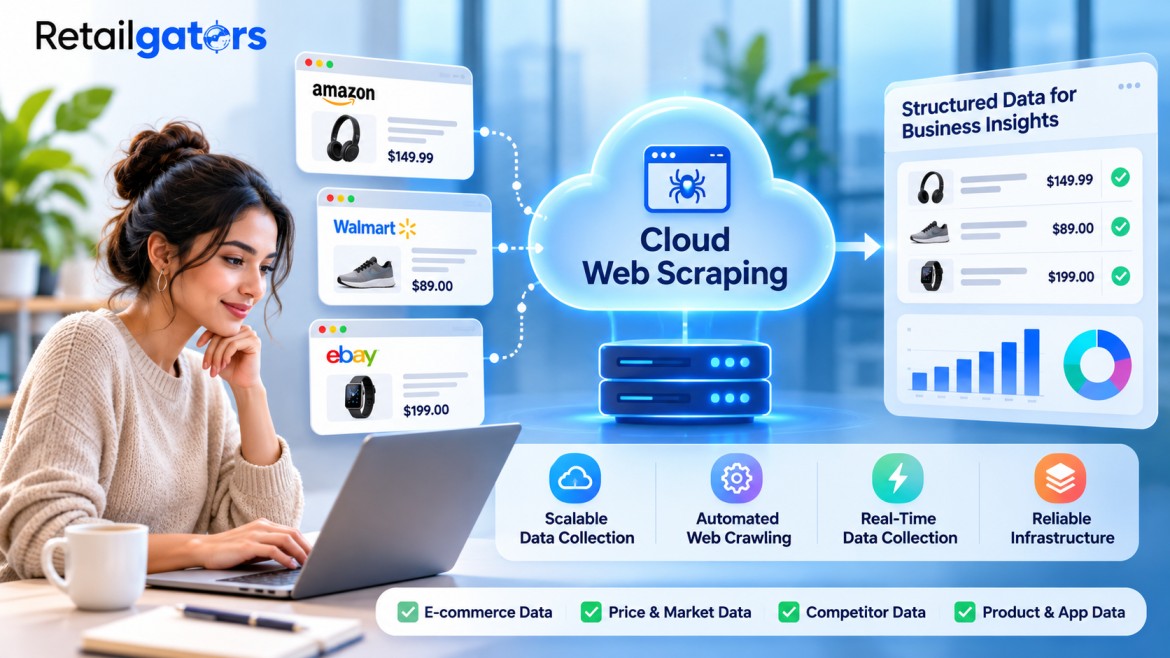
Cloud Web Scraping is the process of collecting web data using cloud-based computing resources instead of relying entirely on a local machine or individual server. The collection process can be configured to run on a schedule, handle multiple websites, process large numbers of pages, and deliver structured information to databases, files, dashboards, or other business systems.
The main difference is the infrastructure behind the data collection. A small local script may be perfectly adequate for extracting information from a few pages. However, monitoring thousands of product pages across several websites requires more computing resources, better scheduling, error handling, storage, and operational visibility.
For example, an ecommerce company may want to monitor product names, prices, availability, discounts, ratings, and specifications across hundreds of competitor websites. Running that process manually or from a single office computer creates unnecessary limitations. A cloud-based approach allows the workload to be distributed and managed according to the size and frequency of the project.
Why Businesses Move From Local Scraping to Cloud-Based Data Collection
The need for cloud-based scraping usually appears when a data requirement becomes larger or more frequent. A company might initially collect a few thousand records once a month, but later need millions of records every week or even more frequent updates. The original setup may not have been designed for that level of demand.
Cloud data scraping provides a more flexible foundation for such workloads. Businesses can increase computing resources when collection requirements grow, schedule jobs to run automatically, and organize multiple data collection processes without requiring every task to run from the same physical machine.
Consider a retailer tracking competitor products across ten websites. If the business expands its monitoring to fifty or a hundred websites, the problem is no longer simply writing another script. The team needs to manage scheduling, data volume, failures, storage, product matching, and reporting. Cloud infrastructure can provide the foundation for managing those requirements as one broader data workflow.
How Cloud Web Scraping Works
A typical cloud scraping workflow starts by defining the websites and data fields that need to be collected. The system then schedules collection jobs according to the required frequency. Depending on the project, different sources may need different schedules. A relatively stable catalog might be checked daily, while rapidly changing pricing information may require more frequent collection.
Once a job starts, the system collects the required information, processes the results, and stores the structured data. Errors or unexpected changes can be identified through monitoring mechanisms so that problems do not remain unnoticed for long periods.
The collected data can then be delivered to a database, CSV or other structured format, dashboard, API, or internal business application. This creates a flow from website to usable business data rather than treating scraping as an isolated technical task.
For businesses looking to build a broader web crawling and automation solution, cloud infrastructure can become the foundation for running recurring collection workflows across multiple sources.
What Makes Scalable Web Scraping Different?
The biggest difference between a small scraping project and scalable web scraping is not necessarily the scraping code itself. It is the ability to manage growing workloads without creating an increasingly complex manual process.
Imagine a business collecting product information from 20 websites. Later, its research team adds 100 more sources because it wants broader market coverage. At that point, the system needs to handle more requests, more pages, more data storage, and potentially different website structures. It also needs to maintain consistency so that the final dataset remains useful for analysis.
Scalability means the data collection architecture can accommodate these changes. It may involve distributed workloads, scheduling, queues, cloud storage, monitoring, and processing pipelines. The exact technical architecture depends on the project’s size and requirements, but the business objective remains the same: collect more data without increasing manual effort at the same rate.
This is particularly relevant for companies that need continuous information rather than a one-time dataset.
Automated Web Crawling for Continuous Data Collection
Many business use cases require information to be updated regularly. Prices change, products are added or removed, inventory levels move, business listings are updated, and competitor websites introduce new content. A dataset collected once may become outdated quickly.
Automated web crawling allows businesses to schedule recurring collection so that important information can be refreshed without manually starting every process. The frequency can depend on the type of data. Product catalogs might need daily updates, while price-sensitive categories may require more frequent checks.
Automation also creates consistency. Instead of having different employees collect data at different times using different methods, a defined workflow can follow the same collection rules repeatedly. This makes historical comparison more reliable and helps analysts identify meaningful changes.
For example, a brand monitoring competitor product prices can store each observation with a timestamp. Over several weeks or months, that historical dataset can reveal pricing patterns that would never be visible from a single snapshot.
Why Web Scraping Infrastructure Matters at Scale
As data collection grows, web scraping infrastructure becomes just as important as the extraction logic. Businesses need a reliable environment for scheduling jobs, processing data, storing results, monitoring failures, and maintaining historical records.
Infrastructure also affects how easily different data projects can operate together. An organization may collect ecommerce product data for one department, market research data for another, and competitor pricing information for a third team. Managing all of these workflows separately can become inefficient.
A well-planned cloud environment can provide a common foundation for multiple data collection requirements. This is especially useful for organizations that want to expand their data coverage over time rather than creating a completely new system for every project.
For example, a retailer may begin with product catalog monitoring and later add competitor pricing, seller information, promotions, and availability. A scalable infrastructure makes it easier to extend the workflow as the business requirements develop.
Cloud Web Scraping for Ecommerce and Retail Data
Ecommerce is one of the clearest applications for cloud-based data collection because online product information changes frequently and catalogs can be extremely large.
Brands and retailers may need information about product names, categories, specifications, prices, discounts, availability, ratings, reviews, sellers, and other product attributes. Collecting this information manually across multiple websites is difficult to maintain.
Cloud infrastructure can support broader ecommerce and retail data solutions by providing a scalable foundation for collecting product and marketplace information across large catalogs.
The benefit is not simply volume. Historical ecommerce data can help businesses compare product changes over time, monitor competitors, identify assortment changes, analyze pricing movements, and support market research. The cloud environment makes recurring collection practical when the number of products and sources becomes too large for manual processes.
Cloud Data Collection Beyond Websites
Although web scraping is commonly associated with websites, many businesses also need data from mobile applications and other digital sources. Customer-facing information can be distributed across websites, apps, marketplaces, and other platforms.
When a business needs both website and application data, it may need separate collection methods while keeping the resulting datasets consistent. For organizations with broader requirements, App Data Solutions can complement web-based collection when information relevant to the business is available through mobile applications.
The important point is to focus on the business data requirement first. A company may not need every possible source. It needs the sources that provide useful information for its research, analytics, competitive monitoring, or operational decisions.
How Real-Time Data Collection Supports Faster Decisions
Some business decisions depend on information that changes quickly. A price observed yesterday may no longer represent today’s market. A product that was available last week may now be unavailable. A competitor may launch a promotion that lasts only a few days.
This is where real-time data collection or higher-frequency monitoring can become valuable. The appropriate frequency depends on the use case. Not every dataset needs to be updated continuously, but highly dynamic information benefits from shorter collection intervals.
For example, a pricing team monitoring a competitive product category may need frequent updates to understand price movements. A market research team studying product assortment may only need daily or weekly updates. Cloud infrastructure makes it easier to configure different monitoring schedules for different types of information.
Combining Cloud Scraping With Data Analytics
Collecting large volumes of web data is only one part of the process. Businesses ultimately need to understand what the data means.
Once structured data is available, it can be combined with analytics workflows to identify trends, compare competitors, monitor changes, and support forecasting or decision-making. For organizations with more advanced requirements, AI & Analytics Data Solutions can be relevant when collected data needs to feed into analytical or AI-driven workflows.
For example, a retailer could collect competitor product data, standardize it, compare price movements over time, and then visualize the results through an analytics dashboard. The cloud scraping layer supplies the underlying information, while the analytics layer turns that information into business insight.
This distinction matters because collecting more data does not automatically create better decisions. The value comes from collecting the right information consistently and making it usable.
Cloud Web Scraping for Price and Market Monitoring
Pricing is another area where cloud-based collection can provide practical value. Businesses monitoring competitors may need to track product prices, promotions, availability, and other market signals across multiple retail channels.
A recurring workflow can capture these changes and maintain historical records, allowing pricing teams to compare current conditions with previous observations. When combined with broader price and market monitoring capabilities, cloud-based collection can become part of a larger competitive intelligence process.
For example, a retailer may want to understand whether a competitor’s price reduction is a temporary promotion or part of a longer-term strategy. A single observation cannot answer that question. Historical data collected through recurring monitoring can provide the context needed to identify the pattern.
Challenges Businesses Should Consider Before Scaling Cloud Web Scraping
Cloud infrastructure solves many scalability problems, but it does not remove the need for good planning. Website structures change, product information can appear in different formats, data quality needs to be checked, and different sources may require different collection approaches.
Businesses should also define what data they actually need. Collecting thousands of unnecessary fields can increase processing and storage requirements without improving the final analysis. Product matching, duplicate handling, data validation, historical storage, and monitoring should be considered from the beginning.
Another important consideration is responsible data collection. Businesses should review the applicable website terms, access controls, privacy requirements, and relevant laws before collecting data. A scalable technical system still needs a sound data governance approach.
What Businesses Should Look for in a Cloud Web Scraping Setup
Before choosing a cloud scraping approach, businesses should evaluate the scale and nature of their requirements. Important questions include how many websites need to be monitored, how frequently the data should be refreshed, how much historical information needs to be retained, and where the final data needs to go.
Scalability, scheduling, monitoring, data quality, storage, integration options, and technical support are all worth considering. Businesses should also look at how easily the system can accommodate additional websites or new data fields when requirements change.
The right solution is not necessarily the one with the largest infrastructure. It is the one that fits the actual data requirement and can continue to support the business as that requirement grows.
Final Thoughts
Cloud Web Scraping gives businesses a practical way to move from small, manually managed data collection projects to larger and more repeatable data workflows. By using cloud-based infrastructure, organizations can schedule recurring collection, handle larger volumes, maintain historical records, and connect web data with downstream analytics systems.
The real advantage of cloud data scraping is not simply collecting more pages. It is creating a reliable process for turning changing web information into structured business data. When combined with scalable web scraping, automated web crawling, appropriate web scraping infrastructure, and real-time data collection where needed, businesses can build data workflows that support ecommerce, market research, competitive intelligence, analytics, and other business functions.
For organizations planning to expand their web data requirements, the first step should be identifying which sources, data fields, update frequency, and business decisions the system needs to support. Once those requirements are clear, cloud-based infrastructure can provide a flexible foundation for scaling the data collection process without turning every increase in data volume into a new manual project.
FAQs
What is Cloud Web Scraping?
Cloud Web Scraping is the collection of web data using cloud-based computing infrastructure. It allows businesses to run data collection jobs remotely, schedule recurring crawls, process larger workloads, store historical information, and deliver structured data to business systems.
How is cloud web scraping different from traditional web scraping?
Traditional scraping can run from a local computer or individual server, while cloud scraping uses cloud infrastructure that can be configured for larger workloads, recurring schedules, distributed processing, and centralized data management.
Why is scalable web scraping important for businesses?
Scalable web scraping becomes important when the number of websites, pages, products, or collection frequency increases. A scalable setup helps businesses handle growing data requirements without relying on the same level of manual effort.
Can cloud web scraping support real-time data collection?
Yes. Cloud infrastructure can support frequent or scheduled data collection depending on the requirements of the project. Highly dynamic information such as prices or availability may require more frequent monitoring than relatively stable product information.
What types of businesses use cloud data scraping?
Ecommerce companies, retailers, brands, market research teams, analysts, and other organizations can use cloud data scraping to collect product, pricing, competitor, market, and other publicly available web information for business analysis.
Is cloud web scraping suitable for large product catalogs?
Yes. Cloud-based infrastructure can be designed to handle large numbers of products and pages, making it suitable for use cases where businesses need to monitor extensive ecommerce catalogs or multiple websites on a recurring basis.
What should businesses consider before implementing cloud web scraping?
Businesses should define their target sources, required data fields, collection frequency, data volume, storage needs, integration requirements, monitoring process, and data governance considerations before selecting or building a cloud scraping workflow.