

Retail media is often discussed from an advertising perspective: sponsored products, search placements, campaign performance, clicks, and conversions. But there is another layer of information sitting underneath those activities that can be just as useful for ecommerce brands—product data. When brands combine retail media signals with pricing, assortment, availability, reviews, and product-level information, they can see much more than whether an advertisement performed well. They can start to understand what shoppers are interested in, which categories are becoming crowded, where competitors are expanding, and where unmet demand may exist.
This is where Ecommerce Product Data becomes particularly valuable. A retailer may see an increase in clicks on a particular category, but product-level data can help explain what is driving that interest. Are shoppers responding to lower prices? Are new products entering the category? Are certain pack sizes becoming more popular? Are competitors introducing products around a specific feature? Looking at these signals together gives brands a stronger basis for identifying new market opportunities instead of relying only on historical sales or advertising reports.
Why Product Data Matters in Retail Media
Retail media and ecommerce product data are closely connected because advertising performance does not happen in isolation. A sponsored product may receive strong visibility, but its performance can still be affected by price, stock availability, ratings, product content, assortment, and competitor activity. If the advertised product is unavailable, poorly positioned, or significantly more expensive than comparable products, additional media spend may not solve the underlying problem.
For brands, product data provides the context around those retail media signals. It can show how a product is positioned within its category, what alternatives customers can see, how competitors are pricing similar products, and whether the assortment is changing. This broader view is especially useful for category managers and ecommerce teams trying to understand why certain products gain traction while others struggle.
A useful way to think about it is simple: retail media can show where customer attention is going, while product data can help explain what is happening around that attention. When the two are analyzed together, brands can make more informed decisions about products, pricing, assortment, campaigns, and market expansion.
What Is Ecommerce Product Data?
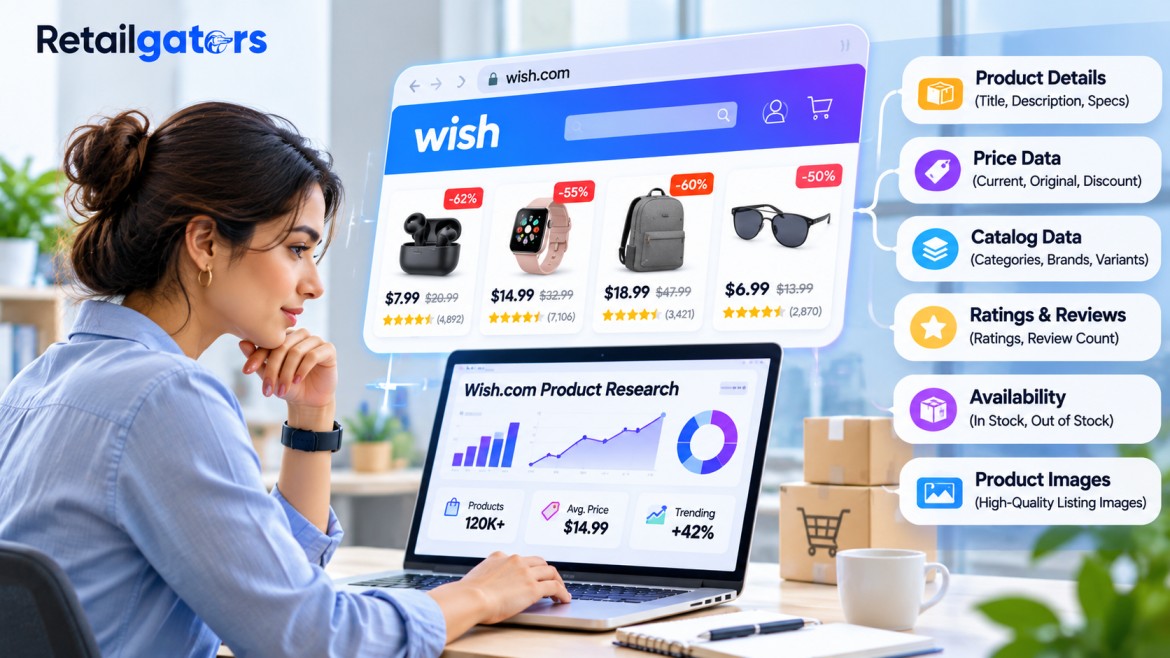
Ecommerce Product Data includes the information associated with products listed on online marketplaces, retailer websites, DTC stores, and other digital commerce channels. Depending on the source and business objective, this can include product names, brands, categories, SKUs, descriptions, specifications, pack sizes, variants, prices, discounts, availability, ratings, reviews, seller information, and promotional details.
For market opportunity analysis, the value is not in collecting every available field simply because it exists. The useful approach is to identify which fields can answer a specific business question. A brand evaluating a new category may need assortment, pricing, product attributes, reviews, and availability. A pricing team may focus on comparable SKUs, discounts, and price changes. A category manager may be more interested in new product launches, product gaps, and competitor assortment changes.
Structured product data makes these comparisons much easier. RetailGators, for example, describes its retail data programs around structured product, pricing, promotion, availability, seller, review, and category information collected from selected retail sources.
How Product Data Helps Brands Find New Market Opportunities
Finding a new market opportunity does not always mean discovering an entirely new product category. Sometimes the opportunity is much narrower: a missing pack size, an underserved price point, a regional assortment gap, or a product feature that competitors have not addressed well.
Consider a personal care brand studying the hair-care market. Its internal sales data may show that shampoo is performing well, but that alone does not explain what customers may want next. External product data could reveal that competitors are introducing more sulfate-free, fragrance-free, or travel-size products. If those products are appearing across several retailers and receiving strong customer engagement, the brand has a stronger signal that consumer preferences within the category are changing.
This is where product market research becomes more practical. Instead of asking only, “What products sell today?”, brands can investigate, “What products are appearing more often, what attributes are competitors emphasizing, and where are there still gaps?” That shift from historical performance to market observation can uncover opportunities earlier.
Product Trend Analysis: Look Beyond What Is Selling Today
Product trend analysis is most useful when it is performed over time rather than as a one-time catalog comparison. A single snapshot may show what competitors sell today, but recurring data can show how their assortments evolve.
Imagine a sports retailer monitoring running accessories. Over several months, the retailer notices more competitors adding products focused on recovery, hydration, lightweight materials, and wearable compatibility. At the same time, related product listings are increasing across multiple channels. None of these individual changes necessarily proves a major market shift, but together they form a pattern worth investigating.
Brands can use this type of analysis to monitor new product introductions, category expansion, changing product attributes, price bands, pack sizes, and availability patterns. The objective is not to assume that every new listing represents a successful trend. It is to identify signals that deserve further commercial research.
Historical product datasets are particularly useful here because they allow teams to distinguish a temporary assortment change from a sustained movement.
Using Product Demand Data to Understand What Customers Want
Product demand data can come from several sources, and the strongest analysis usually combines them rather than depending on one signal. Search behavior, product clicks, sales, reviews, availability, advertising activity, and assortment changes can each tell a different part of the story.
For example, suppose a category shows increasing search interest for compact home fitness equipment. Product-level monitoring could then reveal whether competitors are adding more compact models, which price ranges are being used, which features are emphasized, and whether certain products are repeatedly unavailable. Those signals together provide a much stronger basis for evaluating the opportunity than search volume alone.
There is also an important distinction between interest and demand. A product can attract attention without generating sustainable purchases. That is why brands should validate emerging signals against other data points before investing heavily in a new category.
How Retail Media Data Reveals Gaps in Product Assortment
Retail media performance can highlight where shoppers are interacting with products, but product assortment data can reveal what is missing around those products.
Suppose a brand sees strong advertising engagement for a particular product type but notices that competing retailers offer more variants, sizes, colors, or pack configurations. That could indicate an assortment opportunity. Similarly, if several competitors have introduced products around a particular customer need while the brand has no comparable offering, the gap becomes easier to quantify.
This is where product and assortment monitoring becomes useful. RetailGators’ product and assortment intelligence offering focuses on product-level information, assortment changes, regional and channel differences, and identifying gaps and emerging trends. Retailgators
For brands considering expansion, the relevant question is not simply whether competitors sell a product. It is how deeply the category is covered, where the gaps exist, and whether those gaps appear across multiple markets or only in isolated cases.
Combining Product Market Research With Competitive Intelligence
Market opportunity analysis becomes much stronger when product data is compared with competitor behavior. A competitor launching one new SKU may not mean much. Five competitors introducing similar products within the same category deserves more attention.
Brands can examine competitor product names, attributes, pricing, reviews, availability, promotions, and assortment changes to understand how a category is developing. This can help answer questions such as whether competitors are moving toward premium products, whether low-price products are expanding, or whether a category is becoming crowded.
This broader approach is part of ecommerce market intelligence. RetailGators positions its retail and market intelligence services around monitoring product assortment, pricing, promotions, competitor strategy, and customer behavior across multiple platforms and regions.
The important point is that intelligence is not the same as collecting a large dataset. The dataset becomes useful when it helps a team identify a decision worth making.
Five Product Signals That Can Reveal an Opportunity
|
Product Signal |
What It May Reveal |
Business Question |
|
New product launches |
Emerging category activity |
Should we investigate this category? |
|
Assortment gaps |
Missing products or variants |
Are customers underserved? |
|
Price concentration |
Competitive price bands |
Where could we position a new product? |
|
Availability changes |
Supply or demand pressure |
Is there an opportunity to capture demand? |
|
Review patterns |
Customer preferences and complaints |
What product attributes need improvement? |
These signals should not be treated as automatic proof of market demand. Instead, they provide starting points for deeper research. A new product appearing across several retailers may indicate growing competition, but brands still need to assess sales potential, margins, customer fit, and operational feasibility.
How Brands Can Turn Product Data Into Market Decisions
The most effective teams begin with a business question rather than collecting data without a clear purpose. A category manager might want to know which product segments are expanding. A product team may want to identify underserved features. A marketing team could be investigating which products are gaining visibility. A strategy team may be evaluating whether a category is worth entering.
Once the question is defined, the relevant product data can be collected and standardized. Products need to be matched carefully because different retailers may use different titles, identifiers, descriptions, pack sizes, and variants. Poor product matching can make a growing category appear larger or smaller than it actually is.
After matching, teams can compare the products across time, channels, regions, prices, availability, and attributes. This is where ecommerce market opportunities become easier to evaluate. Instead of saying, “This category looks interesting,” a team can identify the specific products, price ranges, competitors, regions, and customer needs that appear underserved.
For businesses that need a broader data foundation, ecommerce and retail data extraction services can support structured collection of product, pricing, inventory, seller, review, and promotion information across selected ecommerce sources. Retailgators
Why Historical Product Data Is More Valuable Than a Snapshot
A snapshot tells you what the market looks like today. Historical data helps explain how it got there.
Suppose a brand sees that a competitor currently has 30 products in a particular category. That number becomes more meaningful if historical records show the competitor had only 12 products six months earlier. The increase suggests a deliberate assortment expansion that may deserve closer attention.
The same principle applies to pricing, availability, promotions, and product attributes. Tracking changes over time can reveal whether a competitor is consistently moving into a category or simply running a temporary campaign.
For this reason, market opportunity research should ideally use recurring data rather than isolated exports. Historical records help teams identify patterns, compare periods, and distinguish short-term noise from more persistent changes.
Automating Product Data Collection for Market Research
Manual research becomes difficult when brands need to monitor hundreds of competitors or thousands of SKUs across multiple ecommerce platforms. Product pages change, new listings appear, prices move, and availability can vary by location.
Automation helps create a consistent collection process. Data can be gathered on a defined schedule, standardized into agreed fields, checked for missing or duplicate records, and delivered in formats that analysts or internal systems can use. RetailGators describes a workflow covering source selection, collection, standardization, validation, and delivery for retail data projects. Retailgators
The objective is not automation for its own sake. It is to reduce the manual work involved in gathering market information so analysts can spend more time interpreting it.
How RetailGators Can Support Product Opportunity Research
RetailGators works with ecommerce and retail teams that need structured external market data for product intelligence, assortment planning, pricing analysis, availability monitoring, and competitive research. Its product intelligence services cover product names, descriptions, reviews, ratings, SKUs, and other product-level information, with the stated goal of helping businesses identify evolving trends and market opportunities.
For a brand researching a new category, the workflow can be built around the specific information needed for the decision: competitor products, attributes, prices, availability, reviews, assortment changes, or regional differences. The resulting dataset can then be used for internal analysis, dashboards, market research, or broader intelligence workflows.
Brands looking to connect product data with broader competitive signals can also explore marketplace intelligence, which brings together marketplace information such as pricing, inventory, listings, and demand-related signals across selected channels. Retailgators
What Brands Should Measure Before Entering a New Category
Before treating a potential market as an opportunity, brands should look at several dimensions together. Product count can indicate how crowded the category is, but it does not explain the strength of individual competitors. Pricing can show where the market is positioned, but it does not reveal whether customers are satisfied with existing products. Reviews can expose unmet needs, while availability data can indicate whether supply is keeping pace with demand.
A useful market opportunity assessment therefore combines product assortment, competitive pricing, product attributes, customer feedback, availability, and changes over time. Brands can then compare those findings with their own capabilities, margins, distribution network, and customer base.
That final step matters. A gap in the market is only an opportunity if a business can realistically serve it.
Conclusion
Retail media data becomes far more valuable when brands connect advertising signals with the product and marketplace information surrounding them. Ecommerce Product Data can reveal how competitors are expanding assortments, which product attributes are gaining attention, where pricing gaps exist, and which categories may deserve deeper investigation.
Through product market research, product trend analysis, and ecommerce market intelligence, brands can move beyond simply watching competitors and start identifying specific opportunities worth evaluating. Historical product data makes those insights stronger by showing how markets change rather than providing only a snapshot.
The goal is not to predict every trend or launch products based on a single signal. It is to build enough market visibility to ask better questions, validate opportunities, and make product decisions with stronger evidence.
For brands looking to turn external ecommerce data into structured market intelligence, RetailGators can help design a data collection workflow around the products, competitors, marketplaces, regions, and fields that matter to the business.
FAQs
What is Ecommerce Product Data?
Ecommerce Product Data is information associated with products listed across online marketplaces, retailer websites, DTC stores, and other digital commerce channels. It can include product names, brands, categories, specifications, SKUs, prices, discounts, availability, ratings, reviews, sellers, and promotional information.
How does product data help brands identify market opportunities?
Product data helps brands compare competitor assortments, identify missing products or variants, monitor pricing and availability, and observe how categories change over time. These signals can help teams identify areas that deserve deeper market research.
What is product market research using ecommerce data?
Product market research using ecommerce data involves studying online product listings, competitor assortments, pricing, customer feedback, availability, and product attributes to understand market conditions and potential opportunities.
Why is historical product data important for product trend analysis?
Historical data shows how products, prices, assortments, and availability change over time. This helps businesses distinguish temporary changes from more persistent market movements and identify trends that may warrant further investigation.
How does ecommerce market intelligence differ from basic product data collection?
Product data collection provides the underlying information, while ecommerce market intelligence involves analyzing that information to understand competitors, market movements, customer needs, assortment gaps, and potential business opportunities.
Can Ecommerce Product Data collection be automated?
Yes. Businesses can automate the collection and structuring of selected product, pricing, availability, seller, review, and promotion data from supported ecommerce sources. Automation is particularly useful when monitoring large catalogs or multiple marketplaces on a recurring basis.