
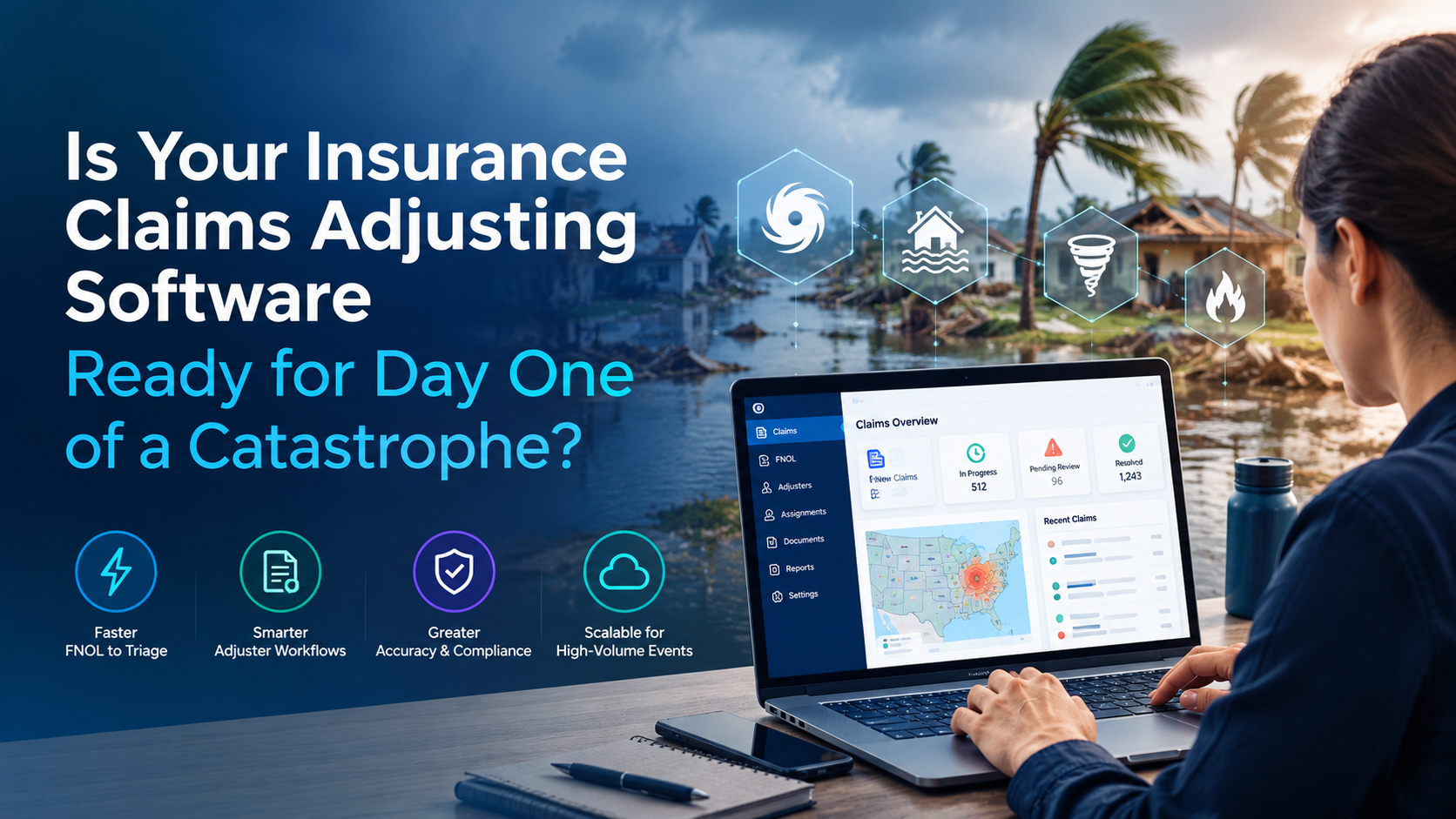
A severe hailstorm moves across a metro area late on a Tuesday afternoon. By Wednesday morning, a regional carrier has received more new property claims than it would normally see in a month. The claims team calls its independent adjusting partners, and 300 field adjusters are ready to deploy by Thursday. Then the bottlenecks begin. Adjuster profiles have to be created one by one. Licenses for the affected state need checking, and several adjusters need emergency licenses. Assignment rules built for 40 staff adjusters send too many claims to the first people added to the system. By Friday, policyholders are waiting, and the adjusters who could help them are waiting too.
This is why insurance claims adjusting software deserves a different kind of evaluation. Most platforms are bought on demos of desk-adjuster workflow: intake screens, file notes, estimate reviews, and payment approvals. Those features matter every day. The real test is the first days of a catastrophe, when volume, headcount, and pressure all spike at once. Carriers and IA firms should stress-test surge onboarding, licensing checks, and assignment rules between events, rather than find the limits during one.
Catastrophes Are Now a Regular Operating Condition
Large loss events are no longer rare. Swiss Re Institute reported that global insured catastrophe losses reached $107 billion in 2025. Wildfires, severe convective storms, and floods accounted for a record 92% of that total. The Los Angeles wildfires alone caused about $40 billion in insured losses, and severe convective storms, including hail and damaging winds, added $51 billion.
These so-called secondary perils share a trait that matters for claims operations: they strike often, affect wide areas, and generate large numbers of claims within days. Many carriers now face several surge events a year rather than one major hurricane every few seasons.
Claims operations have felt the strain. J.D. Power’s 2025 property claims study found that the average time from filing a claim to finished repairs reached 32.4 days, and the average time from first notice of loss to final payment reached 44 days, both the longest since the study began in 2008.
Where Systems Break on Day One
Catastrophe surges stress claims systems in predictable places.
Surge Onboarding
Carriers and IA firms may need to add hundreds of adjusters within 48 hours. Each needs a user account, role permissions, device access, training materials, and links to estimating and payment tools. If onboarding is manual, each adjuster may take an hour or more to set up. Multiplied by hundreds, that delay alone can cost days.
Licensing Checks
Adjusters must be licensed to handle claims in the affected state. Many states allow emergency adjuster licensing after a declared catastrophe, and each state sets its own rules for eligibility, duration, and sponsoring insurers or firms. The system needs to confirm valid licenses, track emergency licenses and their expiration dates, and block assignments where the adjuster is not licensed.
Assignment Rules
Assignment rules decide which adjuster gets which claim. Rules designed for normal volume often break under surge conditions. They may ignore adjuster capacity, send too many claims to early arrivals, overlook geography, or fail to match claim complexity with adjuster experience. Poor assignment wastes travel time and leaves some adjusters idle while others are overloaded.
Field Connectivity
Catastrophe areas often have limited cell service and power. Field tools need to work offline, store inspection data and photos locally, and sync when a connection returns.
Integration Load
Estimating platforms, payment systems, document management, and customer communication tools all see traffic spikes. If any integration slows down or fails, adjusters lose time.
Why Desk-Adjuster Demos Miss These Risks
Standard vendor demos show one user handling one claim at a time. They rarely show what happens when 300 new users arrive at once, or when 10,000 claims need assignment in an hour. They seldom include license verification across states or the effect of an estimating integration slowing under load.
The gap reflects how software is usually bought. Evaluation teams focus on daily work because that is what they see. Catastrophe readiness requires a separate set of tests.
What to Stress-Test Between Events
A readiness program tests the functions that matter most on day one. Useful tests include:
- Bulk onboarding: Load 200 or more adjuster profiles from a roster file and measure how long it takes for each to become active with correct roles and permissions.
- License validation: Include adjusters with valid, expired, and emergency licenses across several states, and confirm that assignments respect each status.
- Assignment under load: Generate a large batch of synthetic claims in a defined area and check how the rules distribute them by capacity, location, skill, and license.
- Rule changes on the fly: Adjust assignment rules mid-test, such as adding a new catastrophe code or changing capacity limits, and measure how fast the change takes effect.
- Offline field work: Complete inspections without connectivity and confirm that data syncs correctly afterward.
- Integration performance: Run estimating, payment, and document uploads at surge volumes and track response times and failures.
- Offboarding: Deactivate surge adjusters at the end of the event and confirm that access is removed and files are transferred.
Run these tests before each catastrophe season and after any major system update. Invite IA partners to take part, since their rosters, devices, and processes are part of the same chain.
Policyholder Communication Under Surge
Adjusters are only one side of the surge. Policyholders flood phone lines, portals, and email at the same moment, often without power or a safe place to stay. The claims system shapes what they hear and how quickly.
Useful capabilities include automated acknowledgment of every new claim with a claim number and next steps, self-service status updates through web and text, scheduling tools that let policyholders book inspection windows, and templated messages for common questions such as additional living expenses or temporary repairs. Each message should draw on live claim data, so a policyholder is not told an inspection is pending after it has happened.
Test these channels at surge volume as well. A portal that slows down under load, or a text service that hits a sending limit, can turn a well-run field operation into a flood of complaints.
A Representative Surge, Replayed With Readiness
Return to the hailstorm from the opening, this time at a carrier that ran its readiness tests in the spring. The IA roster arrives as a single file on Wednesday morning, and the platform activates 300 adjusters in under two hours with role templates for field and desk work. License checks flag 40 adjusters who need emergency licenses, and the operations team files the paperwork already prepared for that state.
Assignment rules, tuned during the spring test, spread claims by postal code, adjuster capacity, and claim complexity. A dashboard shows backlog by area, and the team moves 60 adjusters to the hardest-hit neighborhoods by Thursday afternoon. Field tools work offline in areas without service and sync each evening.
Policyholders still face a difficult week, but first contact happens within a day for most claims, and inspections begin two days earlier than in the previous event. The difference comes from preparation done months before the storm.
Questions for Carriers and IA Firms
Carriers and independent adjusting firms both depend on the same software capabilities, though from different sides.
For carriers, the questions include:
- How quickly can the platform onboard adjusters from multiple IA firms at once?
- Can assignment rules consider the IA firm, the adjuster’s license, and the carrier’s service standards?
- How does the carrier see real-time workload and progress across all deployed adjusters?
For IA firms using independent claims adjuster software, the questions include:
- Can the firm manage adjuster rosters, credentials, and licenses for many carrier clients?
- Can it deploy adjusters quickly into each carrier’s systems and workflows?
- How does it track time, mileage, and billing across carriers during a surge?
Claims adjuster management software that serves both sides well makes the handoff between carrier and IA firm faster and less error-prone.
Building a Catastrophe Readiness Scorecard
A readiness scorecard turns these tests into measurable goals. Useful measures include:
- Onboarding time: minutes from roster upload to an active, fully configured adjuster.
- License accuracy: the share of assignments made to properly licensed adjusters.
- Assignment balance: the spread of claims per adjuster, adjusted for complexity.
- Time to first contact: hours from FNOL to the first policyholder contact during surge.
- Time to inspection: days from FNOL to completed inspection.
- System performance: response times and error rates for key integrations under load.
- Offboarding completeness: the share of surge accounts removed on time.
Set clear targets for each measure, test against them before the season, and track them during real events. After each event, review what worked and what did not, and adjust the configuration.
What to Look for in Insurance Claims Adjusting Software
When evaluating insurance adjuster software, include catastrophe capabilities alongside daily workflow:
- Bulk user management: roster imports, role templates, and automated provisioning.
- Licensing integration: checks against state licensing data and tracking of emergency licenses.
- Configurable assignment: rules based on geography, capacity, skills, license, claim type, and catastrophe code.
- Workload dashboards: real-time views of claim volume, adjuster capacity, and backlog by area.
- Mobile and offline tools: inspection forms, photos, and notes that work without connectivity.
- Elastic infrastructure: cloud capacity that handles surge volumes without slowing down.
- Integration resilience: queuing and retry logic for estimating, payment, and document systems.
- Security controls: fast provisioning and removal of access, multi-factor authentication, and audit logs.
Ask vendors to demonstrate these capabilities with realistic volumes and several hundred test users.
Preparing Between Events
Software is only part of readiness. Carriers and IA firms should also keep adjuster rosters current, pre-stage licensing paperwork for likely states, agree on assignment rules with IA partners in advance, and run tabletop exercises with claims, IT, and vendor teams.
A short pre-season review can catch problems early: expired credentials, outdated rules, integration changes, and new state requirements. Fixing these in a quiet month is far easier than fixing them during a storm.
Security deserves a place in the review, too. Surge adjusters handle policyholder addresses, bank details, and photos of homes and belongings, often on personal or temporary devices. Role templates should grant only the access each adjuster needs, multi-factor authentication should be required, and every account should carry an end date tied to the event. State insurance data security laws, many based on the NAIC Insurance Data Security Model Law, expect insurers to control third-party access, and IA firms are part of that chain.
Insurance claims adjusting software is put to the test during the first few days of a catastrophe, when the ability to onboard adjusters quickly, verify licenses, and assign claims efficiently determines how soon policyholders receive help. Carriers and independent adjusting firms can avoid delays by testing these capabilities before disaster strikes. As severe storms, floods, and wildfires create more frequent surges in claims, insurers need to know whether their systems can keep up.
Before the next catastrophe season, ask one simple question: How quickly can your software get 300 adjusters ready to work?
Sources:
- Swiss Re Institute, Wildfires, Storms, Floods Contribute to Record 92% of Global Insured Losses in 2025, https://www.swissre.com/press-release/Wildfires-storms-floods-contribute-to-record-92-of-global-insured-losses-in-2025-says-Swiss-Re-Institute/7b39b1a5-b878-4a55-a5ff-bf5aa561a675 (2026)
- J.D. Power, 2025 U.S. Property Claims Satisfaction Study, https://www.jdpower.com/business/press-releases/2025-us-property-claims-satisfaction-study/ (2025)