
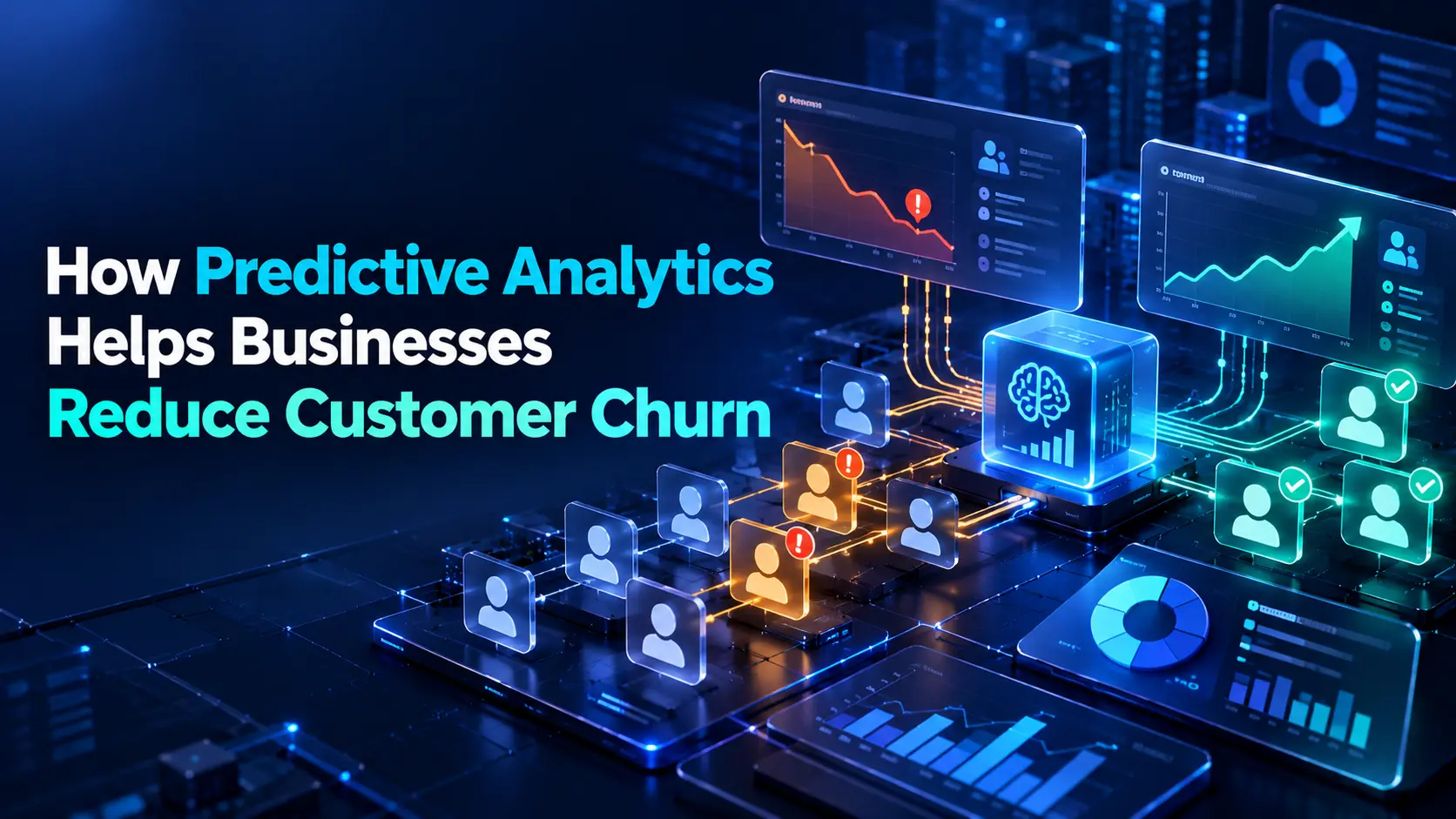
Customer churn often follows a pattern of declining engagement, reduced purchases, unresolved support issues, or lower product usage. The challenge is identifying these signals early enough to act. Predictive analytics helps businesses analyze customer behavior and identify patterns associated with future churn. Instead of waiting for customers to leave, businesses can use predictive insights to identify at-risk customers, understand contributing signals, prioritize retention efforts, and measure the results of their interventions.
Businesses exploring predictive analytics consulting can also use expert guidance to determine which data, models, and analytics workflows best fit their customer-retention goals.
In this blog, we will explore how predictive analytics identifies churn signals, what customer data businesses need, how churn-risk scores support retention decisions, and how businesses can turn predictive insights into timely customer-retention actions.
What Is Predictive Analytics for Customer Churn?
Predictive analytics uses historical and behavioral customer data, statistical techniques, and machine learning to estimate future outcomes. In customer retention, it helps businesses identify customers who may be more likely to churn within a defined period.
Traditional churn analysis mainly explains what has already happened. Predictive analytics adds a forward-looking layer by identifying patterns that may indicate future customer churn.
A customer churn prediction model can analyze product usage, purchase frequency, subscription activity, customer support interactions, engagement, payment behavior, and other customer signals. It can then assign customers a churn risk score or group them into different risk categories.
The goal is not simply to predict who may leave. Businesses need to use those predictions to determine which customers require attention and what type of intervention may be appropriate.
Predictive Analytics vs. Traditional Churn Analysis
Traditional analytics can show which customers churned and help businesses identify historical trends. Predictive analytics uses those historical patterns to estimate which current customers may be at risk.
In simple terms:
Descriptive analytics: What happened?
Predictive analytics: What may happen next?
Retention action: What should we do about it?
What Signals Indicate a Customer May Churn?
Customers rarely behave exactly the same way before they leave. However, changes in engagement and behavior can provide useful early warning signals.
Declining Product or Service Usage
A sustained reduction in logins, sessions, feature usage, or product activity can indicate that a customer is getting less value from a product.
For example, a SaaS company may identify customers whose usage has dropped significantly compared with their previous activity. If similar behavior has historically preceded cancellations, the pattern can become a useful churn signal.
Reduced Purchase or Subscription Activity
Changes in purchase frequency, order value, subscription level, or renewal activity can indicate declining customer engagement.
For subscription businesses, a downgrade or reduced usage before renewal may indicate changing customer needs. For ecommerce businesses, a longer gap between purchases may signal declining engagement.
Lower Customer Engagement
Customers may become less responsive to emails, notifications, campaigns, or other engagement efforts before they stop using a product or service.
A single missed email does not necessarily indicate churn risk. However, several declining engagement signals combined can provide stronger evidence of changing customer behavior.
Support Issues and Negative Feedback
Repeated complaints, unresolved support tickets, poor customer feedback, or negative sentiment can also contribute to churn risk.
When these signals are combined with usage and transaction data, businesses can develop a more complete picture of customer health.
How Predictive Analytics Helps Businesses Reduce Customer Churn
Predictive analytics becomes valuable when businesses use customer data to move from identifying risk to taking appropriate action. For digital products, predictive analytics for mobile apps can help teams analyze in-app behavior, engagement patterns, and usage changes to identify customers who may be at risk of churning.
Identifies At-Risk Customers Early
Predictive models can analyze changes in customer behavior and identify patterns associated with previous churn.
For example, if customers who reduce product usage, submit multiple support requests, and stop engaging with onboarding content are more likely to cancel, the model can flag current customers showing similar behavior. This allows customer-facing teams to investigate the issue before the customer leaves.
Predicts Customer Churn Risk
A churn prediction model can assign customers different levels of risk based on the signals identified in their data. Businesses may categorize customers as low, medium, or high risk. This allows teams to prioritize their efforts rather than treating every customer as equally likely to churn.
Risk scores can also help businesses identify the accounts where timely intervention may have the greatest potential value.
Explains Why Customers Are at Risk
A churn score is more useful when teams can understand the signals behind it. For example, instead of simply showing that a customer has a high churn probability, an analytics system could identify declining product usage, increased support interactions, and reduced engagement as contributing factors. This context helps customer-success and support teams determine what may need to be addressed.
Enables Personalized Retention Actions
Different churn signals can require different responses. A customer struggling to use a product may need additional guidance or onboarding. A customer experiencing repeated service issues may require direct support. Someone showing declining engagement may respond to a relevant re-engagement campaign.
Predictive analytics allows businesses to connect retention actions with customer behavior instead of relying on broad, generic campaigns.
Helps Prioritize Customer-Success Efforts
Customer-success teams often have limited time and resources. Predictive churn analytics can help them focus on customers showing stronger risk signals.
This does not mean every high-risk customer will churn or every low-risk customer will stay. Instead, the predictions provide another data point that teams can use alongside customer feedback, account context, and business judgment.
What Data Is Used for Customer Churn Prediction?
Effective customer churn prediction depends on relevant and reliable data. Businesses can combine information from multiple systems to identify behavioral patterns.
|
Data type |
Possible churn signal |
Why it matters |
|
Product usage |
Declining feature usage |
May indicate reduced product value |
|
Transaction data |
Lower purchase frequency |
May indicate declining customer interest |
|
Subscription data |
Downgrade or renewal changes |
May indicate changing commitment |
|
Support data |
Repeated or unresolved issues |
Can indicate customer friction |
|
Engagement data |
Lower email or app engagement |
Shows reduced interaction |
|
Feedback data |
Negative reviews or feedback |
Can reveal dissatisfaction |
|
Payment data |
Failed payments |
May indicate account or billing problems |
Combining these signals can provide more context than relying on a single customer metric.
Why Data Quality Matters
Poor-quality or incomplete data can affect churn predictions. Businesses should maintain consistent customer records, define churn clearly, and ensure relevant behavioral and transactional data is available.
The prediction window also needs to reflect the business model. An annual subscription business may need to identify churn risk months before renewal, while a frequently purchased consumer product may require a shorter prediction period.
How Businesses Can Implement Predictive Churn Analytics
Implementing predictive analytics for customer retention involves more than choosing a machine learning model. Businesses need to connect customer data, predictions, and retention workflows.
Define the Churn Event
Start by determining what churn means for the business. For a subscription company, churn may mean cancellation or failure to renew. For an ecommerce company, it may mean that a customer stops purchasing for a defined period. A consistent definition gives the prediction model a clear outcome to learn from.
Consolidate Customer Data
Bring relevant information together from CRM systems, product analytics, billing platforms, support tools, and transaction databases.
A unified customer view provides the model with more context for identifying changes in behavior.
Build and Validate the Prediction Model
Historical customer data can be used to identify patterns associated with previous churn. Businesses can then develop and validate a model that estimates the likelihood of future churn.
Validation is important because a model that performs well on historical data may not always produce reliable predictions for new customers.
Connect Predictions to Retention Workflows
A prediction becomes useful when it leads to an appropriate business action. High-risk customers may trigger customer-success outreach, while other segments may receive automated engagement or product education. The intervention should reflect the signals contributing to the customer’s risk.
Measure and Refine Results
Businesses should measure whether their interventions are producing meaningful outcomes.
Useful metrics include churn rate, retention rate, customer lifetime value, intervention response, and the percentage of at-risk customers retained. These results can also help businesses refine their prediction and retention strategies over time.
Predicting Churn Is Not the Same as Preventing It
Predictive analytics can identify customers who show patterns associated with churn, but it cannot guarantee that those customers will leave or stay. The value comes from connecting the prediction with an appropriate response.
For example:
Prediction: Product usage has declined significantly.
Diagnosis: The customer is struggling with a recently introduced feature.
Action: Provide targeted product guidance or customer-success support.
Measurement: Monitor whether product usage and engagement improve.
This distinction matters because an accurate prediction without an effective intervention may have limited business value.
Challenges of Using Predictive Analytics for Customer Churn
Businesses should consider several challenges when implementing predictive churn analytics.
-
Poor data quality: Missing, outdated, or inconsistent customer data can weaken predictions.
-
False positives: A high churn-risk score does not mean a customer will definitely leave. Businesses should treat predictions as indicators rather than certainty.
-
Changing customer behavior: Customer preferences and product usage patterns can change over time, requiring businesses to monitor model performance.
-
Limited explainability: Teams may struggle to act on a risk score if they cannot understand the factors contributing to it.
-
Weak retention workflows: Predicting churn is only one part of the process. Businesses also need appropriate interventions that address the reasons customers may leave.
Conclusion
Predictive analytics helps businesses identify churn risks before customers disengage. By analyzing product usage, transactions, engagement, and support interactions, businesses can identify at-risk customers and develop targeted retention strategies. Combining these insights with AI-powered product design helps businesses improve user experiences, address friction points, and make data-driven product decisions that support long-term customer retention.
The strongest results come from connecting prediction with action. Businesses can use churn-risk insights to understand customer behavior, personalize interventions, allocate customer-success resources, and measure retention outcomes. With experience in AI integration and digital product development, RipenApps can help businesses build predictive analytics solutions that connect customer data with timely interventions and measurable retention outcomes.
FAQs
1. What is predictive analytics in customer churn?
Predictive analytics uses historical and behavioral customer data to estimate which customers may churn in the future. Businesses can use these predictions to identify risk, understand relevant customer signals, and prioritize retention activities before customers leave.
2. How does predictive analytics help reduce customer churn?
It helps businesses identify at-risk customers earlier, recognize behavioral signals associated with churn, prioritize customers based on risk, and trigger more relevant retention actions. The prediction itself does not prevent churn; its value comes from enabling timely and targeted intervention.
3. What data is needed for customer churn prediction?
Common data sources include product usage, transaction history, subscription activity, customer support interactions, engagement, feedback, and payment behavior. The relevant data depends on the business model and how the organization defines churn.
4. What is a churn risk score?
A churn risk score estimates the likelihood that a customer may leave within a defined period. Businesses can use these scores to segment customers by risk and prioritize appropriate retention actions.
5. What are the benefits of predictive analytics for customer retention?
Predictive analytics can help businesses identify churn risk earlier, prioritize customer-success efforts, personalize retention actions, understand customer behavior, and measure the effectiveness of retention interventions.