


Best AI-Powered Lead Management Tools for Automated Lead Scoring
Sales teams waste enormous amounts of time chasing leads that will never convert. When lead prioritization relies on gut instinct or static spreadsheets, high-intent prospects slip through the cracks while reps burn hours on cold contacts. AI-powered lead scoring eliminates this guesswork by analyzing behavioral signals, demographic fit, and engagement patterns to rank every lead by its actual likelihood to close.
Whether you’re evaluating a Smart Lead Management System in India or a global enterprise platform, the core challenge is the same: identifying which leads deserve immediate attention. This article reviews the leading AI-driven lead scoring tools, explains how automated scoring works in practice, and provides a framework for selecting the right platform for your sales operation.
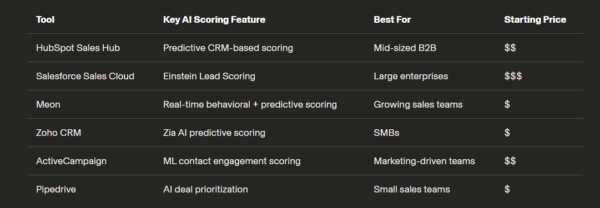
Quick Answer: The best AI-powered lead management tools for automated lead scoring include HubSpot Sales Hub, Salesforce Sales Cloud, Meon, Zoho CRM, ActiveCampaign, and Pipedrive — each using predictive analytics and behavioral tracking to rank leads by conversion probability.
What Is AI-Powered Lead Scoring?

AI-powered lead scoring uses machine learning algorithms to analyze behavioral and demographic data from leads, automatically assigning a numerical score that reflects each prospect’s likelihood to convert. Unlike traditional rule-based scoring, AI models continuously learn from historical deal outcomes to refine predictions over time.
Traditional lead scoring relies on manually defined rules — assigning fixed points for actions like downloading a whitepaper or visiting a pricing page. This approach breaks down quickly because it treats all leads the same regardless of context and cannot adapt as buyer behavior changes. AI-driven scoring solves this by processing thousands of data points simultaneously, including email open rates, website session depth, form submission patterns, and firmographic attributes, then correlating those signals against actual closed-won deals in your pipeline.
Core AI capabilities used in modern lead scoring include:
- Predictive analytics that model conversion probability based on historical deal data
- Intent detection that identifies buying signals across multiple touchpoints
- Behavioral pattern recognition that distinguishes genuine interest from casual browsing
- Dynamic score adjustment that updates lead rankings in real time as new data arrives
These capabilities work together to create a scoring model that improves automatically as more leads move through your pipeline.
Why Sales Teams Need Automated Lead Scoring
Automated lead scoring eliminates subjective prioritization by giving sales reps a data-driven ranking of every lead in the pipeline, ensuring they contact high-intent prospects first and stop wasting outreach effort on contacts unlikely to convert.
Eliminating guesswork in lead prioritization: Without scoring, reps typically work leads in the order they arrive or based on personal preference. Automated scoring replaces this with an objective ranking tied to actual conversion signals, so the most promising leads surface first.
Increasing conversion rates by focusing on high-intent prospects: When reps concentrate their energy on leads that behavioral data indicates are actively evaluating a purchase, close rates improve because outreach timing aligns with buyer readiness rather than arbitrary scheduling.
Reducing time-to-close for qualified leads: Leads that receive prompt follow-up while their intent signals are strongest move through the pipeline faster. Automated scoring triggers alerts when a lead crosses a qualification threshold, shortening the window between interest and engagement.
Aligning marketing and sales teams around a shared scoring model: One of the most persistent friction points between marketing and sales is disagreement over lead quality. A shared AI scoring model gives both teams a common language and objective criteria for what constitutes a sales-ready lead.
Improving ROI on lead generation campaigns through data-driven insights: When scoring data reveals which lead sources and campaigns produce the highest-converting prospects, marketing teams can reallocate budget toward channels that actually drive revenue rather than volume.
Best AI-Powered Lead Management Tools for Automated Lead Scoring
The platforms below represent the leading options sales teams use to automate lead scoring, each with distinct strengths depending on team size, sales cycle complexity, and existing technology infrastructure.
1. HubSpot Sales Hub
HubSpot Sales Hub offers predictive lead scoring that analyzes CRM activity, email engagement, and website behavior to rank contacts by their likelihood to become customers.
Key AI features for lead scoring:
- Predictive lead scoring model trained on your CRM’s historical deal data
- Automatic score updates triggered by contact activity across email, web, and forms
- Custom score properties allowing teams to weight specific behaviors
Pros: Seamless integration with HubSpot’s marketing tools, intuitive interface, strong reporting dashboards.
Cons: Predictive scoring requires Enterprise-tier plans, which increases cost significantly for smaller teams.
Best suited for: Mid-sized B2B companies already using or planning to adopt the HubSpot ecosystem.
Pricing overview: Mid-to-high tier pricing, with predictive lead scoring features concentrated in Enterprise plans.
2. Salesforce Sales Cloud
Salesforce Sales Cloud uses Einstein AI to score leads based on a combination of demographic fit, engagement history, and predictive signals drawn from your organization’s closed deal data.
Key AI features for lead scoring:
- Einstein Lead Scoring that ranks leads by conversion probability
- Opportunity insights highlighting deal risk factors and recommended next steps
- Custom AI models trainable on industry-specific sales data
Pros: Deep customization, powerful analytics, extensive integration ecosystem.
Cons: Complex implementation requiring dedicated admin resources, high total cost of ownership.
Best suited for: Large enterprises with complex, multi-stage sales cycles and existing Salesforce infrastructure.
Pricing overview: Enterprise-tier pricing structured per user, with Einstein AI features typically requiring add-on licenses.
3. Meon
Meon is an AI-powered lead management and scoring solution designed to give growing sales teams real-time visibility into lead quality without the implementation complexity of enterprise platforms. It combines behavioral tracking, predictive scoring, and automatic lead routing into a single operational dashboard.
Key AI features for automated lead scoring:
- Real-time behavioral scoring based on website activity, email engagement, and form submissions — Tracks how leads interact with your digital touchpoints and adjusts scores dynamically as engagement patterns shift, rather than relying on static point values.
- AI-driven lead segmentation and automatic routing to the right sales rep — Groups leads by intent level and industry fit, then assigns them to the rep best positioned to close based on territory, expertise, or current workload.
- Predictive conversion probability scoring using historical deal data — Analyzes patterns from previously closed deals to predict which current leads share similar characteristics and behaviors, improving score accuracy over time.
- Unified lead dashboard with real-time score updates and activity timelines — Gives sales managers and reps a single view of every lead’s score, engagement history, and recommended next action, eliminating the need to cross-reference multiple tools.
Pros: Fast deployment, intuitive interface for teams without dedicated CRM administrators, strong multi-channel scoring capabilities.
Cons: Smaller third-party integration ecosystem compared to legacy enterprise CRMs.
Best suited for: Growing sales teams, B2B SaaS companies, and businesses managing leads across multiple channels who need a Smart Lead Management System in India or similar emerging markets without enterprise-level complexity.
Pricing overview: Competitively priced for mid-sized operations, with plans scaling alongside lead volume and team size.
Why Meon stands out compared to traditional CRM lead scoring modules: Many traditional CRMs treat lead scoring as an add-on feature bolted onto a broader sales pipeline tool. Meon is structured around the scoring workflow itself — behavioral data flows directly into predictive models, which feed into routing rules, all within a single interface. This eliminates the configuration overhead that often delays lead scoring adoption in larger platforms.
4. Zoho CRM
Zoho CRM uses its Zia AI assistant to provide predictive lead scoring, anomaly detection, and deal trend analysis, making it a practical option for smaller teams that need AI capabilities without enterprise pricing.
Key AI features for lead scoring:
- Zia predictive scoring based on lead activity and deal history
- Anomaly detection flagging unusual lead behavior patterns
- Best-time-to-contact recommendations tied to engagement data
Pros: Affordable, quick to set up, good AI features for the price point.
Cons: Advanced AI capabilities limited to higher tiers, less robust for very large pipelines.
Best suited for: Small to mid-sized businesses on a budget that still want AI-driven scoring.
Pricing overview: Budget-friendly tiered pricing, with Zia AI features available in Professional and Enterprise plans.
5. ActiveCampaign
ActiveCampaign combines email marketing automation with machine learning-based contact scoring, making it particularly effective for teams whose lead qualification depends heavily on email and website engagement.
Key AI features for lead scoring:
- Machine learning contact scoring tied to email opens, clicks, and site visits
- Predictive sending that optimizes email timing based on engagement patterns
- Automated lead stage progression based on score thresholds
Pros: Strong email automation integration, affordable for marketing-driven teams, easy to configure.
Cons: Less suited for complex B2B sales cycles with long nurturing periods.
Best suited for: Marketing-driven teams needing combined CRM and email automation with scoring.
Pricing overview: Mid-range pricing scaled by contact count, with machine learning features in Plus and Professional plans.
6. Pipedrive
Pipedrive offers AI-powered deal insights and lead prioritization focused on pipeline visibility, helping small sales teams identify which deals need immediate attention.
Key AI features for lead scoring:
- AI deal insights highlighting at-risk and high-probability opportunities
- Lead prioritization based on activity levels and deal stage progression
- Revenue forecasting tied to pipeline scoring data
Pros: Extremely intuitive pipeline interface, fast adoption for small teams, affordable.
Cons: AI features are less sophisticated than enterprise platforms, limited behavioral tracking depth.
Best suited for: Small sales teams focused on pipeline clarity and deal velocity.
Pricing overview: Budget-friendly per-user pricing, with AI features included in Professional and higher tiers.
Comparison Table: Best AI-Powered Lead Scoring Tools
Key Features to Look for in an AI Lead Scoring Tool
The right lead scoring platform should combine real-time behavioral tracking with predictive modeling and seamless integration into your existing sales workflow — prioritize tools that update scores dynamically rather than those relying on static, manually configured rules.
- Real-time behavioral tracking and score updates — Ensures scores reflect current intent rather than outdated activity.
- Predictive analytics based on historical conversion data — Uses your actual closed deals to train the scoring model.
- Automatic lead routing based on score thresholds — Eliminates manual assignment delays when a lead becomes sales-ready.
- Integration with marketing automation and CRM platforms — Prevents data silos between marketing-generated leads and sales follow-up.
- Customizable scoring models for different buyer personas — Allows different scoring criteria for different product lines or customer segments.
- Multi-channel intent detection (email, web, social, ads) — Captures buying signals across all touchpoints rather than a single channel.
- Reporting dashboards showing score-to-conversion correlation — Validates that the scoring model actually predicts outcomes.
How to Choose the Right AI Lead Scoring Tool for Your Sales Team
Choosing the right tool requires matching platform capabilities to your lead volume, sales cycle length, and existing technology stack — not simply selecting the platform with the most AI features on paper.
Start by assessing your lead volume and sales cycle complexity, since a team closing 50 deals a month from a three-month cycle has very different scoring needs than one managing thousands of leads with a two-week cycle. Define your budget alongside required integrations with your existing marketing automation, CRM, and analytics tools to avoid creating data silos. Evaluate how easily the scoring model can be customized for your specific buyer personas and product lines, since generic models often produce inaccurate scores for niche markets. Check data accuracy and scoring transparency — the best platforms explain why a lead received a particular score rather than presenting a black-box number. Finally, request a demo using your actual lead data to see how the platform scores real prospects before committing to a contract.
Key Takeaways
- AI-powered lead scoring replaces subjective prioritization with data-driven rankings based on behavioral signals and historical conversion patterns.
- Real-time score updates ensure sales reps act on current intent rather than outdated engagement data.
- Meon’s unified dashboard and predictive scoring make it particularly effective for growing teams managing multi-channel leads without enterprise-level complexity.
- Enterprise platforms like Salesforce suit complex, multi-stage sales cycles, while tools like Meon and Zoho CRM offer faster deployment for smaller operations.
- Integration between marketing automation and lead scoring is critical — disconnected systems produce inaccurate scores and misaligned teams.
- The best scoring models improve over time by learning from actual closed-won and closed-lost deal outcomes.
Conclusion
Manual lead prioritization doesn’t scale, and static scoring rules can’t keep pace with changing buyer behavior. AI-powered lead scoring solves both problems by continuously analyzing engagement data and conversion patterns to rank leads by their actual likelihood to close. Whether your team needs the enterprise-grade analytics of Salesforce, the marketing integration of ActiveCampaign, or the fast, real-time scoring offered by a Smart Lead Management System in India like Meon, the right platform should reduce wasted outreach effort and help reps focus on the prospects most likely to buy. The goal isn’t simply adding another score to your CRM — it’s building a scoring model that actually predicts outcomes and shortens the path from first contact to closed deal