
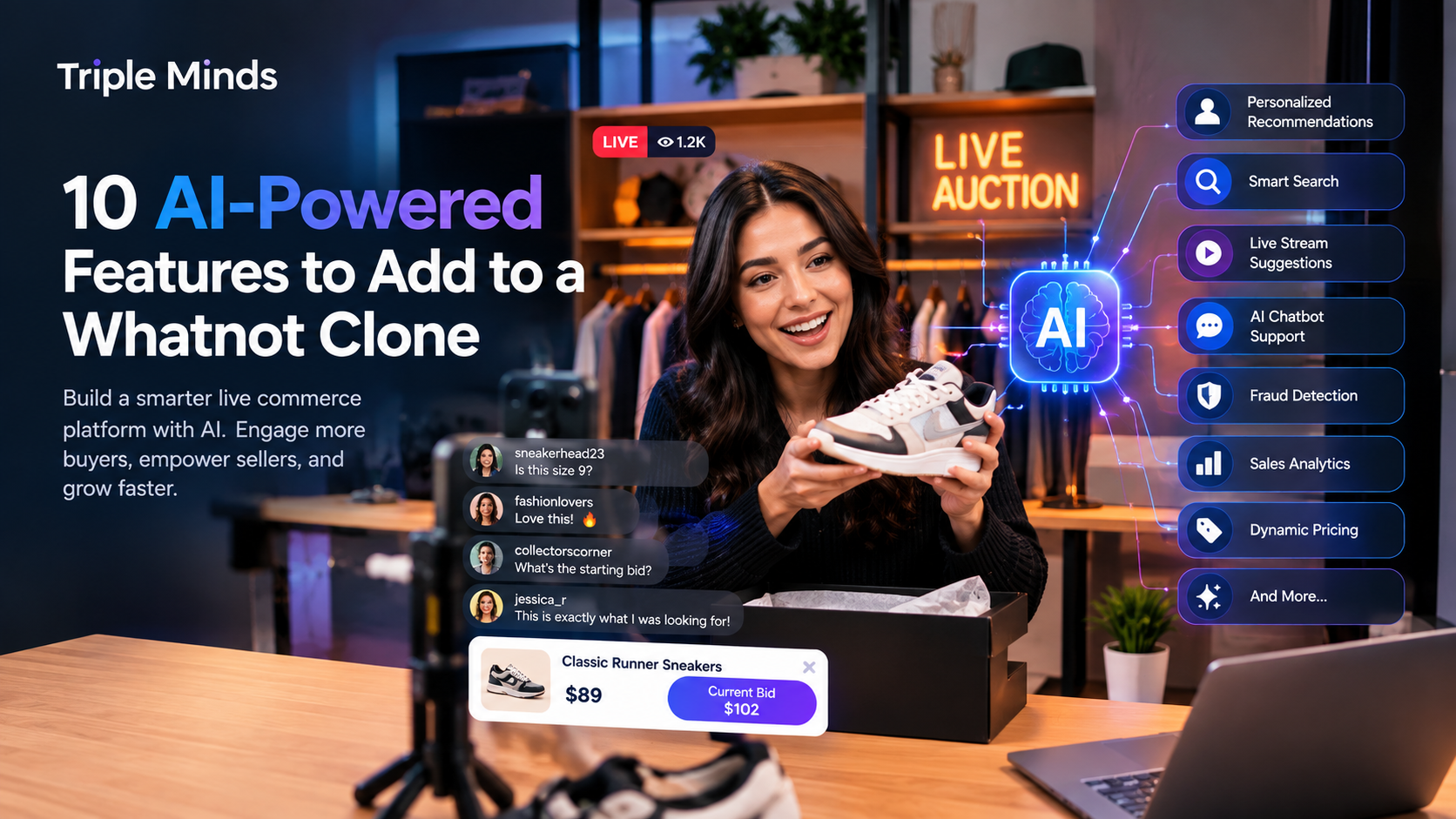
Live commerce is changing how people discover, interact with, and purchase products online. Platforms such as Whatnot have shown how live video, real-time interaction, and instant purchasing can create a more engaging shopping experience.
For businesses entering this market, building a whatnot clone can provide a foundation for launching a live shopping platform with similar core functionality. However, simply copying traditional live-streaming and marketplace features may not be enough in a competitive market.
AI can make the difference.
From personalized product recommendations to intelligent seller assistance, artificial intelligence can help a modern live commerce platform understand user behavior, automate repetitive tasks, and improve conversions.
Here are 10 AI-powered features worth considering when developing a Whatnot-style live commerce platform.
1. AI-Powered Product Recommendations
One of the most valuable AI features for a whatnot clone is personalized product recommendation.
AI can analyze factors such as:
- Products users have viewed
- Previous purchases
- Search history
- Favorite sellers
- Categories they follow
- Engagement during live streams
- Products added to their wishlist
The system can then recommend relevant products and live streams.
For example, if a customer frequently watches sneaker auctions, the platform could automatically highlight upcoming sneaker streams and recommend related products.
This creates a more personalized shopping experience while helping sellers reach interested buyers.
2. Intelligent Live Stream Recommendations
A live commerce platform may have hundreds or thousands of sellers streaming at different times. Finding the right stream can become difficult for users.
AI can solve this problem by creating personalized live-stream recommendations.
Instead of showing the same streams to everyone, an AI-powered whatnot clone can rank streams based on individual interests and behavior.
The algorithm could consider:
- User interests
- Watch duration
- Previous interactions
- Seller engagement
- Product categories
- Purchase history
- Current stream popularity
This can increase session duration and help users discover streams they are more likely to engage with.
3. AI Chatbot for Buyers
Live commerce involves real-time interaction. Buyers may have questions about products, shipping, availability, sellers, or auction rules while a stream is happening.
An AI chatbot can provide instant assistance without requiring human support for every question.
For example, users could ask:
“Is this product still available?”
“What sizes are available?”
“How much is shipping?”
“When will my order arrive?”
The AI assistant can retrieve information from the platform and provide quick responses.
For businesses, this can reduce customer-support workload while improving the shopping experience.
4. Automated Product Descriptions
Creating product listings can take considerable time for sellers.
AI can automate much of this process.
A seller could upload product images and provide a few basic details. The AI system could generate a structured product description containing information such as:
- Product name
- Key features
- Condition
- Specifications
- Suggested category
- Search-friendly keywords
- Short promotional copy
This feature can be particularly useful for sellers who list large numbers of products.
It also helps maintain consistency across the marketplace.
5. AI-Based Price Recommendations
Pricing is critical in live commerce, particularly when sellers use auctions or limited-time offers.
An AI pricing engine can analyze historical sales, product demand, category trends, competitor pricing, and buyer behavior to provide sellers with suggested prices.
For example, the platform could tell a seller:
“Based on recent sales and current demand, the recommended starting price is $45.”
The seller can then decide whether to accept or adjust the recommendation.
This doesn’t mean AI should control pricing automatically. Instead, it can act as a decision-support tool for sellers.
6. AI Fraud and Suspicious Activity Detection
Security is another important consideration for a White Label Whatnot App.
Live marketplaces can experience suspicious transactions, fake accounts, payment abuse, bot activity, and unusual bidding patterns.
AI can monitor activity and identify patterns that may indicate fraud.
Potential signals include:
- Unusual bidding behavior
- Multiple accounts using similar patterns
- Abnormally frequent transactions
- Suspicious payment activity
- Sudden account behavior changes
- Automated interactions
When suspicious activity is detected, the platform can flag it for review or trigger additional verification.
This can help create a safer environment for both buyers and sellers.
7. AI Seller Assistant
Sellers often have to manage several tasks simultaneously while running a live stream.
An AI seller assistant can act like a virtual co-host or business assistant.
It could help sellers:
- Prepare product listings
- Generate product descriptions
- Suggest pricing
- Answer common questions
- Summarize sales performance
- Recommend products to feature
- Create promotional messages
- Analyze audience engagement
Over time, the assistant can learn from seller activity and provide increasingly relevant recommendations.
For small businesses and independent sellers, this can significantly reduce the amount of manual work involved in live selling.
8. AI-Powered Search
Traditional marketplace search generally depends on keywords.
AI-powered search can understand user intent rather than simply matching exact words.
For example, instead of searching for:
“black running shoes under $100”
a user could search:
“Show me affordable black shoes for daily running.”
An AI search system can interpret the intent and return relevant products.
It can also use natural language processing to understand product attributes, categories, brands, and user preferences.
Adding intelligent search to a whatnot clone can make product discovery faster and more convenient.
9. AI Sales and Audience Analytics
Data is essential for sellers and platform owners.
AI can analyze marketplace and live-stream data to identify trends and opportunities.
A seller dashboard could provide insights such as:
- Best-performing products
- Peak viewer times
- Most engaged customers
- Average watch duration
- Conversion rates
- Repeat purchases
- Product demand trends
AI can go one step further by turning raw data into recommendations.
For example:
“Your electronics streams receive 28% more engagement on weekends.”
Or:
“Products in this category have shown increased demand over the past month.”
These insights can help sellers make better decisions.
Businesses working with an ai enterprise seo agency can also use AI-driven data strategies to identify search trends, understand audience intent, and create content around high-value commercial topics.
10. AI-Powered Personalization
Personalization can bring together many of the AI capabilities discussed above.
Instead of giving every customer the same marketplace experience, an AI-powered platform can dynamically personalize:
- Home feeds
- Live-stream recommendations
- Product suggestions
- Notifications
- Search results
- Promotional offers
- Seller recommendations
For example, a collector interested in trading cards could see more card-related streams, sellers, auctions, and products.
Another user interested in fashion could receive an entirely different experience.
This level of personalization can help a White Label Whatnot App deliver a more engaging experience without requiring every user to manually configure their preferences.
Why Add AI to a Whatnot Clone?
A basic live commerce platform can provide streaming, product listings, auctions, payments, chat, and seller management.
AI can make these features smarter.
Instead of simply providing functionality, AI can help the platform understand user behavior, automate repetitive processes, detect risks, and make predictions.
For startups, this can create opportunities to differentiate their platform instead of launching another generic live-shopping marketplace.
The key is to choose AI features based on actual business requirements rather than adding AI simply because it is trending.
How Triple Minds Can Help
Building an AI-powered live commerce platform requires more than just adding an AI chatbot.
It involves combining marketplace functionality, live streaming, payments, user management, analytics, recommendation systems, and AI capabilities into one scalable solution.
Triple Minds can help businesses approach this process strategically by identifying the right technologies and digital growth opportunities for their platform.
AI can also support the marketing side of the business. With the right SEO strategy, businesses can target users searching for live shopping platforms, marketplace solutions, seller tools, and related services.
Working with an ai enterprise seo agency can help businesses explore AI-assisted keyword research, content optimization, search intent analysis, and scalable SEO strategies alongside product development.
Final Thoughts
The future of live commerce is likely to be more intelligent and personalized.
A whatnot clone with basic streaming and marketplace functionality can provide a starting point, but AI can help take the platform further.
Features such as intelligent recommendations, AI chatbots, automated product descriptions, fraud detection, pricing assistance, and predictive analytics can create additional value for both buyers and sellers.
For businesses considering a White Label Whatnot App, AI should be viewed as a strategic layer that can improve the overall platform rather than as a standalone feature.
The right combination of live commerce functionality and AI can help businesses build a more competitive, scalable, and user-focused marketplace.