
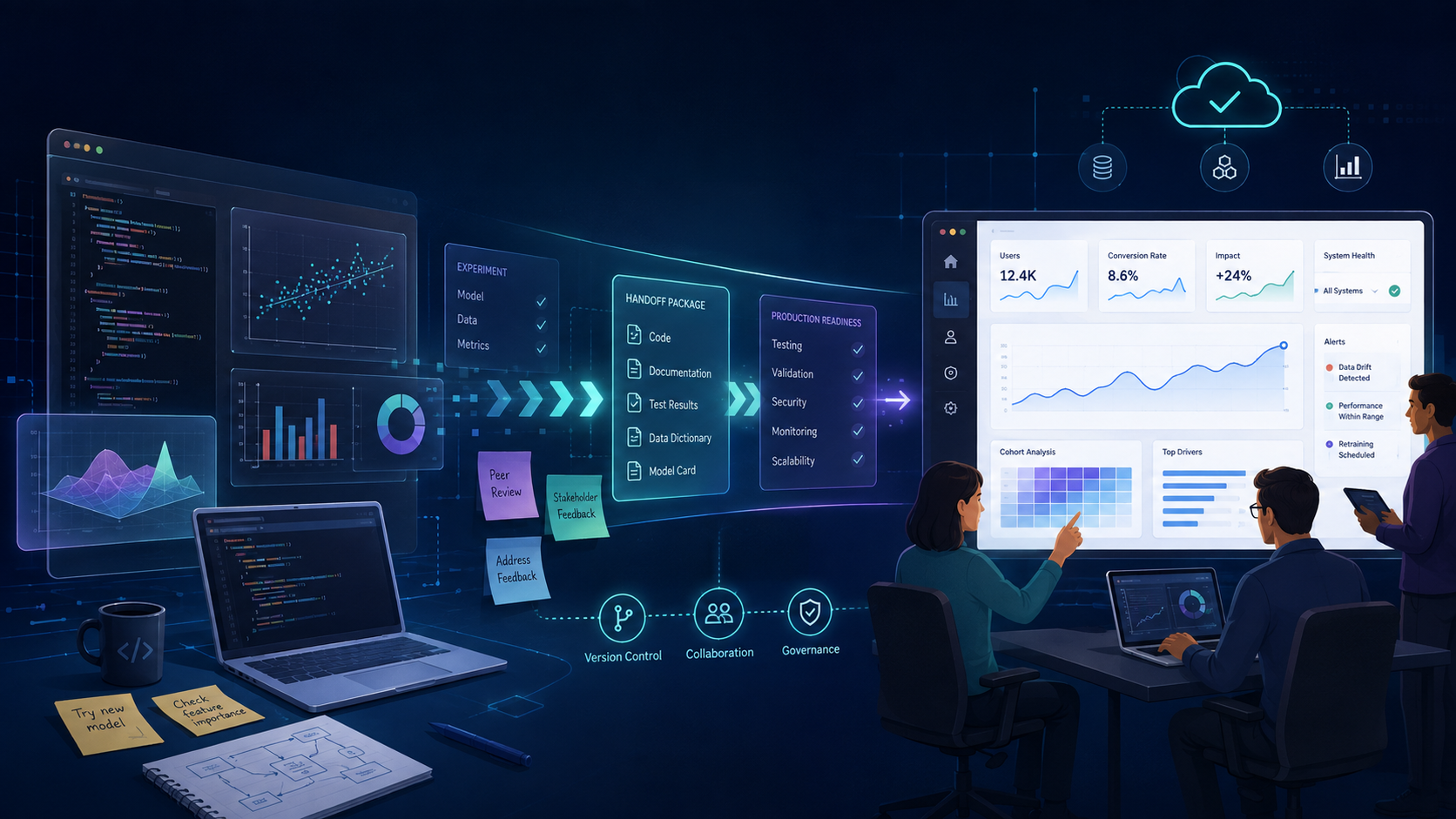

By Monday morning, a promising datathon prototype can already be harder to understand than it was during the final presentation. The notebook still runs and the dashboard still looks convincing, but the temporary team has scattered. People who knew which assumptions were built into the model or which steps had to happen in a particular order are no longer sitting beside it.
Enthusiasm from judges or stakeholders can make production feel like the obvious next move. Yet technical hardening is expensive, and a strong event demo says little about whether the idea will survive normal working conditions. Before more engineering time goes into the project, the team has to find out whether the product case still holds once the event environment disappears.
The event environment disappears first
During a datathon, speed matters more than durability. Teams usually work with a defined challenge, a prepared dataset, and a short deadline. Just as importantly, the people who built the prototype are present when somebody sees it for the first time.
That presence can hide a lot of friction. One person explains an unusual output. Another skips over an unfinished screen. Someone else tells the audience which input to use. None of that necessarily weakens the competition entry, but it becomes a problem once another team is expected to evaluate the product without guidance.
A useful first review therefore removes the presenters from the equation. If the workflow stops making sense when the builders stop narrating it, the project is not yet ready to be judged on technical maturity alone.
Can someone understand the prototype without its builders?
There is no need to build a polished production interface just to answer that question. What matters first is whether someone outside the original team can follow the intended workflow and understand why it is useful.
Imagine an anomaly-detection system built for maintenance staff. The model might perform well, but the practical value depends on what happens after an anomaly appears. The interface has to make the signal understandable and lead the user toward an appropriate action without a developer explaining every screen.
How much technical fidelity that review requires will vary. Some proofs of concept depend on live integrations or real backend behavior. Others only need a controlled representation of the workflow so stakeholders can explore the idea. Teams comparing TestBox with lighter demo environments face that same trade-off between realism and speed. Building the heavier environment only makes sense when the validation question actually depends on it.
Misunderstandings at this stage are valuable. They expose gaps in the product concept while changes are still relatively cheap, rather than after the interface and infrastructure have already been hardened.
Feedback is only useful when it changes a decision
Post-datathon reactions tend to be generous. Judges liked the concept. A manager suggests another feature. Colleagues see possible applications in their own teams. Positive feedback is encouraging, but it does not automatically tell the builders what deserves further investment.
The stronger test comes from people who understand the real workflow. A forecasting model, for example, could produce an accurate result but deliver it too late for the person expected to act on it. That timing issue matters as much as the technical performance because it affects whether the product fits the job it was designed to support.
Instead of collecting comments in an open-ended meeting, teams can run a collaborative review session where concerns are surfaced, priorities are discussed, and decisions are recorded in one place. The point is not to gather the largest possible volume of feedback. It is to leave the session knowing which uncertainty deserves another test.
Some ideas will move straight into the next iteration. Others can stay in the backlog until the main use case has stronger evidence behind it.
Preserve the knowledge that never reached the repository
A surprising amount of datathon knowledge lives outside the code. Someone may have cleaned a dataset manually, changed an assumption halfway through the event, or discovered that one input only works under a specific condition. Those details are easy to lose once the temporary team breaks up.
Documentation at this stage does not have to describe every function. It is more important to capture why key choices were made, where shortcuts were taken, and which parts of the workflow remain uncertain. The next person responsible for the project should not have to reverse-engineer the event itself before continuing the work.
Ownership also needs to become explicit. A prototype can sit untouched for months even when everyone agrees it has potential simply because nobody has authority to decide what happens next. Assigning a clear owner turns vague interest into a decision process. That person can approve another validation round, move the project toward production, or stop further investment if the evidence is weak.
Production changes the technical standard
Only after the use case survives that handoff does the engineering bar change significantly. A notebook built around a prepared dataset now has to deal with real inputs, and model behavior has to be evaluated outside the controlled conditions of the event.
Databricks’ description of the machine learning lifecycle extends beyond model development into staging, deployment, monitoring, and retraining. Those responsibilities may have been irrelevant during a weekend challenge, but they become important once predictions begin affecting real work.
Not every project follows the same production path. An internal decision-support tool may tolerate limits that would be unacceptable in a customer-facing prediction service. What matters is that the technical standard reflects the environment in which the product will actually operate rather than the environment in which it won a datathon.
For many teams, a limited pilot provides better evidence than a large launch. Real data and unfamiliar users expose weaknesses that the event setup could never reveal.
Public products introduce a different technical question
If the project eventually becomes a public application, demo environment, or documentation site, discoverability joins the release checklist.
JavaScript-heavy pages deserve attention because the experience rendered for a human visitor may not be identical to what an automated crawler receives. Prerender handles that problem by rendering JavaScript pages for crawler requests and serving the resulting HTML.
This work belongs later in the lifecycle. Search visibility has little value if the product itself has not earned a release, but public-facing documentation and product pages still need to be accessible once they become part of how users find and evaluate the project.
Decide what the next month is supposed to prove
A datathon does not have to produce a production-ready product to be worthwhile. Some prototypes reveal a strong direction but need another round of validation. Others expose an interesting technical idea that does not fit the workflow well enough to justify continued development.
Before approving another month of engineering, define the uncertainty that the work is supposed to remove. If nobody can explain who will use the product, how it fits into the real process, or who owns the next decision, production work is probably premature.
Once those questions have credible answers, technical investment becomes easier to judge. The project is no longer moving forward because the event created momentum. It is moving because the prototype has earned the next stage.