
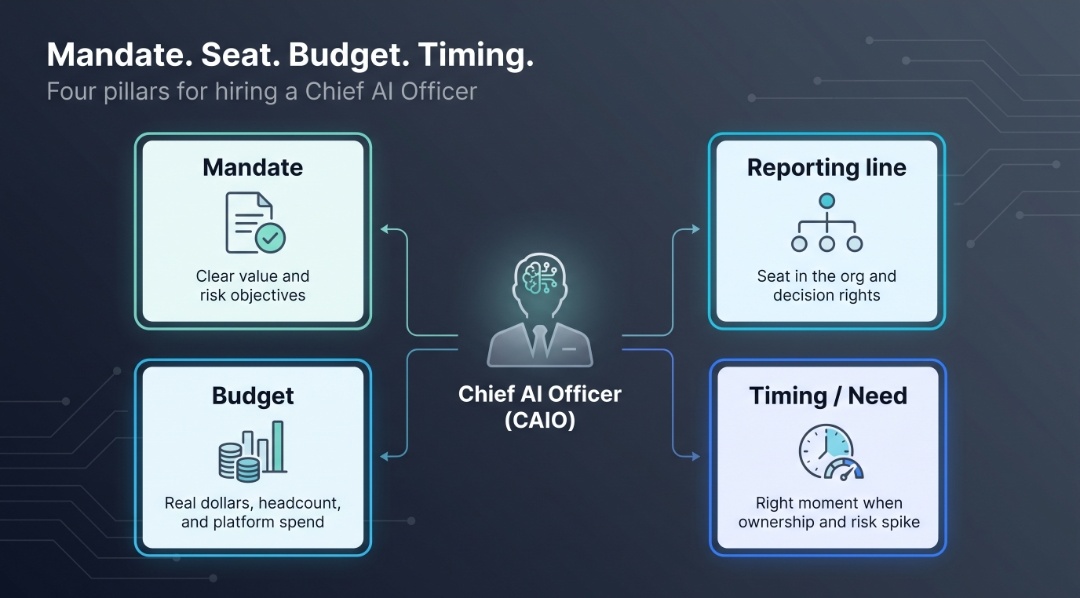
Boards often default to “Hire a Chief AI Officer and fix this.” But searches stall when four basics stay blurry: what problem the role solves, where it sits, how much budget it controls, and whether the company needs it yet.
IBM’s 2026 CEO Study shows that 76 percent of executives already have a CAIO, up from 26 percent in 2025. The label is spreading faster than the substance.
This guide shows you how to get the hire right: confirm the need, nail the mandate, seat, and budget, then widen the talent funnel.
Do you need a Chief AI Officer?
Hire the title only when a single leader must own four things at once: enterprise value, model risk, cross-unit coordination, and straight talk to the board.
Most organizations can keep AI under the CTO, CDO, or COO until those pressures merge. The Data Foundation’s 2025 federal CDO survey, run with Deloitte, found that only 30 percent of federal Chief Data Officers also carried the CAIO title, yet 96 percent worked with AI leaders at least monthly; that gap shows a separate seat is optional until oversight becomes unwieldy.
Ask yourself:
- Are multiple business units funding pilots with no shared roadmap?
- Could one model failure expose customers, regulators, or core products?
- Do data, cloud, and talent budgets sit in different cost centers that fight for priority?
- Has the board asked for one accountable voice on AI value, spend, and exposure?
If you answer “yes” to all four, a standalone CAIO shifts from luxury to necessity. Hire too early and you add overlap; wait too long and every incident lands on your desk at once. Picking the moment is the first real act of AI governance.
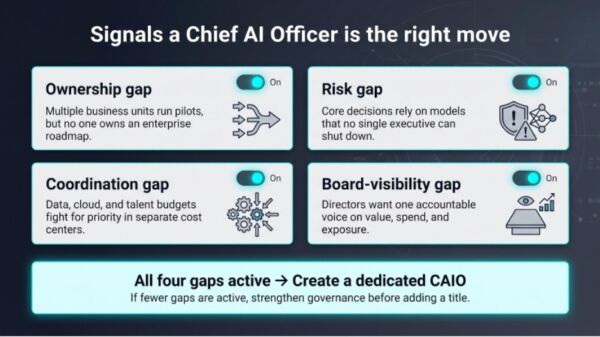
Signals a Chief AI Officer is the right move
Create a dedicated CAIO only when ownership, risk, coordination, and board accountability all spike at the same time. McKinsey’s 2025 State of AI study found that firms with clear senior ownership were three times more likely to be AI high performers; unclear accountability is expensive.
- Ownership gap. Multiple business units run pilots, but no one owns an enterprise roadmap.
- Risk gap. Customer decisions, regulated processes, or core products depend on models that no single executive can shut down.
- Coordination gap. Data, cloud, and talent budgets sit in different cost centers that fight for priority.
- Board-visibility gap. Directors want one voice on value, spend, and exposure.
When all four gaps appear together, a full-time CAIO moves from nice-to-have to non-negotiable. Appoint the role too soon and you add overlap; wait too long and every model failure, contract dispute, and compliance letter lands on your desk at once. Picking that moment is the first real act of AI governance.
Write the mandate before the job description
Pick the dominant CAIO archetype
Before you list competencies, decide which of three evidence-backed roles the board truly needs:
- Value builder. Owns the AI portfolio and talks in margin, share, and adoption terms.
- Platform builder. Shapes architecture, model choices, and engineering speed.
- Governance steward. Focuses on safety and compliance; success shows up in clean audits and few incidents.
McKinsey’s 2025 State of AI report found that high performers are three times more likely to have clear senior ownership of AI work, so pick one lead mission rather than blending all three.
Most companies try to cover two mandates at once, but one executive can excel at only one primary mission. Choose it, bold it, and let every later decision flow from that choice.
Draft a one-page CAIO mandate brief
Capture the mandate on a single sheet any director can scan in a minute:
- Why now? One sentence on the value or risk at stake.
- Year-one outcomes. Three concrete results, no more.
- Decision edges. What sits inside the CAIO’s circle and what stays with peers.
- Budget authority. Real dollars and headcount, not ranges.
- Board cadence. When and how the officer reports.
Silicon Valley search firm SPMB warns that the biggest pitfall in this search is “a poorly defined mandate; the role is not one size fits all.” Their playbook, how to hire a chief AI officer, expands on that caution: it separates the CAIO’s accountability from the CTO’s and CDO’s, lists the four core responsibilities the mandate should cover (strategy and execution, talent, governance, innovation), and lays out a four-stage interview loop and a 30-60-90 day plan that boards can run alongside the five bullet points above.
One page enforces discipline: it keeps the search team honest, reassures candidates the job is real, and gives the hire a 90-day yardstick. Skipping it is the quickest way to hire a résumé instead of a results owner.
When the Chief AI Officer reports to the CIO or CTO
Placing the CAIO under the technology chief keeps architecture, data pipelines, and deployment muscle in one place. That structure shortens the path for model choices, compute spend, and production reliability. The payoff shows up in faster release cycles.
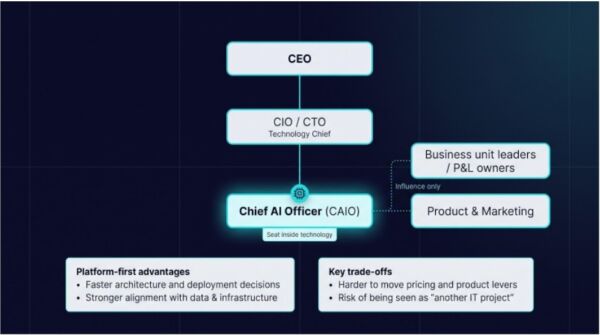
Heidrick & Struggles’ 2024 survey of global AI and data leaders found that 37 percent report to the chief information, technology, or digital officer, the most common reporting line, while 31 percent report directly to the CEO. That split is evidence that many companies view platform strength as the first priority.
Trade-offs exist. A CAIO inside IT may struggle to move business levers such as pricing, product bundling, or frontline adoption. To P&L owners, the role can look like “another platform project,” not a catalyst for change. That perception can stall value even when the code works.
Choose this seat when your immediate mission is to build a sturdy, reusable platform and only then adjust the business model. If value creation still sits on the CAIO’s scorecard, give the officer a dotted line strong enough to influence P&L leaders; otherwise, every shiny feature may work in staging yet still flop in the field.
When the Chief AI Officer reports to or combines with the Chief Data Officer
Aligning your CAIO with the CDO keeps data lineage, quality fixes, and model performance under one roof. That setup can prevent turf wars over storage bills and governance policy.
The model is common in government. The same Data Foundation survey found that 30 percent of CDOs also carried the CAIO title, and 96 percent worked with AI leaders at least monthly. Those numbers show a dual role can function when data readiness is the main blocker.
Risks focus on overload and diluted value. Modernizing data alone can fill an executive calendar; add enterprise AI and both agendas may stall. A data-first lens can also delay revenue conversations. No CEO wants to hear, “We’ll talk growth after the lake-house rebuild.”
Choose this structure when fractured data, not ambition, is the hurdle. Set a 12-month review with two exit criteria:
- Core data quality metrics (completeness, latency, lineage coverage) hit target.
- AI portfolio funding outpaces pure data spend.
When both conditions are met, separating the roles often unlocks faster AI value creation and clearer accountability.
When the Chief AI Officer reports to the COO, chief strategy, or transformation leader
If adoption, not algorithms, is the sticking point, placing your CAIO under an operator can help. McKinsey’s 2025 State of AI report notes that nearly two thirds of organizations remain stuck in the pilot phase, with primary blockers being organizational, such as workflow redesign, rather than technical issues like model accuracy. That finding shows operational pull often matters more than technical push.
A COO already owns processes, metrics, and incentives. A CAIO plugged into that engine can weave models directly into workflows and customer journeys.
Risks focus on technical distance. Every architecture choice still runs through the CIO or CTO, which can slow experiments. And if the COO’s charter is pure cost-out, funding for growth use cases may disappear.
Use this structure when:
- Cross-functional execution is the main bottleneck
- The data and platform stack can already support rapid iteration
Strengthen the model by giving the CAIO a dotted line to the CTO for architecture calls and by balancing the portfolio: efficiency plays plus revenue bets. That balance keeps AI from being viewed as savings only.
When the Chief AI Officer reports to risk, compliance, or legal
Industries such as medical devices, aviation, and systemic finance face penalties from a bad prediction that dwarf the cost of delay. In those cases, placing your CAIO under the chief risk officer or general counsel creates a single point of accountability for regulatory compliance.
A 2024 survey by Heidrick & Struggles found that only 7 percent of AI leaders now report to “other” roles outside the CEO or tech chiefs, showing that governance-first reporting is reserved for high-stakes contexts.
The trade-off is innovation speed. A risk-centric home can signal that AI is mainly a hazard: experiments slow, funding drifts to safer priorities, and talent leaves for growth-focused firms.
Use this structure only when:
- A single model error could trigger regulatory fines or public-safety crises
- The board has documented zero-tolerance thresholds for AI incidents
Even then, set up a formal bridge to product and engineering leaders so governance insights feed design decisions instead of turning into blanket stop orders.
Fund the Chief AI Officer’s mandate, not just the executive package
A job title is cheap compared with an under-funded program. In year one, carve the budget into three envelopes:
- Executive and search. Base salary, bonus, equity or long-term incentives, make-whole awards, and retained-search fees.
- Central AI capability. Core team, shared platforms, governance tools, security upgrades, and compute.
- Use-case portfolio. Discovery, pilots, change management, integration, and kill fees for projects that miss the mark.
Heidrick & Struggles’ 2025 survey of 318 AI, data, and analytics officers shows U.S. respondents averaged $380,000 in total cash and $498,000 in equity, for roughly $878,000 in total compensation. Treat those figures as directional.
Ask yourself two questions before you post the role:
- Does the CAIO control a budget proportional to the outcomes the board expects?
- Can the officer move funds between use cases without multi-month approvals?
If either answer is “no,” refine the mandate first; otherwise you risk funding a résumé, not a results owner.
Break first-year funding into three buckets
A Chief AI Officer succeeds only when money matches mandate. Allocate the first-year budget like this:
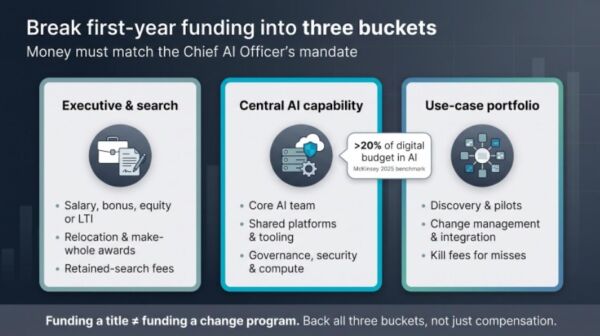
- Executive and search. Salary, bonus, equity or LTI, relocation, and retained-search fees.
- Central AI capability. Core team, shared platforms, governance tools, security controls, and compute, the factory every business line will tap.
- Use-case portfolio. Discovery, pilots, change management, integration, and the kill fees for projects that miss the mark.
McKinsey’s 2025 State of AI report shows that one third of AI high performers invest more than 20 percent of their digital budgets in AI, a benchmark boards can use to test bucket two.
Funding in this way brings discipline: you see at a glance whether the company is backing a change program or merely adding a title. It also shows candidates the seat carries real firepower, not just a business card.
Compensation snapshot for Chief AI Officers
Heidrick & Struggles’ 2025 survey of 318 AI, data, and analytics officers found average total cash of $380,000 and average annual equity or LTI of $498,000 for total annual compensation of about $878,000. Use these numbers as directional benchmarks.
Pay shifts with context:
- Public companies paid more than privately held peers: in the US sample, average total cash was about $434,000 at public companies against $320,000 at private-equity-backed firms.
- Seniority did not map neatly to pay: executives two levels below the CEO earned higher cash bonuses and equity than CEO direct reports, the highest total compensation of any group in the survey.
The lesson is mix, not magnitude. Cash keeps the lights on, but equity and a performance kicker align the CAIO with long-term value creation. If the budget covers only base pay, the board is signaling that AI success is optional.
Choose the Chief AI Officer search model
Pick the path that fits your timeline, talent pool, and mandate stability.
- Internal promotion.
Fastest start and lowest cost: no search fee and the leader already knows your culture, tech debt, and stakeholders. IBM’s 2025 Chief AI Officer study found that 57 percent of sitting CAIOs were appointed from the organization’s internal talent pool. The risk: legacy duties crowd the new role, and peers may hesitate to speak frankly with a former teammate. Treat the promotion as a fully competitive option, same mandate brief, same authority, same scorecard.
- Retained executive search.
Best for thin benches or when the board wants outside validation. Expect fees of 25-35 percent of first-year compensation and timelines of 4-6 months from kickoff to signed offer. Freeze the brief before launch; shifting requirements restart the clock.
- Internal executive recruiting.
Works when your corporate talent team already maps the external market. You save the fee but must supply assessment depth and bandwidth. Choose this route when the talent pool is known and the mandate is stable; add external assessors if the role is first-of-its-kind.
- Fractional or interim CAIO.
A bridge when you need judgment before you can justify head count. Typical commitments run 2-3 days a week for 3-9 months at executive day rates. Write a clear scope, decision rights, conflict wall, and hand-off plan. Convert or exit once the permanent mandate is set.
Hybrid approaches (internal sourcing plus external assessment, or interim leadership while a retained search runs) can balance speed, cost, and rigor.
Build the Chief AI Officer candidate market and assessment loop
Search beyond the “Chief AI Officer” label
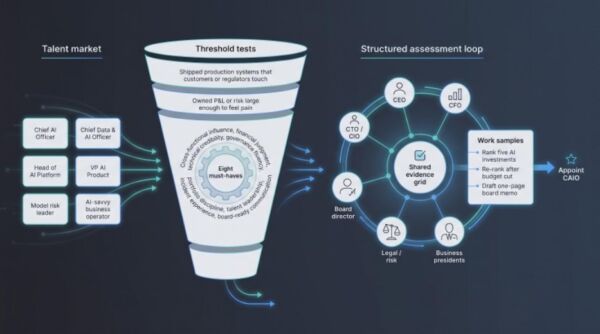
Adoption figures vary with the sample: IBM’s CEO survey puts it at 76 percent, while Randy Bean and Tom Davenport’s 2026 AI and Data Leadership Executive Benchmark Survey of large-enterprise data leaders finds a much smaller share have appointed a dedicated Chief AI Officer. Either way, many AI leaders still sit under data, technology, product, or transformation banners. Casting a wider net is mandatory. Map adjacent families: Chief Data & AI Officer, Head of AI Platform, VP AI Product, model risk leader, or a business operator who has scaled AI-driven revenue in a line unit.
Filter for two threshold tests:
- Has the leader shipped production systems that customers or regulators touch?
- Have they owned a P&L or risk statement large enough to feel pain when a model misbehaved?
Anyone who clears both belongs on the long list, whatever the badge says.
Separate non-negotiables from learnable knowledge
Anchor the scorecard in eight must-haves: cross-functional influence, financial judgment, technical credibility, governance fluency, portfolio discipline, talent leadership, incident experience, and board-ready communication. Weight them equally at first, then refine after the first interview round. Everything else (vendor stack, sector jargon) is learnable.
Run a structured, cross-functional interview loop
Replace informal “coffee chats” with a fixed panel that mirrors the mandate:
- CEO on strategy and influence
- CFO on capital allocation and kill decisions
- CTO or CIO on architecture and security
- Business presidents on adoption and change management
- Legal or risk leader on governance and incidents
- Board director on clarity under pressure
Each interviewer scores the same evidence grid within 24 hours to avoid halo effects.
Use real work samples to surface judgment
Ask finalists to rank five AI investments, then re-rank when the budget is cut in half, and to draft a one-page board memo on the toughest trade-off. Watching candidates wrestle real numbers shows how they frame uncertainty, weigh risk, and defend a position. Leaders who need outside consultants for a one-hour brief rarely match the demands of this seat.
Put the Chief AI Officer’s mandate in the offer letter
Document every commitment
The offer letter is your final guardrail against mismatched expectations. Attach the one-page mandate brief and restate, in plain language, five items:
- Reporting line and board-access cadence.
- Budget envelope and head-count authority.
- Specific decision rights (for example, stop a deployment, reallocate funds, sign seven-figure cloud contracts).
- First-year outcomes tied to compensation triggers.
- A nine-month formal review clause that lets the CEO and board adjust scope or start phase two.
Name the signatories (CEO, CHRO, and board compensation chair) and specify that any change requires the same signatures. A clear contract is the simplest, most reliable onboarding tool you can give a new Chief AI Officer.
Use the Chief AI Officer’s first 90 days to earn authority and reset the portfolio
Before day one: build the data room
- Assemble a full inventory of AI systems, pilots, contracts, and committed spend.
- Map stakeholders by name: data owners, cloud-invoice signers, model approvers.
- Compile the governance dossier: policies, risk exceptions, incidents, and regulatory deadlines.
- Schedule introductory meetings with the CEO, CFO, technology heads, business presidents, and board sponsor.
Executive-transition research summarized by McKinsey & Company finds that between roughly a quarter and nearly half of senior-leader transitions are judged failures or disappointments within two years, often because integration is poor. A complete pre-start data room cuts that risk by speeding discovery.
Days 1-30: diagnose facts, not slides
Run ride-alongs with frontline users, code walk-throughs with engineers, and finance reconciliations against the spend log. Deliver four artifacts by day 30:
- Master inventory of models and pilots.
- Data-quality heat map.
- Current and forecast spend.
- “Stop, fix, or scale” list.
Days 31-60: design, decide, and prune
Sort initiatives into scale, salvage, or sunset lanes. Draft a target operating model that clarifies who owns data, models, deployment, and risk sign-off. Present a straw-man roadmap, head-count ask, and governance update to the CFO and board sponsor by week 8.
Days 61-90: commit and deliver a visible win
- Lock budget with the CFO.
- Hire or reassign critical talent.
- Authorize the first scaled project or retire an unsafe model, whichever best fits risk appetite.
- Set up monitoring: incident response, model-drift alerts, benefit dashboards.
Close day 90 with a formal review involving the CEO, CAIO, and board sponsor to adjust scope and the scorecard. Authority earned in these three months compounds over the next three years.