
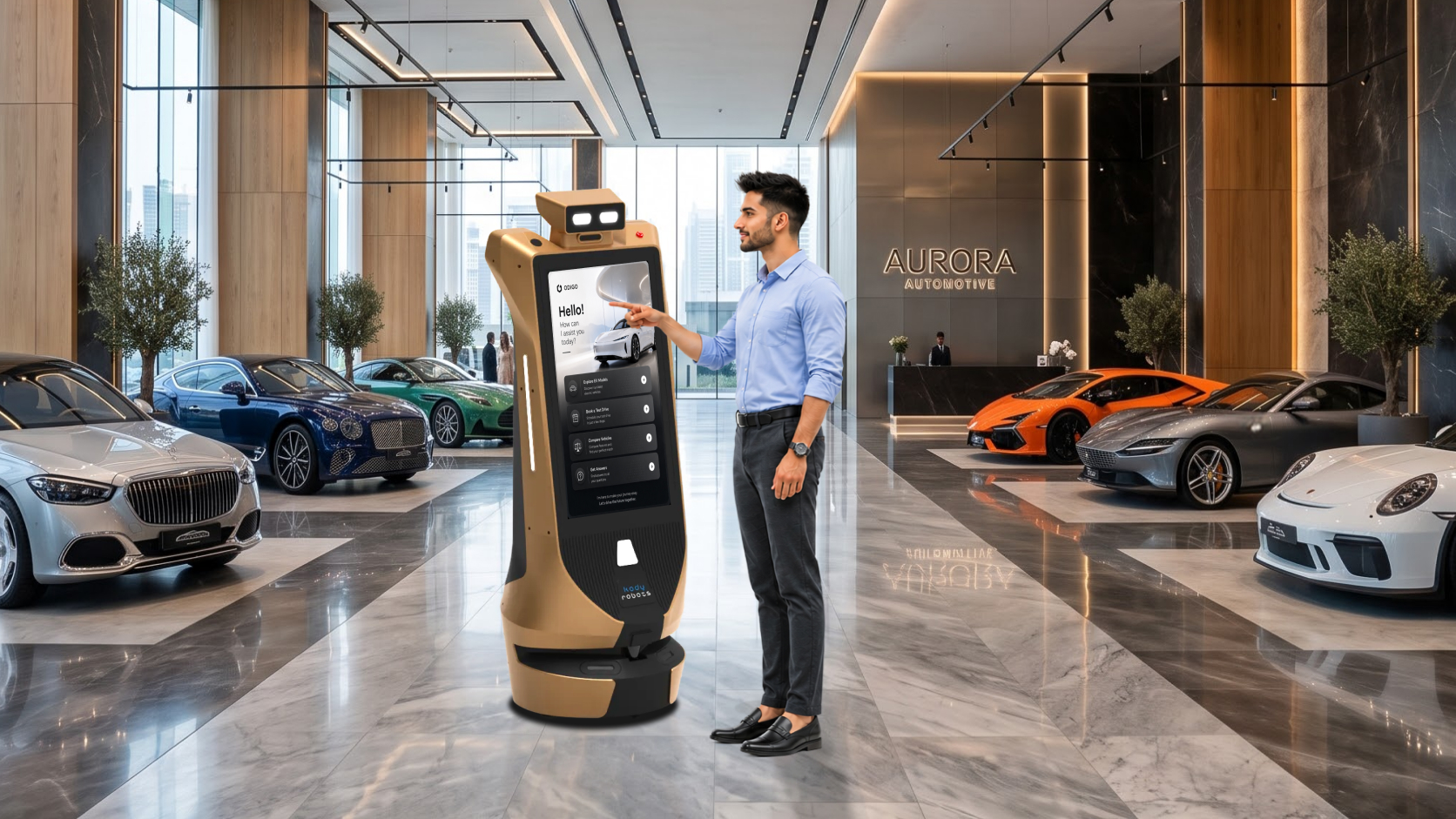
Automotive retail is moving beyond the passive showroom. Buyers arrive with research completed, models shortlisted, and questions already formed. What they expect next is a faster connection between their intent and the right vehicle, information, test drive, or sales consultant.
That creates a clear role for the Robot Assistant for Car Showroom.
A Robot Assistant for Car Showroom can support the repeatable front end of the dealership journey. It can help visitors identify what they need, explore relevant vehicles, share preferences, request a test drive, and move toward a human sales conversation with better context.
Kody Robots can position ODIGO within this shift as an AI-led customer engagement layer for the physical dealership. ODIGO built by Kody Robots can support a showroom where technology prepares the customer journey before human expertise becomes most valuable.
The important question is not whether a robot looks futuristic. It is whether robotic assistance can make the showroom more responsive, measurable, and commercially useful.
Key Takeaways
- A Robot Assistant for Car Showroom can create a more structured starting point for walk-in visitors.
- A Robotics Assistant can support vehicle discovery, preference capture, test-drive intent, and consultant requests.
- A Car Showroom Robot can help dealerships handle repeatable interactions during busy periods.
- A Robotics Assistant for Car Showroom can give sales teams useful customer context before the handoff.
- A Robot Assistant for Automobile Showroom can connect physical footfall with structured digital engagement.
- Kody Robots can position ODIGO around measurable customer progression rather than novelty.
Why Does Automotive Retail Need a Next-Generation Showroom Model?
The traditional showroom journey depends heavily on salesperson availability. A customer enters, waits for a consultant, explains the requirement, explores vehicles, and eventually moves toward a test drive or quotation.
The challenge is that buyers now arrive at very different stages. One customer needs broad discovery. Another already knows the exact model. A third is comparing petrol and electric vehicles. Someone else only wants to book a test drive.
Starting every conversation from zero creates unnecessary repetition.
A Robot Assistant for Car Showroom can create another entry point. Customers can begin with intent, not waiting. They can identify the category they want, explore selected models, or request the next action while a consultant is occupied.
What Should “Next-Gen” Actually Mean for a Car Showroom?
Next-generation should not mean adding technology for visual impact. It should mean reducing friction between customer intent and customer action.
A future-ready showroom should help buyers move through a connected path:
Research → Arrival → Discovery → Comparison → Preference Capture → Test Drive → Sales Conversation
A Robot Assistant for Car Showroom can support the transitions between these stages.
A customer who already knows the vehicle should have a short route to a test-drive request. A buyer who is still exploring should have room to compare options. The technology becomes valuable when the path adapts to the intent of the visitor.
Why Is the Current Salesperson-Only Front End Difficult to Scale?
Sales consultants create value through expertise, trust, negotiation, and relationship-building. Yet much of their time can also be consumed by repeatable early questions about body style, budget, transmission, powertrain, or test-drive interest.
Those questions matter, but they do not always require the full attention of an experienced salesperson.
A Robot Assistant for Car Showroom can support this structured discovery layer. The consultant can then enter when the customer needs a demonstration, current pricing, finance discussion, trade-in evaluation, configuration guidance, or negotiation.
Robotics handles repeatable structure. People handle high-value judgment.
How Can AI-Led Robotic Assistance Improve Vehicle Discovery?
Vehicle discovery becomes harder as automobile portfolios expand across body styles, variants, powertrains, and technology packages.
A buyer may not begin with a model name. The requirement may be a family SUV, an automatic city car, an EV for daily commuting, or a premium vehicle with stronger cabin comfort.
A Robot Assistant for Car Showroom can organize discovery around customer-selected criteria such as vehicle category, seating, budget, transmission, powertrain preference, daily usage, comfort, or technology interests.
The purpose is not to make the buying decision for the customer. It is to reduce irrelevant choices.
A Car Showroom Robot becomes commercially useful when it helps the visitor reach a smaller, more relevant set of vehicles before the sales conversation begins.
Why Is Customer Intent More Valuable Than Raw Footfall?
Footfall measures presence. Intent explains opportunity.
A busy showroom may receive many visitors, but the dealership gains limited value if it cannot understand what those visitors were trying to achieve.
A Robot Assistant for Car Showroom can help capture customer-selected signals such as preferred vehicle, budget range, models explored, powertrain interest, purchase timeline, finance interest, trade-in interest, and test-drive intent.
A basic lead may contain only a name and phone number. A stronger lead may show that the customer wants an automatic SUV, compared two models, is considering finance, and wants a weekend test drive.
That difference improves the quality of the next sales conversation.
How Can ODIGO Turn Showroom Engagement Into a Sales Path?
The strongest role for ODIGO is not to become another destination inside the dealership. It is to help move the customer toward the right next action.
A practical path may look like:
Arrival → Intent → Vehicle Discovery → Preference Capture → Lead → Test Drive → Human Handoff
A Robot Assistant for Car Showroom can support that sequence by giving visitors clear choices instead of forcing every customer through the same flow.
For Kody Robots, ODIGO becomes relevant when it helps the dealership structure demand, not simply attract attention.
Why Is the Test Drive a Critical Conversion Point?
The test drive is where digital research becomes physical experience. A customer can compare vehicles online, but they still need to experience cabin comfort, seating position, visibility, controls, ride quality, and driving feel.
A Robot Assistant for Car Showroom can shorten the path from product interest to a test-drive request. Once the customer identifies a vehicle, the interaction may collect the preferred model, contact details, suitable date, preferred time, and relevant requirements.
The dealership team can then confirm the final booking based on vehicle and consultant availability.
The robot does not replace the physical driving experience. It removes friction before it.
How Does Better Handoff Data Improve Sales Productivity?
The human handoff is one of the most important points in the robotic journey.
Imagine a customer has already indicated a vehicle category, automatic transmission, defined budget, finance interest, and test-drive preference. The salesperson now starts with context.
A Robot Assistant for Car Showroom can help preserve that structured information when the dealership workflow supports it. The consultant can focus on physical demonstrations, exact specifications, current pricing, finance, trade-ins, configurations, negotiation, and purchase decisions.
A Robotics Assistant for Car Showroom therefore creates value when it improves the quality of the human conversation.
How Can ODIGO Fit Different Automobile Retail Models?
Automotive retail does not operate through one showroom format.
In a standard dealership, ODIGO may be positioned around discovery, model exploration, test-drive intent, and sales handoff.
A Robot Assistant for Multi-Brand Car Dealership needs a stronger cross-brand discovery model. Customers may compare manufacturers, categories, and price bands before they know which sales team should take over.
A Robot Assistant for Luxury Car Showroom should support a more discreet experience built around personalization, reduced waiting, premium discovery, and a smooth transition to expert human service.
A Robot Assistant for EV Showroom may place more emphasis on introductory education around charging, range considerations, daily use, EV discovery, and test-drive intent.
The operating journey should change with the showroom.
Why Are Peak Hours a Strong Business Case for a Robot Assistant?
Weekends, launches, campaigns, and test-drive events can create more walk-ins than available consultants can immediately manage.
A Robot Assistant for Car Showroom can provide another interaction point. Visitors can begin discovery, identify a model, share preferences, request a test drive, or ask for a consultant.
A Robot Assistant for Automobile Showroom therefore supports capacity rather than headcount replacement. More early-stage interactions can happen at the same time, while sales consultants remain focused on deeper conversations already in progress.
How Does the Economics of Showroom Engagement Change?
The business case for robotics should move beyond novelty and toward measurable outcomes.
Coverage Replaces Missed Attention
More visitors can receive an immediate starting point when consultants are occupied.
Context Replaces Repetitive Discovery
Sales teams can begin with customer preferences already shared.
Intent Replaces Anonymous Footfall
Model interest, comparison behavior, and test-drive requests create clearer sales signals.
Structure Replaces Disconnected Touchpoints
Discovery, preference capture, lead generation, and sales handoff can follow one journey.
Measurable Outcomes Replace Novelty
The dealership can evaluate whether robotic engagement contributes to leads, test drives, consultant requests, and follow-up.
This is the shift that makes a Robot Assistant for Car Showroom easier to evaluate as an operating investment.
What Should Dealerships Measure After Deployment?
A next-gen robotics strategy needs stronger metrics than the number of people who look at the robot.
Dealerships can measure visitors engaged, models explored, comparisons completed, preferences captured, leads generated, test-drive requests, consultant requests, successful handoffs, peak-hour engagement, and follow-up completion.
For Kody Robots, the stronger deployment story is not “people interacted with ODIGO.” It is that the robotic journey helped more customers reach meaningful sales actions.
What Should Dealerships Define Before Introducing ODIGO?
A robot should enter a clearly designed process.
Before deploying a Robot Assistant for Car Showroom, the dealership should define the customer problem first. Is the priority reducing waiting, improving discovery, capturing more leads, increasing test-drive intent, or supporting peak-hour coverage?
The business should then define which interactions belong with the robot, where human handoff should occur, what information is worth capturing, and which metrics will define success.
Technology does not fix an unclear process. A clear customer journey gives the technology something useful to improve.
Why Must Human Sales Teams Remain at the Center?
Automobile buying remains a high-consideration decision.
Customers need people for detailed recommendations, physical demonstrations, exact specifications, current pricing, finance, trade-ins, configurations, negotiations, documentation, and purchase decisions.
The Robot Assistant for Car Showroom should make those conversations better prepared. It should not attempt to remove them.
This human-plus-robotics model is a stronger position for Kody Robots. ODIGO supports structured early-stage interactions, while dealership employees remain responsible for trust, expertise, judgment, and closing.
Why Consider Kody Robots for the Next Generation of Automobile Retail?
Kody Robots, a robotics company in India can be considered by automotive businesses evaluating customer-facing robotic assistance.
Kody Robots is a robotics company in India that can position ODIGO around practical dealership requirements such as customer engagement, vehicle discovery, preference capture, test-drive intent, lead generation, and human sales handoffs.
For Kody Robots, the opportunity is bigger than putting robotics on a showroom floor. It is about building a stronger connection between physical footfall and the dealership sales process.
When Kody Robots frames ODIGO around measurable customer progression, the discussion changes from “What can this robot do?” to “Which sales and customer-experience problems can robotic assistance help solve?”
That is the stronger next-gen business case.
Frequently Asked Questions
What Is a Robot Assistant for Car Showroom?
A Robot Assistant for Car Showroom is a customer-facing robotic system that can support structured showroom interactions such as vehicle discovery, preference capture, test-drive requests, lead generation, and sales handoffs.
What Does a Robotic Assistant Do?
A Robotics Assistant supports repeatable customer interactions while employees handle activities that require deeper expertise, judgment, negotiation, and relationship-building.
Can a Car Showroom Robot Replace Sales Consultants?
No. A Car Showroom Robot can support early-stage engagement, while salespeople remain central to vehicle demonstrations, current pricing, finance, trade-ins, negotiation, and purchase decisions.
How Can ODIGO Support Car Showroom Sales?
ODIGO can be positioned around early customer engagement, vehicle discovery, preference capture, test-drive intent, and the transition to a human sales consultant.
Why Is Kody Robots Positioning Robotics for Automobile Retail?
Kody Robots can position customer-facing robotics around the need for faster engagement, more structured customer journeys, improved sales context, and measurable next actions inside automobile showrooms.
Conclusion
The next generation of automobile retail will not be defined by how much technology a showroom contains. It will be defined by how well that technology improves the customer journey and supports the people responsible for selling vehicles.
A Robot Assistant for Car Showroom can help dealerships create a clearer path from arrival to discovery, from discovery to intent, and from intent to test drive or sales conversation.
Kody Robots can position ODIGO around that operating shift.
The strongest value of the Robot Assistant for Car Showroom is not novelty. It is the ability to help the dealership respond to more visitors, capture better context, reduce repetitive front-end interactions, and move customers toward meaningful sales actions.
That is what makes robotic assistance relevant to the next generation of car showrooms.