
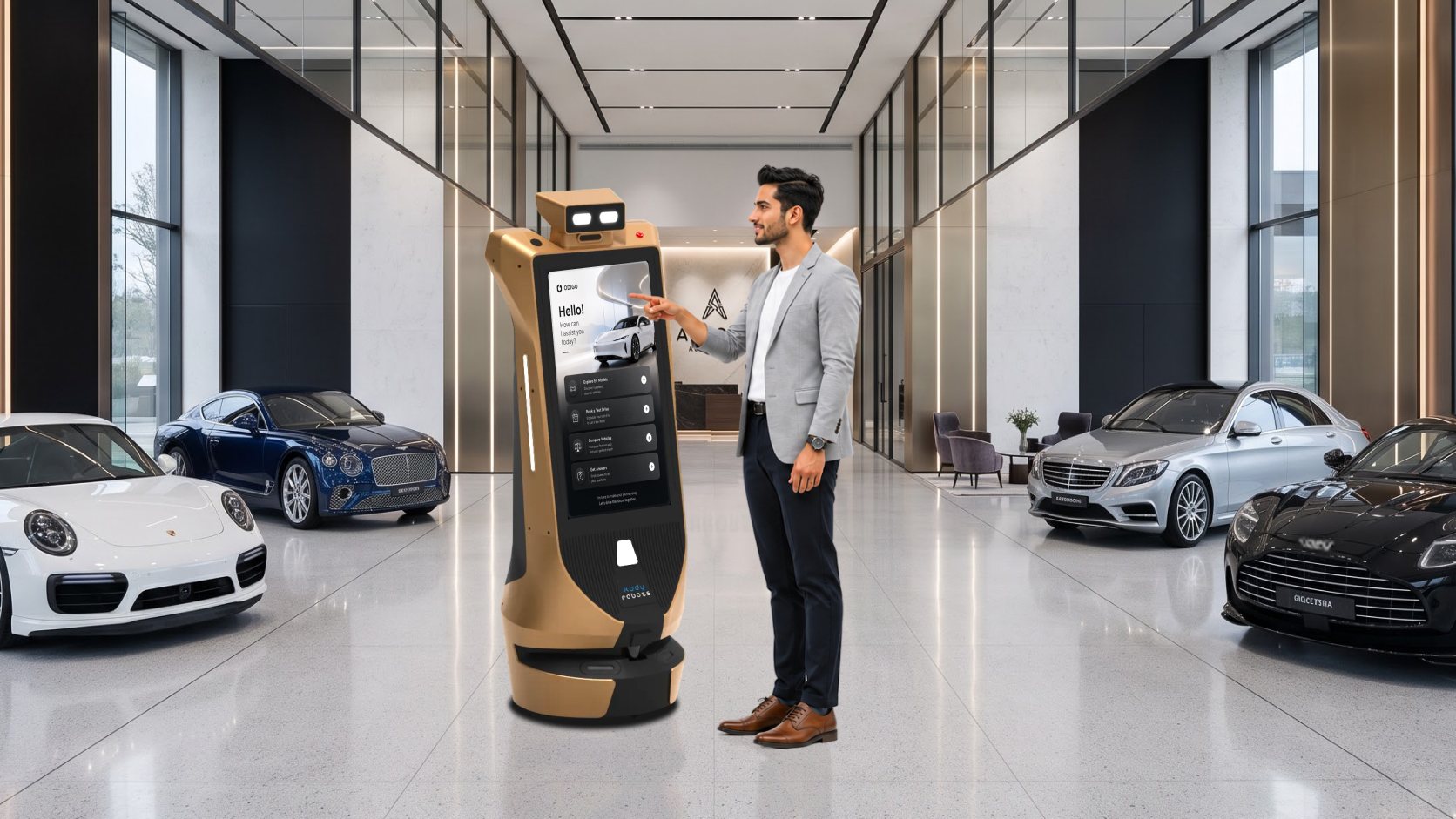
The modern car showroom is no longer only a place where vehicles are displayed. It is becoming a connected customer-engagement environment where buyers expect faster answers, relevant guidance, and a smoother path from arrival to test drive. That shift creates a new role for the Robot Assistant for Car Showroom.
A Robot Assistant for Car Showroom can support the early dealership journey by helping visitors identify relevant vehicles, share preferences, request a test drive, and connect with a sales consultant. The goal is not to replace the salesperson. It is to make the journey more structured before human expertise becomes essential.
ODIGO built by Kody Robots can be positioned within this model as a customer-facing assistant for automobile retail. A Robot Assistant for Car Showroom gives dealerships another way to manage repeatable early interactions while preserving the human sales relationship.
The stronger opportunity is not simply adding a robot to the showroom. It is using robotics to create a better path between customer intent and the next meaningful sales action.
Key Takeaways
- A Robot Assistant for Car Showroom can give visitors a clear starting point when they enter.
- A Robotics Assistant can support discovery, preference capture, and consultant requests.
- A Car Showroom Robot can help dealerships manage early-stage engagement during busy periods.
- A Robotics Assistant for Car Showroom can give sales teams more context before the human conversation begins.
- A Robot Assistant for Automobile Showroom can connect physical footfall with structured digital engagement.
- Kody Robots can position Odigo around measurable customer progression rather than novelty.
Why Does the Automobile Showroom Need a New Kind of Assistant?
The traditional showroom journey begins with a salesperson. A visitor enters, waits for someone to become available, explains what they want, looks at vehicles, and eventually moves toward a test drive or quotation.
That model still matters, but the customer has changed.
Many buyers now arrive after substantial online research. They may already know the segment, price range, powertrain, and features they want. Some have shortlisted two or three models before speaking with anyone.
The physical showroom often starts the conversation from zero.
A Robot Assistant for Car Showroom can help close that gap. Instead of asking every visitor to wait for the same introductory conversation, the dealership can offer a structured interaction that helps the customer explain intent, explore relevant vehicles, or request the next step.
The issue is not whether salespeople are needed. They are. The issue is whether every early-stage interaction must depend on a salesperson being immediately available.
What Makes Odigo More Than Another Digital Showroom Touchpoint?
A kiosk can show vehicle information. A display can play videos. A QR code can open a product page.
Those tools are useful, but they are primarily passive.
Odigo can be positioned differently. As a Robot Assistant for Car Showroom, it becomes part of the customer journey rather than another screen inside it.
The visitor can begin with a practical need: find an SUV, compare electric vehicles, request a test drive, or speak with a consultant. The value comes from turning those requests into a structured path forward.
A buyer who already knows the model should not be forced through a long discovery flow. A customer who is still researching should have space to explore. The robot can support both paths when the dealership designs the workflow around customer intent.
Why Is Immediate Engagement a Commercial Issue?
A walk-in carries some level of buying intent. The dealership may not know whether that intent is high or low, but losing the opportunity to understand it creates a commercial blind spot.
Busy periods make this more visible. Consultants may already be handling demonstrations, finance discussions, test drives, or appointments. New visitors can quickly become passive footfall.
A Robot Assistant for Car Showroom can give those visitors an immediate starting point. They can explore vehicles, compare models, request a test drive, check an appointment, or ask for a salesperson.
This creates two advantages. The customer gets direction, and the dealership gets context.
That is where robotic assistance begins to move from showroom novelty toward operating value.
How Can Odigo Make Vehicle Discovery More Structured?
Vehicle portfolios are becoming more complex. Buyers may need to understand body styles, powertrains, transmissions, technology packages, comfort features, and price bands.
A salesperson can explain all of this, but much of the early discovery process is repetitive.
A Robot Assistant for Car Showroom can begin with customer needs instead of a complete product catalogue. The visitor may identify vehicle category, seating requirement, budget range, transmission preference, petrol or EV interest, daily driving needs, and technology priorities.
The system can then help narrow the relevant choices.
A Car Showroom Robot should not decide which vehicle the customer must buy. Its stronger role is to reduce irrelevant options and prepare a more focused human conversation.
That is the difference between product display and guided discovery.
Why Does Preference Capture Matter to the Sales Team?
A name and phone number create a contact. A useful lead explains intent.
That distinction matters because the sales consultant needs to know why the customer is interested.
A Robot Assistant for Car Showroom can help capture customer-selected information such as:
- Preferred model
- Budget range
- Transmission
- Powertrain interest
- Purchase timeline
- Finance interest
- Trade-in interest
- Test-drive request
This creates a better handoff.
A Robotics Assistant can reduce the need for a salesperson to repeat basic discovery questions the visitor has already answered. The consultant can move faster toward vehicle demonstration, exact product information, finance, and purchase guidance.
For Kody Robots, this is where robotic assistance starts to support sales productivity rather than only engagement.
How Can Odigo Turn Showroom Footfall Into a Sales Opportunity?
Footfall tells the dealership that someone entered. Structured intent explains why they came.
Consider two visitors. The first walks around for fifteen minutes and leaves. The dealership knows very little about that visit. The second explores two SUVs, indicates a budget range, prefers automatic transmission, and asks for a weekend test drive.
The second interaction creates usable sales context.
A Robot Assistant for Car Showroom can support natural next actions such as saving vehicle interest, requesting a callback, asking for finance assistance, requesting a consultant, or booking a test drive.
The dealership can then collect contact information at a point where the customer has already received value.
That creates a stronger lead than asking for a phone number before the buyer has found anything relevant.
Why Is the Test Drive a Critical Conversion Point?
The test drive is where research becomes physical experience.
Online content can help customers compare vehicles, but it cannot reproduce seating position, cabin comfort, visibility, controls, ride quality, or driving feel.
A Robot Assistant for Car Showroom can make the path to a test-drive request easier. Once the visitor identifies a vehicle, the robot may help collect the selected model, contact details, preferred date, preferred time, and relevant requirements.
The dealership team can then confirm the final appointment based on vehicle and consultant availability.
The robot does not replace the test drive. It reduces friction before it.
For Kody Robots, that is a stronger outcome than interaction volume alone. A conversation becomes commercially meaningful when it helps move a buyer toward a high-intent action.
Why Is the Human Handoff More Important Than the Robot Interaction?
The strongest robotic journey should lead to a better human conversation.
If a customer has already shared that they want an automatic SUV, have a defined budget, are considering finance, and want a weekend test drive, the consultant should not need to restart from the beginning.
A Robot Assistant for Car Showroom can help preserve that context when the dealership workflow supports it.
The salesperson can then focus on physical demonstrations, exact specifications, current pricing, finance, trade-ins, configurations, negotiation, and purchase decisions.
This is the right division of work.
Robotics handles structured and repeatable interactions. People handle trust, persuasion, judgment, negotiation, and relationship-building.
A Robot Assistant for Automobile Showroom should therefore strengthen the sales team, not compete with it.
Where Does Odigo Fit Into the Showroom Operating Model?
The strongest role for Odigo is not “a robot that talks.” It is a robot with a defined place in the customer journey.
A practical model can look like:
Arrival → Intent → Discovery → Preference Capture → Lead → Test Drive → Sales Handoff
Kody Robots can position Odigo around this sequence so the technology has an operational purpose.
The Robot Assistant for Car Showroom supports the structured front end. The sales team takes over when detailed product expertise, physical demonstration, finance, or negotiation becomes important.
This makes robotic assistance part of the showroom operating model rather than an isolated attraction.
How Does the Business Case Change When Robotics Is Measured Properly?
The weakest way to evaluate a robot is to ask how many people stopped to look at it.
The stronger questions are tied to customer progression.
Did more visitors receive a useful first interaction? Did more customers reach relevant vehicles? Were more preferences captured? Did test-drive requests improve? Did sales handoffs become better prepared? Did peak-hour coverage improve?
A Robot Assistant for Car Showroom becomes commercially relevant when these outcomes are measurable.
Dealerships can track visitors engaged, models explored, comparisons completed, leads created, test-drive requests, consultant requests, successful handoffs, and follow-up completion.
This is where robotics moves from novelty to infrastructure.
What Should Dealerships Define Before Deploying Odigo?
Technology should enter a clearly designed process.
Before deploying a Robot Assistant for Car Showroom, the dealership should define five things:
The Customer Problem
Is the priority waiting, vehicle discovery, lead capture, test-drive requests, or peak-hour engagement?
The Robot’s Role
Which structured and repeatable interactions should be handled through the robot?
The Human Handoff
At what point should a salesperson or specialist take over?
The Data Worth Capturing
Only information that supports a useful customer or sales action should be collected.
The Measure of Success
The dealership should decide which customer and commercial outcomes matter before deployment.
This discipline separates a technology demonstration from a real operating model.
Why Consider Kody Robots for Automobile Showrooms?
Kody Robots, a robotics company in India can be considered by automobile businesses evaluating customer-facing robotic assistance.
Kody Robots is a robotics company in India that can position Odigo around practical dealership requirements such as visitor engagement, guided discovery, preference capture, lead generation, test-drive intent, and sales handoffs.
For Kody Robots, the opportunity is larger than placing robotics on the showroom floor. It is about connecting the robot with the operating logic of automotive retail.
When Kody Robots positions Odigo around measurable customer progression, the discussion changes from “What can this robot do?” to “Which customer and sales problems can this robot help the dealership solve?”
That is the stronger commercial argument.
Frequently Asked Questions
What is Odigo as a Robot Assistant?
Odigo can be positioned as a customer-facing Robot Assistant for Car Showroom that supports structured early interactions such as discovery, preference capture, test-drive requests, and sales handoffs.
What does a Robot Assistant for Car Showroom do?
A Robot Assistant for Car Showroom can help customers explore relevant vehicles, share preferences, request a test drive, and connect with a sales consultant.
What does a Robotics Assistant do?
A Robotics Assistant supports repeatable customer interactions while employees handle tasks that require deeper expertise, judgment, negotiation, and relationship-building.
Can a Car Showroom Robot replace a salesperson?
No. A Car Showroom Robot can support early engagement, while sales consultants remain central to demonstrations, pricing, finance, trade-ins, negotiations, and purchase decisions.
How can Kody Robots fit into a car showroom?
Kody Robots can position Odigo around customer-facing workflows where robotic assistance supports discovery, lead capture, test-drive intent, peak-hour engagement, and human sales handoffs.
Conclusion
This is Odigo, but the business story is larger than introducing another robot.
The automobile showroom is becoming a more connected sales environment. Buyers arrive with more information and expect a faster path to relevant vehicles, useful answers, physical experience, and human expertise.
A Robot Assistant for Car Showroom can help create that path. It can support immediate engagement, structured discovery, preference capture, test-drive intent, and better sales handoffs.
For Kody Robots, that creates a clear commercial direction.
Odigo should not be measured by how futuristic it makes the showroom look. It should be measured by how effectively the Robot Assistant for Car Showroom helps customers move from arrival to a meaningful next action.
When that happens, robotic assistance stops being a showroom attraction and starts becoming part of the sales infrastructure.