
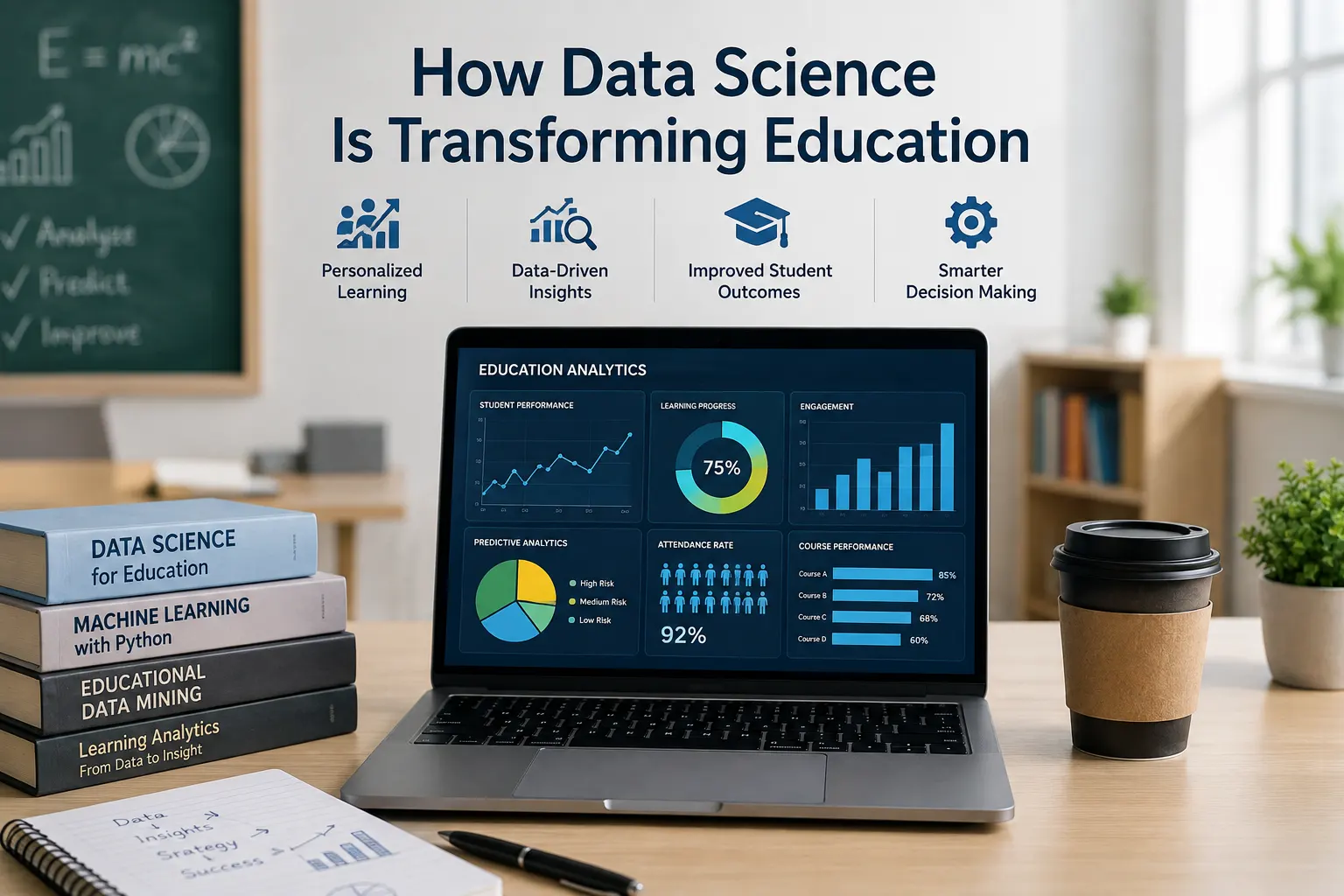
The landscape of education has undergone tremendous shifts in the last 10 years, and data science is one of the primary forces behind these changes. Data has a growing role within schools, colleges, universities and online learning platforms in enhancing approaches to learning, tailoring learning experiences and informing decision-making processes.
Educational institutions can no longer just resort to traditional teaching methods, but can now analyse the performance of their students and determine what they are missing out on, and give them the assistance they need.
With the evolution of technology, data science is now aiding teachers to make smarter classrooms and better learning outcomes. Data is transforming education through its power to predict student success, increase administrative efficiency, and more.
This blog will discuss how data science is influencing education and its significance in today’s learning.
What Is Data Science In Education?
Data science involves collecting, structuring, analysing and understanding large quantities of data to extract patterns and insights from them. This data is used in education from a variety of sources, including:
- Student attendance records
- Assignment and exam scores
- Online learning platforms
- Classroom participation
- Learning management systems
- Student feedback
- Enrollment data
This data is utilised by educational institutions for decision-making, optimising teaching methods, and enriching the student experience. You can also take guidance from Assignment Writing Service about this.
Personalised Learning Experiences:
Personalising education is one of the best benefits of data science. All students are unique, and traditional approaches to teaching do not always address their individual learning needs.
With the aid of data analytics, teachers can determine:
- Students who require extra assistance
- Suitable challenges for high-achieving students.
- Learning preferences
- Students’ subject areas of difficulty
Adaptive learning platforms leverage this to suggest personalised lessons, quizzes and study resources to suit the learning progress of every student.
Consequently, student learning is based on their strengths and weaknesses, rather than the one-size-fits-all model.
Early Identification of At-Risk Students:
Data science can help schools and universities to pinpoint students who are at risk of failing or dropping out of school.
These are considered to be good because they allow analysis of factors such as:
- Attendance
- Assignment submission rates
- Grades
- Participation levels
- Online activity
Predictive analytics can identify red flag behaviour before it becomes a problem.
Teachers and academic advisors can then intervene in a timely manner, counsel, tutor, or offer other learning resources to assist students in meeting their objectives.
This proactive strategy helps enhance student retention and student success. Students can hire Dissertation Help to help them right on time.
Improving Teaching Strategies:
The use of data science is not just for students, but also for teachers.
Teachers can review data from the classroom to gain knowledge about:
- What works and what doesn’t work!
- Identify which topics students find difficult.t
- Relationship between classroom engagement and time
- The effectiveness of assignments and assessments
The information enables teachers to make necessary adjustments to the curriculum, use new teaching methods, and concentrate on those sections of the curriculum that require extra support.
Rather than assuming, teachers can make informed decisions to enhance learning outcomes.
Smarter Curriculum Development:
Schools continually revise their courses to comply with the evolving needs of the industry. Data science offers many insights into subjects, skills and courses which are most relevant.
By analysing:
- Student performance trends
- Employment statistics
- Industry requirements
- Graduate outcomes
Universities can create courses geared toward future employment opportunities.
This means that students are equipped with the knowledge and skills that are in demand by employers.
Enhancing Online Learning:
Even if online learning is still growing, data science has become a key part in creating better, more effective virtual learning experiences.
Learning platforms process student behaviour to find out:
- Which videos are watched through?
- Students’ stopping points
- Quiz performance
- Time spent studying
- Course completion rates
This data can be used by teachers to enhance the quality of the course and clarify parts of the course.
Students are also given individualised suggestions to enrich the learning experience.
Better Student Assessment:
The traditional tests only assess a part of what a student can do. There are several performance indicators that allow continuous assessment with data science.
Schools can assess:
- Classroom participation
- Homework completion
- Project performance
- Online discussions
- Practical assignments
- Learning progress in the course of time
This can give a more detailed picture of student development than can final exams.
Efficient Resource Management:
Schools and universities operate many resources such as classrooms, faculty, technology, finances, etc.
Data science supports administrators to optimise:
- Class scheduling
- Faculty allocation
- Library resources
- Campus facilities
- Budget planning
- Student enrollment management
When resources are allocated better, the learning experience is enhanced and operational costs are reduced.
Supporting Career Guidance:
Student career choice planning can be difficult. Data science is useful for career counsellors to deliver tailored recommendations to their clients based on their strengths and interests.
Academic performance, skills, and extracurricular activities, combined with the labour market, are important factors that can be used to plan the appropriate career for students.
Pupils are exposed to industries that are expanding in importance and the skills they need to acquire to enhance their employability.
Predictive Analytics For Institutional Planning:
Schools and universities must make numerous decisions on their admissions policies, budget, staffing, and building.
Predictive analytics is a tool for administrators to predict:
- Student enrollment numbers
- Graduation rates
- Resource requirements
- Faculty needs
- Financial planning
The predictions will help in long-term planning and in decision-making.
Supporting Educational Research:
Data science is applied in the study of learning behaviour, educational policies and teaching effectiveness.
Large-scale education data can be used to:
- Recognise effective teaching approaches.
- Measure learning outcomes
- Evaluate educational reforms
- Understand student engagement
- Improve curriculum design
The knowledge gained is used to make ongoing improvements in the education system.
Conclusion:
Data science is revolutionising education by personalising, optimising, and directing learning through data. Data analytics is transforming the way education is delivered at all levels, from assisting in identifying struggling students and improving teaching methods, to enhancing online learning and aiding institutional planning.
Data science is expected to be more relevant in the future as increasingly advanced technologies are being integrated into education. Data-driven decision-making is a process that, when adopted by schools and universities, will help them make better decisions for enhancing student success, improving resources, and preparing students for the future.
The concept of education in the future is not only based on intuition and tradition. It’s growing more and more data-driven, allowing teachers to make smarter decisions to build smarter classrooms, better academic results, and more impactful learning experiences for all students.