
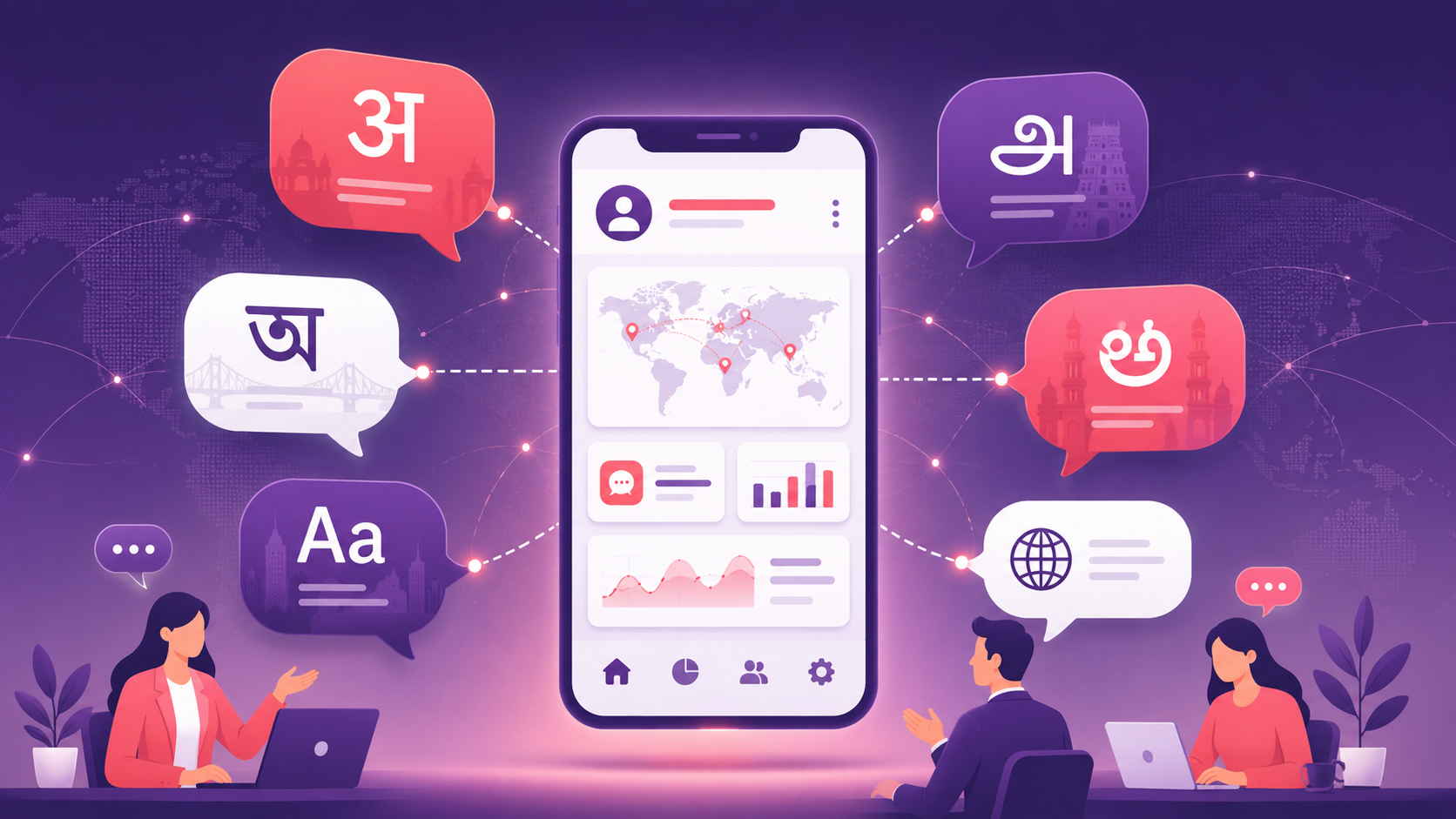
Here’s a number that doesn’t get said enough: roughly 90% of India isn’t actually comfortable transacting in English. Not reading-it-in-school comfortable. Trusting-a-stranger-with-my-money comfortable. Big difference. For years, businesses shrugged this off, fix it later, once the “real” market in English is squeezed dry. That thinking is dead now, or it should be. 4G reached villages that didn’t have paved roads a decade ago. Tier-2 and tier-3 towns are where the next growth curve lives, and that growth curve doesn’t speak English by default. Regional language support stopped being a backlog item somewhere in the last two or three years. It’s closer to plumbing now: invisible when it works, catastrophic when it’s missing. Below are eight reasons this shift is real, not hype, and why ignoring it is expensive.
Quick caveat before the list: none of this is about abandoning English. It’s about not pretending English is the only door into your product. The commercial case is blunt: customers convert more, trust faster, and stay longer when addressed in their own language. Shows up in the numbers. BFSI, healthcare, logistics, recruitment, edtech all quietly rebuilding around this right now.
1. The Next Wave of Users Isn’t Coming from Metro India
Next 300-400 million internet users? Small towns. Rural belts. Places where English was never part of daily conversation. These users shop fine, browse fine, transact fine, just not in English. Hindi, Tamil, Telugu, Bengali, Marathi, take your pick. Push them into an English-only screen, and they bounce, fast. No loyalty to fight for if they never got past the homepage.
2. Voice Search Skews Vernacular, and It’s Not Close
Typing in a second language is work. Speaking isn’t. That’s the whole reason voice search is growing faster in regional languages than English: it removes the keyboard-literacy tax entirely. Support lines, IVR, digital assistants all need rethinking around this. A Voice AI Platform that actually handles multiple Indian languages well (not just technically “supports” them) wins markets that typed English always locked out.
3. Familiar Language Builds Trust Faster — No Way Around This
Insurance, lending, healthcare. Categories where a wrong click costs real money or real health. People open up faster, ask more questions, actually finish transactions when it’s happening in a language they think in. English-only interfaces create friction you won’t see on a dashboard; it just shows up as drop-off, right when you need the customer to commit.
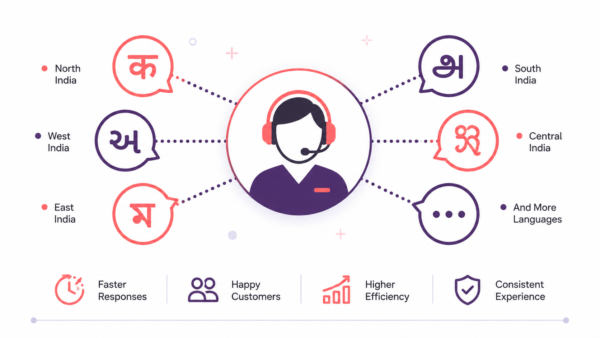
4. Support Costs Fall When the Language Barrier Disappears
Tickets close faster in a customer’s own language. Fewer escalations. Fewer “let me transfer you.” Every minute an agent spends untangling broken English is a minute that costs money and annoys the customer. This isn’t just a nicer experience; it’s a straight efficiency play, and a fairly obvious one once you look at average handle time by language.
5. Regulation Is Already Moving This Direction
Digital India pushes, state-level mandates, and sector rules tightening in banking and insurance local language interfaces are shifting from optional to expected. Move early, and the rollout is smooth. Wait, and it’s a scramble against a deadline someone else set for you.
6. It’s One of the Few Differentiators Left
Fintech, edtech, D2C features converge fast, pricing wars eat margin, everyone looks the same after eighteen months. Language capability is hard to copy overnight. Ten regional languages done well is a real moat next to a competitor still running clunky machine-translated screens.
7. NLP Finally Made This Affordable
Used to mean hiring huge multilingual teams or shipping stiff, literal translations nobody liked. Not anymore. Modern NLP handles nuance, code-switching, and dialect variation at a fraction of the old cost. Mid-sized businesses can do this now. Not just enterprises with a localization budget the size of a small country’s GDP. Multilingual Voice AI for Indian Languages is making this multilingual capability even more accessible.
8. Retention Lives or Dies on Whether Communication Feels Native
Acquisition gets someone in the door. Retention pays the bills. Customers who feel understood no lost-in-translation moments, no waiting for the “English speaker” to be free just stay longer. Subscription businesses feel this hardest. Every small language-related drop-off compounds, quarter after quarter, until it’s a real dent in lifetime value.
Eight reasons, one thread running through all of them: trust, conversion, cost, retention the actual levers of growth all move when language does. Companies still treating this as a minor add-on are handing a whole market segment to whoever shows up speaking the customer’s language first.
Enterprise procurement is already catching up to this. Voice AI Agents capable of natural, dialect-aware conversation across Indian languages are turning into a checklist item during vendor evaluation, not an afterthought. Rootle and other similar competitor companies in this space built their entire pitch around exactly this gap, letting enterprises run customer-facing automation that doesn’t force users through an English-only funnel they never wanted to be in. Move now, not once regional language becomes table stakes, and the advantage is gone.
How Businesses Should Approach This Shift
Knowing regional language support matters is one thing. Actually building for it is another, and this is usually where companies stumble. The instinct is often to bolt on translation as an afterthought, run existing English content through a translation layer, and call it done. That approach rarely works. Literal translation misses tone, misses cultural context, and often reads as stiff or even slightly wrong to a native speaker, which defeats the entire purpose.
A more effective approach starts with prioritization. Not every business needs to launch in fifteen languages on day one. Look at where the actual customer base sits which states, which language clusters, which use cases carry the highest transaction volume and build outward from there. A BFSI company serving Maharashtra and Gujarat gets more value from nailing Marathi and Gujarati first than spreading thin across languages with minimal customer overlap.
Technology choices matter just as much as language choice. Voice-first interactions, in particular, need systems capable of handling code-switching the way Indian users naturally blend English words into Hindi or Tamil sentences mid-conversation. A system that breaks the moment a user mixes languages creates more frustration than one that never offered vernacular support at all. This is where the underlying AI architecture, not just the language list on a marketing page, ends up determining whether the investment actually pays off.
Finally, this isn’t a one-time project with a launch date and a wrap party. Language models, customer expectations, and regional dialects all shift over time. Businesses that treat regional language support as a living part of their product something reviewed, measured, and refined the same way conversion funnels or pricing are tend to see compounding returns rather than a short-lived bump after launch.
Conclusion
Regional language support went from courtesy to requirement, quietly, over the last few years, and most businesses haven’t fully caught up to that yet. The case holds: bigger addressable market, faster trust, lower support cost, regulatory alignment, real differentiation, better retention. Not an argument against English. An argument against treating it as the only option. Businesses building genuine multilingual capability now, particularly through Voice AI for Indian Languages, are positioning for a market that’s always existed but used to be too expensive and too technically messy to reach well. That barrier keeps dropping. The gap between early movers and everyone still waiting is only going to get harder to close.