
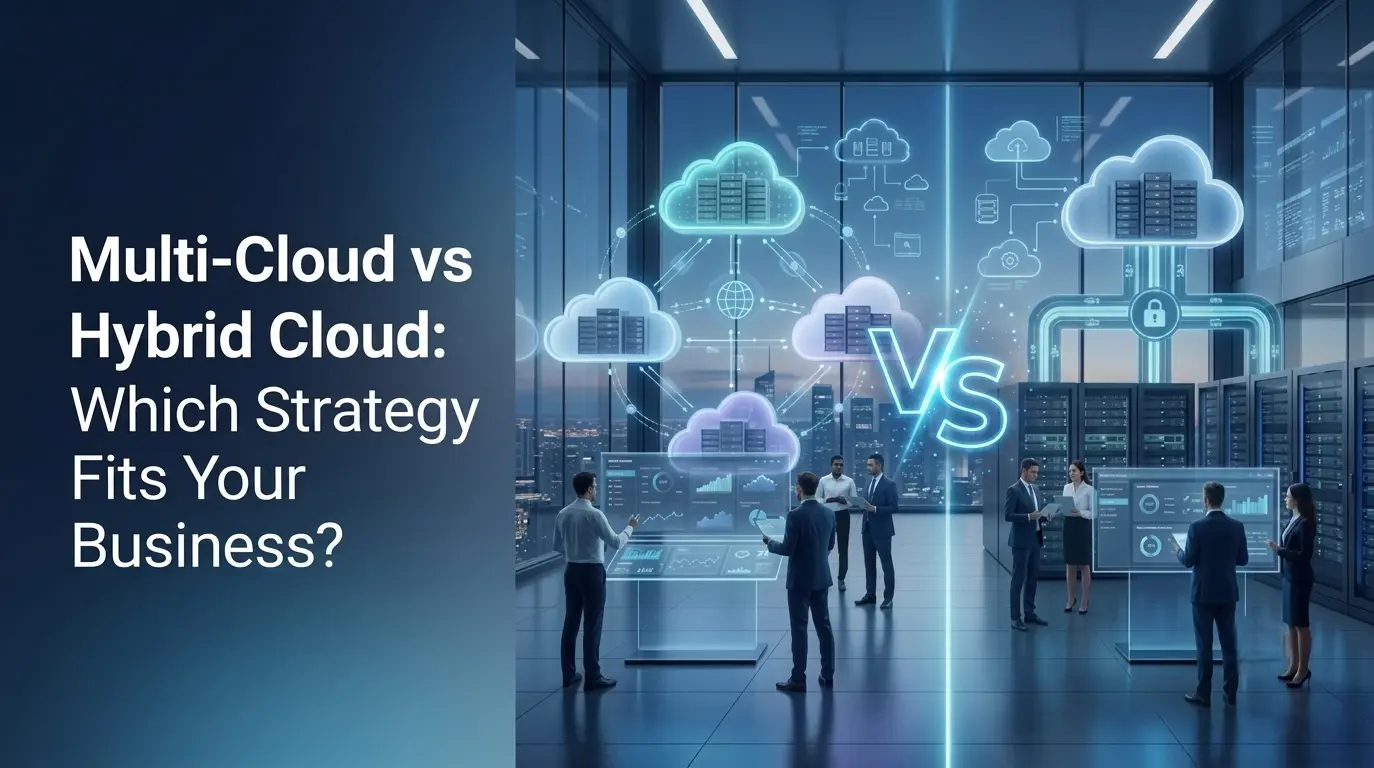
Cloud adoption has evolved beyond simply moving applications from on-premises servers to the cloud. As businesses scale, expand into new markets, and modernize legacy systems, many discover that relying on a single cloud environment no longer meets their performance, security, or compliance needs.
This is where multi-cloud and hybrid cloud strategies come into play. Although these terms are often used interchangeably, they solve different business challenges. Choosing the right approach can improve application performance, strengthen security, reduce downtime, and provide greater flexibility as your business grows. Working with an experienced cloud consulting company can help businesses evaluate their infrastructure, migration goals, and long-term scalability requirements before selecting the right cloud strategy. In this guide, you’ll learn the key differences between multi-cloud and hybrid cloud, their advantages, ideal use cases, and how to determine which strategy aligns with your business goals.
What Is Hybrid Cloud?
A hybrid cloud combines a private infrastructure, such as an on-premises data center or private cloud, with one or more public cloud platforms. These environments are connected, allowing applications and data to move securely between them when required.
Instead of replacing existing infrastructure, a hybrid cloud extends it. Businesses can continue running sensitive workloads in their private environment while leveraging public cloud services for scalability, analytics, backups, or customer-facing applications. As highlighted in any comprehensive cloud app development guide, selecting the right cloud architecture early helps build secure, scalable, and high-performing applications that can evolve with changing business needs.
For example, a healthcare company may store patient records in a private environment to meet compliance requirements while hosting its appointment-booking application in a public cloud to handle fluctuating user traffic.
Key characteristics of a hybrid cloud
- Combines private and public cloud environments
- Enables secure data sharing between environments
- Supports gradual migration from legacy infrastructure
- Offers greater control over sensitive applications
- Helps meet industry-specific compliance requirements
Benefits of a Hybrid Cloud
- Enhanced security: Keep sensitive business data in a private environment while using the public cloud for less critical workloads.
- Better compliance: Meet industry regulations by storing regulated data in private infrastructure without limiting scalability.
- Lower modernization risk: Modernize legacy systems gradually without disrupting existing business operations.
- Flexible resource allocation: Run critical workloads on private infrastructure and use public cloud resources to handle peak demand efficiently.
What Is Multi-Cloud?
A multi-cloud strategy involves using cloud services from multiple public cloud providers instead of relying on just one.
For instance, a business may host customer-facing applications on Amazon Web Services (AWS), use Microsoft Azure for analytics, and deploy AI services through Google Cloud. Each platform is selected based on its strengths, pricing, or specialized capabilities.
Unlike hybrid cloud, multi-cloud does not necessarily include private infrastructure. The focus is on distributing workloads across multiple public cloud providers.
Key characteristics of a multi-cloud strategy
- Uses two or more public cloud providers
- Reduces dependence on a single vendor
- Optimizes workloads based on provider strengths
- Improves service availability and resilience
- Offers greater flexibility in cloud adoption
Benefits of a Multi-Cloud Strategy
- Reduced vendor lock-in: Avoid dependence on a single cloud provider by distributing workloads across multiple platforms.
- Improved reliability: Minimize downtime by running workloads across different cloud providers, ensuring better business continuity.
- Access to specialized services: Leverage the unique strengths of different providers for AI, analytics, databases, storage, or application hosting.
- Global performance optimization: Deploy applications on cloud providers with the strongest regional presence to improve speed and user experience.
Multi-Cloud vs Hybrid Cloud: Key Differences
Although both strategies involve multiple cloud environments, their objectives and architecture differ significantly.
| Feature | Hybrid Cloud | Multi-Cloud |
| Infrastructure | Private cloud combined with public cloud | Multiple public cloud providers |
| Primary goal | Balance security with scalability | Improve flexibility and avoid vendor lock-in |
| Private infrastructure | Required | Not required |
| Compliance | Strong choice for regulated industries | Depends on cloud provider capabilities |
| Vendor dependency | Partial dependence on one public provider | Reduced dependence across multiple providers |
| Complexity | Moderate | Higher due to multiple platforms |
| Cost optimization | Balances existing infrastructure with cloud resources | Optimizes spending across providers |
| Disaster recovery | Supports backup between private and public environments | Enables cross-cloud redundancy |
| Best suited for | Enterprises with legacy systems | Digital-first businesses and global SaaS products |
Why Businesses Are Moving Beyond a Single Cloud
A single cloud provider may work well during the early stages of business growth. However, as organizations expand, they often face challenges that require a more flexible infrastructure strategy. Gartner predicts that more than 90% of organizations will adopt a hybrid cloud approach through 2027, driven by digital transformation initiatives and evolving business requirements.
Some common drivers include:
- Growing application traffic across multiple regions
- Increasing regulatory and compliance requirements
- Rising concerns about vendor lock-in
- Business continuity and disaster recovery planning
- Legacy application modernization initiatives
- Demand for AI, analytics, and specialized cloud services
- Cost optimization across workloads
These factors have made hybrid and multi-cloud strategies an important part of modern digital transformation initiatives.
When Should Your Business Choose a Hybrid Cloud?
A hybrid cloud strategy is the right choice when your business needs to balance security, compliance, and scalability without completely replacing existing infrastructure. Instead of migrating everything to the public cloud, you can modernize at your own pace while continuing to leverage on-premises investments.
This approach is especially valuable for organizations that handle sensitive data or operate under strict regulatory requirements.
Your business should consider a hybrid cloud if you:
- Manage confidential customer or financial data
- Operate in highly regulated industries like healthcare, banking, or government
- Have significant investments in legacy infrastructure
- Need to modernize applications gradually instead of rebuilding everything
- Require secure disaster recovery and backup solutions
- Want to scale customer-facing applications without moving critical systems off-premises
When Should Your Business Choose a Multi-Cloud Strategy?
A multi-cloud strategy is best suited for organizations that prioritize flexibility, resilience, and access to the best cloud services available. Instead of depending on a single provider, businesses distribute workloads across multiple public clouds based on performance, pricing, geographic availability, or specialized capabilities.
This strategy has become increasingly popular among SaaS companies, global enterprises, and digital-first businesses that require continuous availability.
Choose multi-cloud if your business:
- Wants to avoid vendor lock-in
- Operates across multiple countries or regions
- Requires high availability and business continuity
- Uses specialized services from different cloud providers
- Needs workload optimization based on pricing or performance
- Supports large-scale digital products with global users
Hybrid Cloud vs Multi-Cloud: Which Strategy Is Better?
There is no universally better option. The right choice depends on your business objectives, regulatory environment, existing infrastructure, and long-term growth plans.
The table below can help simplify the decision.
| If your business needs | Choose |
| Regulatory compliance | Hybrid Cloud |
| Legacy application modernization | Hybrid Cloud |
| Maximum control over sensitive data | Hybrid Cloud |
| Global application deployment | Multi-Cloud |
| Reduced vendor lock-in | Multi-Cloud |
| High availability across providers | Multi-Cloud |
| Best-in-class cloud services | Multi-Cloud |
| Gradual cloud migration | Hybrid Cloud |
| AI and advanced analytics from multiple vendors | Multi-Cloud |
| Long-term infrastructure flexibility | Multi-Cloud |
Think of hybrid cloud as an evolution of existing infrastructure, while multi-cloud is an optimization strategy for cloud-native operations.
Best Practices for Cloud Strategy Success
Regardless of whether you choose a hybrid cloud or multi-cloud strategy, following these best practices can help improve security, performance, and long-term scalability.
- Develop a cloud roadmap: Define clear business objectives, migration priorities, timelines, budgets, and success metrics before moving workloads to the cloud.
- Prioritize security from the beginning: Implement strong identity and access management (IAM), encryption, continuous monitoring, and regular security assessments across all cloud environments.
- Standardize governance: Establish consistent policies for compliance, access control, workload management, and resource provisioning to simplify operations and reduce risks.
- Monitor cloud spending: Continuously track resource usage and optimize infrastructure with cloud cost management tools to prevent unnecessary expenses.
- Automate wherever possible: Use infrastructure automation, CI/CD pipelines, and automated monitoring to improve deployment speed, consistency, and operational efficiency.
- Modernize strategically: Evaluate each application individually and choose the right modernization approach, such as rehosting, replatforming, refactoring, or rebuilding, based on business and technical requirements.
Conclusion
Both hybrid cloud and multi-cloud are effective cloud strategies, but they address different business needs. Hybrid cloud is ideal for organizations looking to modernize legacy systems, maintain greater control over sensitive data, and meet regulatory requirements. Multi-cloud, on the other hand, provides greater flexibility, reduces vendor dependency, and enables businesses to leverage the best capabilities from multiple cloud providers.
Rather than asking which model is better, the more important question is which one aligns with your business objectives, operational requirements, and long-term growth strategy. A well-planned cloud strategy should support innovation while balancing security, performance, and cost efficiency. As organizations continue investing in digital transformation and application modernization, choosing the right cloud architecture becomes a strategic business decision rather than just a technical one. At RipenApps, this business-first approach extends to cloud architecture services, helping organizations align their cloud environments with application needs, security requirements, scalability goals, and long-term growth.
Frequently Asked Questions
1. What is the main difference between multi-cloud and hybrid cloud?
Hybrid cloud combines private infrastructure with public cloud services, while multi-cloud uses multiple public cloud providers. Hybrid cloud focuses on integrating existing infrastructure, whereas multi-cloud emphasizes flexibility and vendor independence.
2. Which is more secure: hybrid cloud or multi-cloud?
Hybrid cloud generally provides greater control over sensitive workloads because critical data can remain in private infrastructure. However, both strategies can achieve strong security when implemented with proper governance and security controls.
3. Is multi-cloud more expensive than hybrid cloud?
Not necessarily. Multi-cloud can optimize costs by leveraging competitive pricing across providers, but managing multiple platforms may increase operational expenses. The overall cost depends on architecture, workloads, and management practices.
4. Can a business use both hybrid cloud and multi-cloud?
Yes. Many enterprises adopt a combination of both strategies by maintaining private infrastructure while also using multiple public cloud providers. This approach offers maximum flexibility but requires advanced management and governance.
5. How do I decide which cloud strategy is right for my business?
Start by evaluating your compliance requirements, existing infrastructure, business growth plans, budget, and technical expertise. Organizations with legacy systems often benefit from hybrid cloud, while businesses seeking scalability and vendor flexibility may find multi-cloud more suitable.