
Introduction
As digital landscapes expand, the methods used to protect them must evolve. Modern cybersecurity needs a new approach because traditional, perimeter-based defenses are increasingly bypassed by sophisticated, AI-powered cyber threats. Decentralized AI represents a paradigm shift, moving security intelligence away from a single vulnerable point to a distributed, resilient network. This guide explores how this technology works, the challenges it addresses, and its future in a hyper-connected world.
What Is Decentralized AI?
A Simple Definition
Decentralized AI is an architecture where artificial intelligence processing is distributed across multiple nodes rather than being confined to a central server.
How Decentralized AI Works
Instead of sending all sensitive data to a central cloud for analysis, the intelligence is moved to where the data resides. This allows for localized decision-making while maintaining global network awareness.
Core Components of Decentralized AI
- Distributed AI Models: AI models that run across various devices simultaneously.
- Edge Computing: Processing data at the “edge” of the network, closer to the source.
- Federated Learning: Training AI on local data samples without actually exchanging the data itself, which preserves privacy.
- Blockchain Technology & Smart Contracts: Used to ensure data integrity and automate security protocols.
- Peer-to-Peer (P2P) Networks: Removing the need for a central intermediary.
Understanding Modern Cybersecurity Challenges
Organizations today face an unprecedented volume of cyberattacks, particularly as AI-supported cybercrime reaches new levels of sophistication. Modern attackers leverage automated machine learning to bypass traditional perimeter defenses. Centralized security systems often struggle with data privacy concerns and the persistent risk of insider threats, where a single compromised account can grant access to an entire repository.
Why Traditional Cybersecurity Models Are No Longer Enough
The fundamental flaw in traditional models is the Single Point of Failure; if the central hub is breached, the entire system collapses. These models suffer from centralized data storage risks, limited scalability, and slow threat detection times as data must travel back and forth from the cloud. Furthermore, maintaining massive centralized data centers results in high infrastructure costs.
How Decentralized AI Improves Cybersecurity
Decentralized AI transforms defense by enabling distributed threat detection, allowing every node in a network to act as a security guard.
- Real-Time Attack Identification: Threats are identified at the edge immediately.
- Faster Incident Response: Automated decisions can be made locally to isolate a threat before it spreads.
- Secure Data Sharing: Using privacy-preserving AI models, organizations can share threat intelligence without exposing raw, sensitive data.
Key Technologies Behind Decentralized AI Security
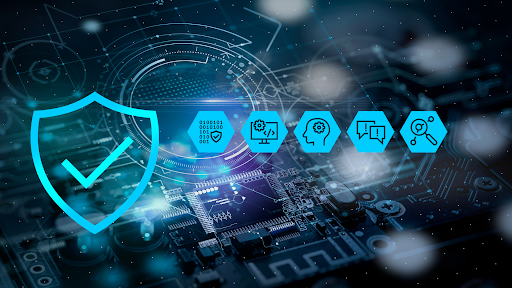
- Federated Learning: Essential for training global models on private data.
- Blockchain & DLT: Provides a tamper-proof record for data integrity.
- Edge AI: Facilitates local intelligence on IoT and mobile devices.
- Zero-Trust Architecture: Operates on the principle of “never trust, always verify,” even within the network.
- Secure Multi-Party Computation (SMPC): Allows multiple parties to compute a function over their inputs while keeping those inputs private.
Benefits of Using Decentralized AI in Cybersecurity
The primary advantage is enhanced data privacy, as sensitive information never leaves its source. By distributing the intelligence, organizations see improved threat detection accuracy and a significantly reduced single point of failure. This architecture offers better scalability and stronger network resilience, allowing the system to continue learning from distributed data even if parts of the network are offline.
Real-World Applications

- Financial Services: Detecting fraud across distributed banking nodes.
- Healthcare Systems: Securing patient records while allowing for research through federated learning.
- Internet of Things (IoT) & Smart Cities: Managing millions of connected devices securely.
- Government & Critical Infrastructure: Protecting power grids and public services from targeted attacks.
Beyond enterprise systems, consumer-facing digital vectors also amplify malware risks—for instance, widespread security risks associated with illegal TV-Streams in Deutschland frequently expose end-users to drive-by downloads, botnets, and data theft that traditional security measures struggle to contain.
Decentralized AI vs Traditional AI in Cybersecurity
| Feature | Traditional AI | Decentralized AI |
| Architecture | Centralized / Cloud-based | Distributed / Edge-based |
| Data Processing | Sent to central server | Localized processing |
| Privacy Protection | High risk of exposure | Privacy-preserving (Federated) |
| Fault Tolerance | Low (Single point of failure) | High (Resilient network) |
| Transparency | Often “Black Box” | Increased via Blockchain |
Challenges and Limitations
Implementation is not without hurdles. It requires complex deployment strategies and often involves higher initial costs. Technical issues like model synchronization across thousands of nodes and network latency can impact performance. Additionally, navigating regulatory compliance and governance challenges in a decentralized environment remains a significant task for legal teams.
Best Practices for Implementing Decentralized AI Security
- Adopt a Zero-Trust Model: Never assume a device is safe just because it is on the network.
- Encrypt Data at Every Stage: Use robust encryption for data at rest and in transit.
- Continuous Monitoring: Use continuous model monitoring to detect drift or adversarial attacks on the AI itself.
- Validate Outputs: Regularly check AI decisions to ensure accuracy.
- Train Employees: Human error remains a major factor; specialized AI security training is vital.
Future Trends
The next frontier includes autonomous AI security agents that can self-heal networks and the integration of Quantum-Resistant Security to protect against future computing threats. We also expect to see a rise in Decentralized Identity (DID) and Confidential Computing, further cementing privacy as a core component of digital infrastructure.
Frequently Asked Questions (FAQ)
- What is decentralized AI in cybersecurity? It is a distributed approach to security where AI models process data locally across various nodes rather than in one central location.
- Is blockchain necessary? No. While blockchain provides excellent data integrity, decentralized AI can also function through federated learning and edge computing alone.
- Can it prevent ransomware? While no system is 100% foolproof, its ability to detect and isolate threats at the edge makes it highly effective at stopping ransomware from spreading.
Conclusion
Decentralized AI enhances cybersecurity by providing a distributed, resilient, and privacy-preserving framework for threat management. It is important to remember that this technology complements—not replaces—traditional controls. Organizations should look toward a layered, future-ready strategy that leverages decentralized intelligence to stay ahead of an ever-evolving threat landscape.