Skip to content

Data Science Society

Data.Platform

  • Events
  • News
  • Learn
    • Cases
    • Solutions
    • Courses
    • Monthly Challenge
  • Datathons
    • Datathon NFT 2022
    • Datathon 2020
    • Datathon 2019
    • Hack News Datathon
    • Global Datathon
    • Academia Datathon
    • Datathon 2018
    • Datathon 2017
  • Society
    • About Us
    • Join Slack
    • Contact us
    • Help
  • Sign in
News

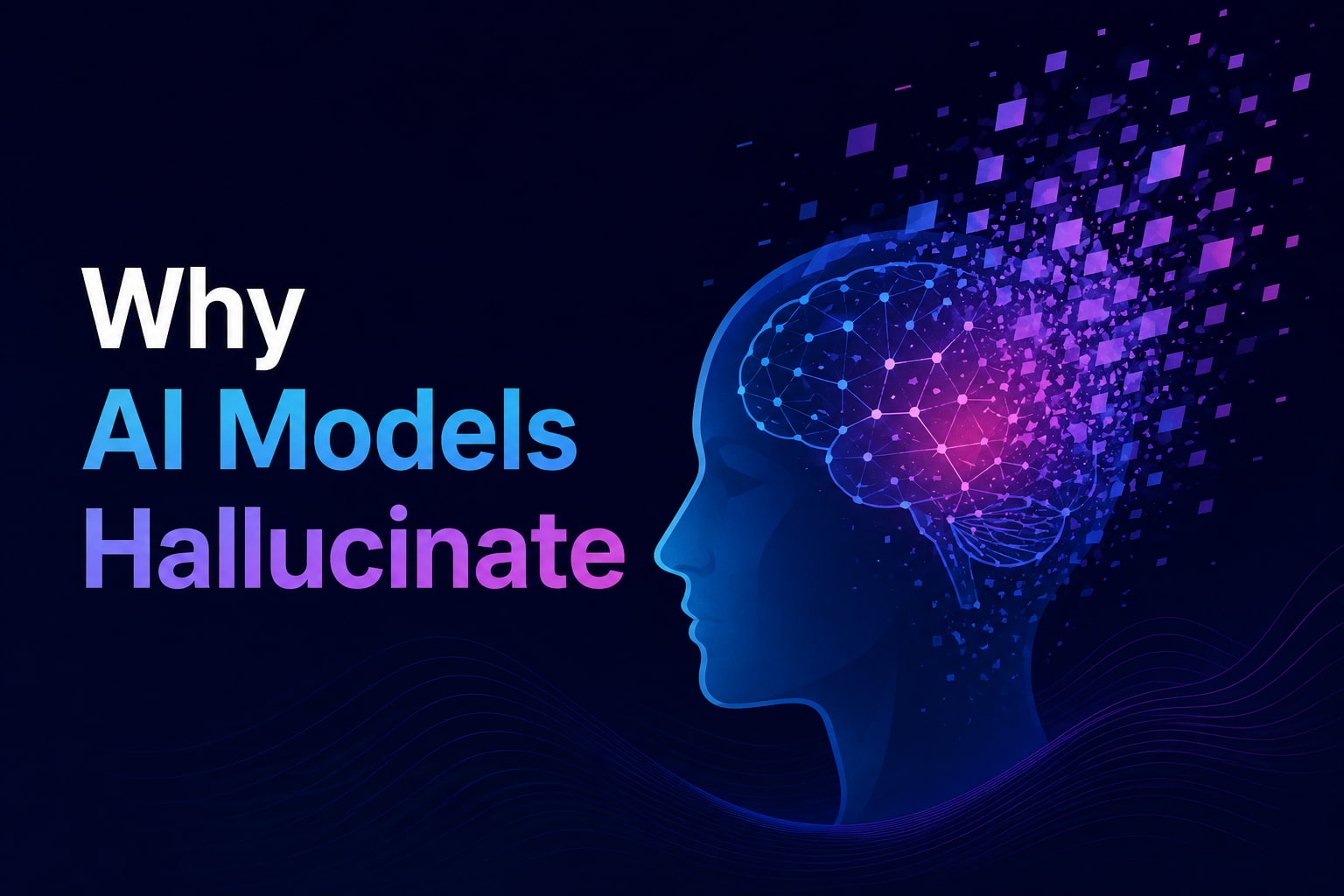
Why AI Models Hallucinate Even When Trained On High Quality Data?

Posted 22.07.2026 himanshuwrites

AI models still make up facts, even when trained on clean, high-quality data. This is not just a data problem. OpenAI’s own research shows hallucination comes from how models are trained and scored, not from bad inputs alone. Benchmarks reward confident guessing over honest uncertainty, so models learn to bluff instead of saying “I don’t know.” This piece breaks down the real causes, shares real-world consequences, and gives simple steps to catch AI errors before they cause harm.

Your AI chatbot sounds so sure of itself. It gives you a name, a date, a fact. Then you check it. And it is wrong.

This is called hallucination. Many people think bad data causes it. But that is not the full story. Even with clean, high quality data, AI models still make things up.

What Hallucination Actually Means?

Hallucination happens when an AI states something false as if it were true. It does not say “I am not sure.” It just answers, with full confidence.

Think of a kid guessing on a test. If blank answers get zero marks, why leave it blank? Guessing might get lucky. AI models do the exact same thing.

The Real Reason: We Trained Them To Guess

In September 2025, OpenAI researchers published a paper that changed how people understand this problem. Adam Tauman Kalai and his team studied ten major AI benchmarks. Nine out of ten used a scoring system where a wrong guess and “I don’t know” both earned zero points (Computerworld, 2025).

That is the trap. If honesty scores the same as a lie, the model has no reason to be honest.

The researchers compared this to students facing hard exam questions. Both guess when unsure, instead of admitting they don’t know (arXiv, 2025). That single comparison explains a lot.

It’s Not Just About Bad Data

Most people assume hallucination happens because the training data had errors, junk, or bias. That is called Garbage In, Garbage Out, or GIGO.

But OpenAI’s paper goes further. Even with flawless training data, large language models can never be all-knowing. Some questions are simply unanswerable, no matter how good the data is (AAAS Science, 2025).

So even a perfectly clean dataset cannot stop hallucination completely. Three mathematical reasons explain why:

  • Rare facts: If something appeared only once or twice in training, the model barely learned it.
  • Model limits: Some tasks are simply too complex for the model’s architecture to represent correctly.
  • Impossible problems: Some questions are computationally hard, even for a very smart system.

This is not a bug someone forgot to fix. It is baked into how these models work.

A Quick Comparison Table

Cause of Hallucination Can Better Data Fix It? Why
Dirty or biased training data Yes, partly Cleaning data reduces this type of error
Binary grading in benchmarks No Model still gets rewarded for confident guessing
Rare or one-off facts No Data quality doesn’t fix rarity, more examples might
Inherently unanswerable questions No Some things simply cannot be known for certain

Real World Cost Of This Problem

This is not just a small glitch. When OpenAI’s Whisper transcription tool was used in medical settings, it showed hallucination rates between 50 and 80 percent in some cases, sometimes inventing medical terms in patient notes (AI Consciousness, 2026).

Imagine a doctor reading a wrong diagnosis that was never actually spoken. That is not a small mistake. That is dangerous.

This is why businesses using AI tools for content, customer support, or decision-making need proper checks in place. It is also why conversations around AI governance matter so much right now, especially for companies scaling AI use across teams. Someone still needs to review the output before it reaches a real person (AI Governance).

Why Fixing This Is So Hard

You would think the fix is simple. Just tell the model to say “I don’t know” more often. But leaderboards do not reward that.

The training loops, the benchmarks, and the leaderboards that decide which model gets called best all use one scoring system. That system treats a confident wrong answer and honest uncertainty as equally worthless (Iain Harper’s Blog, 2026).

So a model that plays it safe and admits uncertainty looks weaker on paper. A model that guesses confidently, even wrongly, often scores higher. This creates a strange incentive. Confidence gets rewarded over honesty.

What Companies Are Trying Now?

Some labs are starting to shift direction. OpenAI and Anthropic ran a joint safety evaluation in August 2025, testing training methods that build calibrated uncertainty directly into model behavior.

New benchmarks are also showing up. Names like HalluLens and HalluHard are gaining attention because they specifically measure hallucination, not just raw accuracy.

Still, this shift has not reached most public leaderboards yet. Model marketing still leans heavily on accuracy scores. Until that changes, the underlying incentive to guess will likely stick around.

Simple Ways To Protect Yourself From AI Errors

You do not need to wait for AI labs to fix this. A few habits help a lot:

  1. Always double-check facts, dates, and numbers from AI answers.
  2. Ask the AI to show its sources, then verify those sources yourself.
  3. Be extra careful with medical, legal, or financial answers.
  4. Treat AI output as a first draft, not a final answer.

The Bigger Picture

AI hallucination is not really a data problem. It is closer to an incentive problem. We built systems that get rewarded for sounding sure, not for being right.

GPT-5 hallucinates less than older models, especially during reasoning tasks. But even OpenAI itself admits hallucinations remain a fundamental challenge across all large language models (OpenAI, 2025).

So next time an AI tool gives you a confident answer, pause for a second. Confidence is not the same thing as correctness. That gap is exactly where hallucination lives.

Share this

ai hallucination, ai training, Large Language Models

Search

EVENTS

2022

WHAT’S POPULAR THESE DAYS

Datathon – Sofia Air 2.0 – Solution – Wonder Gang: Articles on Particles

14.04.2019

Datathon Kaufland Solution – LSTM and EDM Models for Predictive Maintenance

29.09.2018

Datathon – HackNews – Solution – FlipFlops

27.01.2019

LATEST ARTICLES

  • Will call center agents be replaced by real-time AI? 27.01.2025
  • Common Angular Performance Issues and How to Fix Them 30.09.2026
  • Key Advantages of Fitness App Development for Business Growth 15.05.2026
  • How Chicago Businesses Can Use AI-Powered IT Solutions to Cut Downtime and Boost Security 16.04.2026
  • How Do People Fall in Love with an AI Generated Companion? 20.02.2026

Data Science Society Sitemap

  • Home
  • Learn
    • Cases
    • Solutions
  • Datathons
  • Monthly Challenge
  • The Society
    • News
    • Events
  • DataChat
  • About Us
    • Contact us
    • Privacy Policy
  • Help

Data Science Society

Serdika 20, Sofia
+359 888400290
info@datasciencesociety.net

This website uses cookies. Learn more

© 2026 Data Science Society. Proudly powered by Sydney