
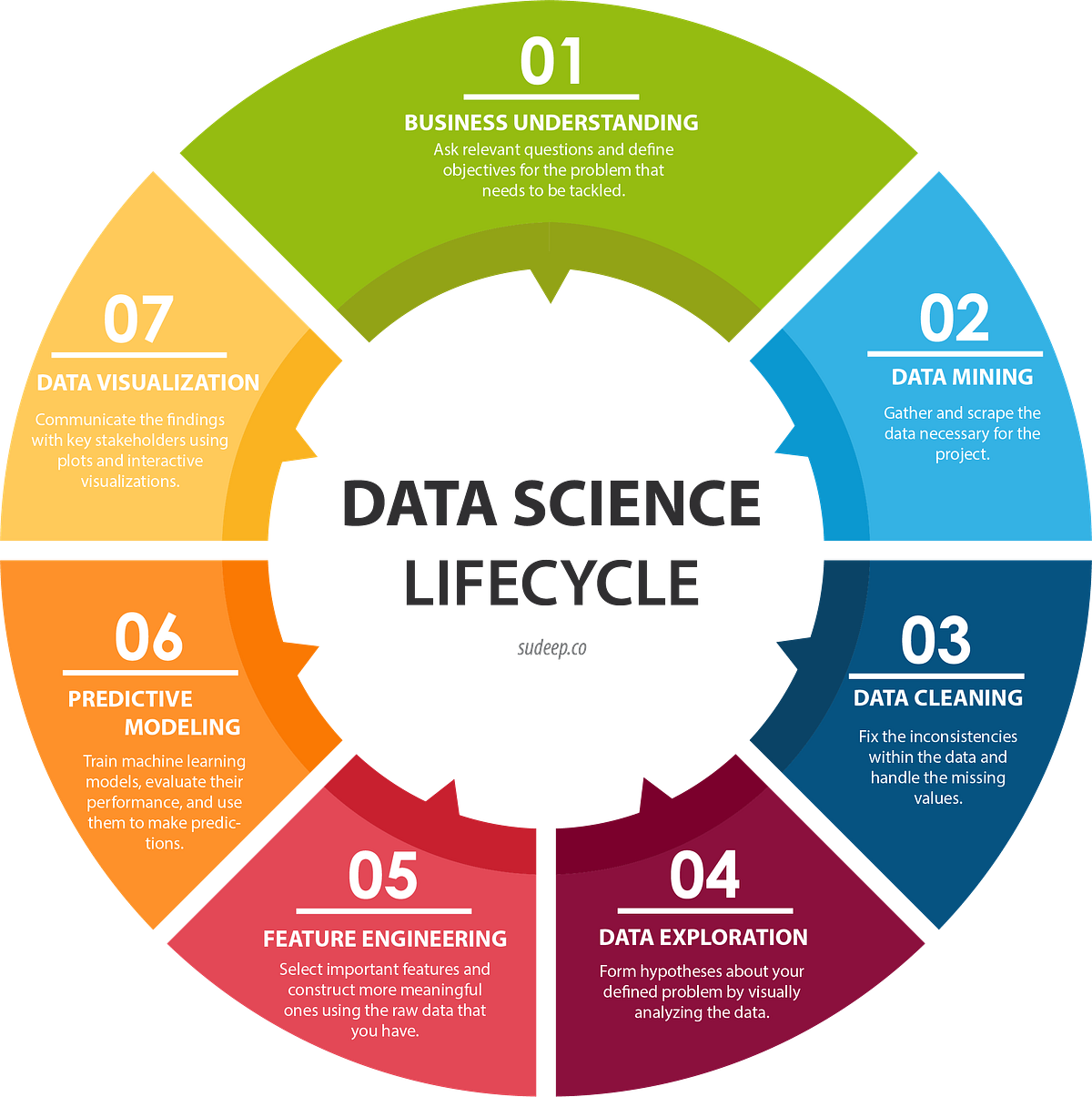
Data science is the study of extracting valuable information from large datasets using tools, algorithms, and scientific methods.
This field is naturally interdisciplinary since it merges expertise from stats, IT, math, and domain-specific knowledge.
Because of that, the domain is highly versatile, and this field has a wide range of real-life applications like healthcare, finance, marketing and environmental research.
So, learning big data and how to make sense of it is more essential now than it was in the past. You have to remain connected with the fast-changing corporate world.
If you are a career changer, learner, or recent graduate who wants to pursue a career in STEM and computer science, becoming a data scientist is the best choice for you.
Let’s begin the article.
Data Science Career Roadmap
Here is the data career roadmap from beginner to advanced levels.
Stage 1: Learn Fundamental Computer Science Skills
These computer science skills are effective and valuable in the field of IT. Below are the key and basic skills you must learn to become a data scientist.
Python
It is the most essential programming language for data science.
DSA (Data Structures amp; Algorithms)
It boosts problem-solving and interview performance. So you must learn these skills.
Git amp; GitHub
These skills will help you handle and share your code.
Cloud Computing (AWS Recommended)
These days, large, modern firms use cloud-based data systems. Financial institutions like banks, tech firms, and multinational firms mostly use cloud architecture.
By learning these skills, you will take your data science career to the next stage.
Stage 2: Master Data Handling Skills
Once you have learned fundamental data skills, it is time to learn and master data-handling skills.
SQL
These skills are used in almost every company, from IT to finance to healthcare. So, you need to learn databases such as.
- MySQL
- PostgreSQL
- Big Query
Pandas
This skill is best for data cleaning and analysis, and will be use nearly 70% of your job.
NumPy
It is basically NumPy, a core library for scientific computing in Python.
Moreover, it offers quick and fast numerical calculations. So, you have to aim on your skill growth in these core abilities in order to manage and analyse data optimally.
Data Visualization
Here is the wide range of skills you will learn in data visualization.
- Matplotlib
- Seaborn
- Tableau / Power BI
Stage 3: Learn Core Maths for Machine Learning
To become a data scientist, you have to learn and grasp these basic concepts and skills.
- Stats and probability
- Linear Algebra
- Calculus (Basic Intuition)
Remember, without learning math, machine learning feels like guessing, and you cannot calculate math on the basis of a guess.
Stage 4: Core Machine Learning
Here are the fundamental data science and ML concepts you must learn.
Supervised Learning
- Regression
- Classification
Unsupervised Learning
- Clustering
- Dimensionality Reduction
Feature Engineering
Producing smart signals for the model.
Model Evaluation
Accuracy, precision, recall, F1-score, ROC-AUC, etc.
Scikit-Learn
Key library for employing machine learning algorithms
Work on projects
Here is the work on project examples.
- Sales forecasting
- Customer churn prediction
- Recommendation system
- Uber wait-time prediction
Practice on Kaggle
Finally, if you want to practice on Kaggle, you must create a solid portfolio. Because it is vital for getting interviews.
Step 5: Advanced Data Science Learning (This is optional for beginners)
At the last stage, once you master the above skills, you will need to learn these advanced skills.
- Deep Learning
- Neural Networks
- CNN, RNN, LSTM
- PyTorch / TensorFlow / Keras
- Model deployment (Flask, FastAPI, AWS)
To learn online step by step and become a Data scientist by developing effective skills, you can seek consultation from seasoned Data Science Assignment Help. The brand owns a team of certified tutors and consultants who specialise in ML; they will help you solve all of your queries.
Educational Pathway
In order to become a data scientist and pursue a career in data science, you must have the following educational qualifications.
1. Traditional Degree pathway
- Undergrad degree- You need an undergraduate degree in a field of ML, computer science, maths or statistics in order to create a solid theory foundation.
- Graduate- A lot of positions in this domain need a postgraduate or even PHD in Machine learning and AI for advanced research and modelling roles.
2. Bootcamps and Wide Certificates
This is best if you graduated in a non-STEM domain. Or if you need quick and hands-on practical experience to create a portfolio.
Focus Areas: SQL, Python, ML and Data Wrangling. You must learn.
3. Self-Taught and Online Pathway
It is a flexible, cost-effective approach to acquiring particular industry skills. There is a wide range of online courses you can easily enroll in, such as those on Coursera and Udemy.
Core Syllabus: First, start with Python and SQL, then learn statistics and ML. And finally, become an expert in visualization tools such as Tableau.
For enrolling in online courses and need guidance, connect with a good Data Science Assignment Help in UK provider.
Best Data Science Bootcamps
Here are the top data science bootcamps accessible in 2026.
- General Assembly- Provide a 12-week, wide and intensive program. The program offers 16,450 USD in tuition fees and covers technical skills such as ML with TensorFlow, Pandas, and Python.
- NYC Data Science Academy- IT is an advanced program aimed at both Python and R. The fees for studying with this provider total 17,600 USD and require a solid background in a STEM field.
- Le Wagon: The program features a top-rated, hands-on 9-week full-time AI and DS course. Plus, it also provides a 24-week part-time course. The price starts at roughly 7900 GBP.
Coursera vs Udemy for Data Science
Here are the key differences to consider before enrolling in Coursera or Udemy.
- Both of these courses provide a huge number of free courses and paid choices
- Both platforms are primarily self-paced, while Coursera offers many courses that are more theory-based and have a more structured approach.
- Coursera syllabi are provided by tutors from universities like Stanford and MIT, as well as businesses like IBM and Google. On the other hand, anyone can teach a course on Udemy.
- Finally, both platforms provide community support, even though Coursera is more solid and effective than Udemy.
Conclusive Note
A career in data science is highly effective, versatile, and in demand in today’s world.
Also, once you develop skills and graduate, you will have many opportunities in the best industries in the UK.