
There is a dialogue taking place in the boardrooms and leadership meetings of industries right now and it is always the same. Business leadership takes the decision to be serious about AI. A budget is allocated. Tools are evaluated. An individual vendor is chosen. Implementation begins.
Then, at some point during that implementation, that same uncomfortable thought arises: The data isn’t ready.
Customer records that are missing information. Multiple contacts that have been created over years due to poorly entered data. Different sales reps take different approaches to the stages in the deal. Activity logs that are present in one system but not the other system that the AI tool must access. CRM that has been treated as a “file cabinet” instead of a strategic business tool for years.
AI can’t clean up messy data. It amplifies it. Give the AI a poorly managed CRM and what you get is not an intelligent insight. It is sure, quick, and incorrect. That mix is frequently worse than not having AI in the first place.
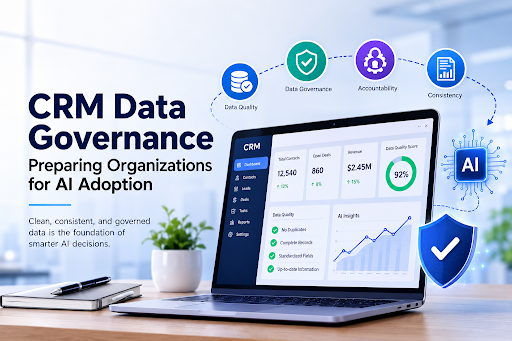
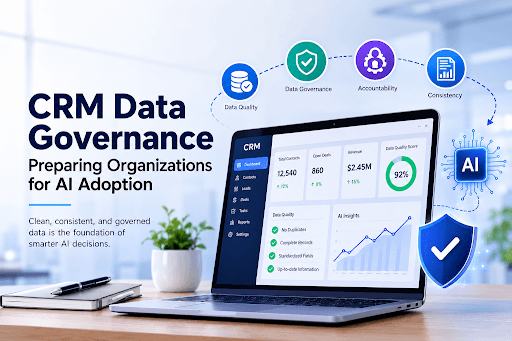
That’s why CRM data governance is not a technical requirement that the IT person must do first before the actual work. It is a key factor that can make or break an organization’s AI goals.
What CRM Data Governance Actually Means
There’s one term that seems more complex than it sounds: data governance. CRM data governance is the policies, processes, and standards that govern the creation, evolution, maintenance and quality monitoring and enforcement of the data in your CRM.
It is used to respond to questions such as: What fields must be filled in when a new contact is added? Who can delete records and when can they? What should be done with the duplicate records if they are found? How to update customer information if it changes? Do we have a retention period for inactive accounts and what happens to the data once that retention period is off?
The questions are administrative sounding. Their answers are also the source of the quality of all the insights, reports and AI-generated recommendations that cascade from your CRM. Organizations that have definite, consistent answers to these questions have CRM data they can rely on and put into action. Those that haven’t officially talked about them are sitting on a big asset of data that’s not as dependable as it seems.
Why the CRM Is the Right Place to Start
The CRM is likely to be the most impactful data source for an organization’s readiness to adopt AI. It’s home to the customer history that underpins most of the valuable AI applications that a company uses: customer segmentation, churn prediction, lead scoring and sales forecasting, personalization, and revenue intelligence all rely on CRM data, among others.
For most organizations, it is also the data source that has the most quality issues. CRMs are handled by many more individuals than almost any other business system out there. Customer records are accessed by sales teams, marketing teams, customer success teams, and support teams.
Everybody has their own habits, interpretation and level of data discipline. The lack of governance during months and years adds up to a data quality issue that is truly challenging to scrub the data after the fact.
This is why the CRM is the best place to invest in data governance before a data initiative for AI is launched. When it’s done correctly, it sets the stage for all subsequent AI projects that may utilize customer data in the future.
The Most Common CRM Data Quality Problems
Having a detailed understanding of the problems of poor data governance is the first step in discussing solutions, but the problems are more numerous and more serious than most organizations realize until they attempt to put it to use for something challenging.
Duplicate records are the most visible problem. Having a contact on your system twice under different name variations, or a company operating under its legal name and trading name, can cause confusion when reporting and downstream errors due to the AI system processing contact-level information. Deduplication is not typically a project that is completed once and for all. It needs continuous governance, or else new duplicates will be added.
Incomplete records are often more damaging than duplicates because they are less visible. A lead record without an industry classification, a contact record without a company, or a deal record without a close date or deal value: These missing values don’t cause any obvious errors, but they leak in the background out of analyses and AI models that rely on that information.
Inconsistent field usage is a governance failure that is particularly common in CRMs used by multiple teams or regions. If the sales reps do not all understand the different phases of the sales process, then the pipeline data will no longer be reliable as a forecasting tool. A segmentation analysis that is based on different industry classifications in different segments of the organization yields misleading results.
Stale data accumulates silently. Job titles change. Companies are acquired. The address is outdated. An out-of-date CRM, that has not been updated actively for 2 or 3 years, can have a large number of records that aren’t accurate anymore and therefore present challenges for any AI application that relies on the accuracy of the records in the CRM to accurately reflect the existing state of the customer relationship.
Building a Data Governance Framework That Holds
One of the objectives of a CRM data governance framework isn’t to make a perfect database. Is to develop an adequate database that continues to improve over time and that will be useful and reliable. This depends on three things coming together: clear standards, accountable ownership and monitoring.
Clear standards mean documented, specific definitions for how data should be entered and maintained. Not just general advice, but definite rules: what required fields are, what values are acceptable for each dropdown, how names of contacts should be formatted, what it means to have a duplicate and how to deal with it. In addition to it being readable by all, these standards should be available to all users of the CRM.
Accountable ownership means assigning clear responsibility for data quality at the field level, the record type level, and the overall CRM level. The cleanliness of account data must be taken care of by someone. Ownership of integrity for deal stage definitions is necessary. Someone must have to execute the deduplication processes on a regular basis. If it’s not named, the standard for governance is on paper and weak.
Ongoing monitoring means building visibility into data quality as a regular business metric rather than something that gets checked when a problem surfaces. Organizations can gain the visibility necessary to identify quality deterioration falling below acceptable standards before it becomes a major issue with dashboards that indicate the percentage of required fields that are completed, the percentage of new duplicate records created, and the age distribution of contact records.
Where Zoho Consulting Services Make the Difference
Organizations that rely on Zoho CRM for their customer relationship management (CRM) can achieve AI-ready data governance right from the start by configuring and managing their CRM data effectively.
The journey to achieving AI-ready data governance is a direct one for organizations using Zoho CRM for their customer relationship management (CRM) solutions, as the configuration and management of the CRM data drive the transformation. While Zoho CRM is a powerful, flexible system, governance results are greatly dependent upon how the system is implemented.
An unthoughtfully designed, quickly setup Zoho CRM system has more chances of picking up data quality issues than a well-designed CRM with governance from the beginning. Inconsistently used fields are created without clear definitions.
If every field is displayed to each user, it becomes ambiguous which of the fields is important. Automation that has not been put in place means that data entry relies on human discipline, the least certain governance tool at our disposal.
This is where seasoned Zoho consulting services make a difference. A Zoho consultant entering into a data governance engagement isn’t just cleaning up existing data. They redesign the configuration architecture to enable the CRM to promote good data practices instead of just enabling bad ones.
That means to use validation rules that are used to make sure that required fields are filled and that the content in the field is kept within the limits of acceptable values. It refers to setting up role-based layouts so that each team is able to see the information most relevant to their role, thereby minimizing cognitive load to prevent fields from being left blank.
It involves creating workflow automation that automatically fills in fields with data when it is available from system activities, minimizing manual data entry. And it also involves making reports and dashboards that make data quality meaningful to the people who are responsible for maintaining it.
By prioritizing data governance as part of their professional Zoho consulting services, organisations can start their AI initiatives with a solid foundation of trust and reliability, rather than tackling it as an afterthought.
The Connection Between Governance and AI Readiness
If an organization is well-governed and has a CRM that is ready for AI, the benefits are clear and substantial.
Clean, complete, consistently structured data means sales teams can trust and act on lead scores generated by lead scoring models. Customer activity data that is reliable allows churn prediction models to identify churned customers with a high degree of accuracy and merit proactive action before the renewal process.
Clean pipeline data enables sales forecasts, providing leadership with visibility to plan against. Customer Segmentation based on full demographic and behavioural information creates segments that are real customers instead of a result of inconsistencies in data entry.
All of these outcomes would not be possible without the governance base on which they sit and would not be meaningful if it was not done in a quality way. That’s why data governance is invariably the top constraint that comes up in an AI readiness assessment for any CRM-backed project. The tools are at the ready. The data is not.
The organizations that will accelerate the most in AI impact are the ones that take AI data governance seriously as a true strategic priority, invest first, before the AI initiative, in getting it right, and design the processes that will keep it right as the business evolves and grows.
Final Thoughts
The main hurdle of adopting AI is not a technological issue. In most organizations, it comes down to a data dilemma. For businesses that have data critical to their operations stored within their CRM, it’s a CRM data governance challenge.
The bad news is that this challenge is a completely achievable one! It demands clarity of standards, responsibility of ownership, continuous monitoring, and platform setup. For those using Zoho CRM, seasoned Zoho consulting services offer just the expertise required to construct that base efficiently and correctly.
CRM data governance is no longer an investment in preparation for an AI initiative. For most growing organizations, this is almost all business decisions that rely on customer data.
Begin with the facts. The AI will follow.