
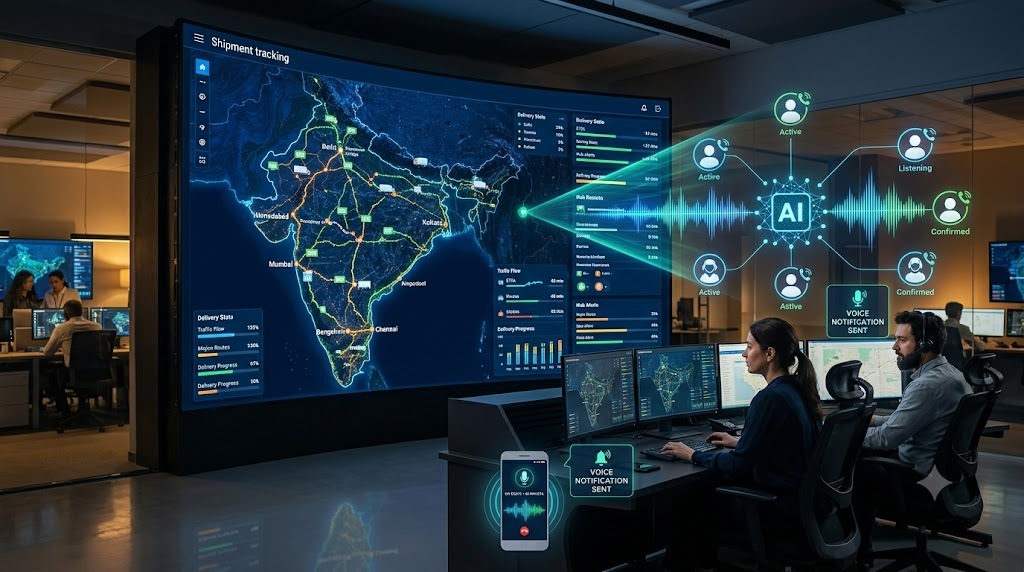

Most logistics companies don’t have a tracking problem. They have a talking problem.
A truck sits at a checkpoint outside Nagpur for three hours longer than planned. Nobody calls the consignee. By the time anyone does, the customer has already opened a complaint on the support portal, and now the conversation starts on the back foot instead of the front foot. Multiply that by a few hundred shipments running on any given day, and a support team stops doing support. It just reacts, all day, to problems that were visible on the dashboard hours earlier.
That’s really the core issue. Not tracking communication. Most fleets in India already run GPS-enabled vehicles feeding TMS dashboards that know, almost to the minute, where a shipment is sitting. What those dashboards don’t do is pick up a phone and tell someone. Somebody still has to translate “delayed at checkpoint” into a call, a message, an update that the customer actually receives. At scale, that translation step is where operations quietly fall apart.
Nine ways this gets fixed, in practice, below. Some of these will feel obvious once you read them. A few won’t.
1. Automated Delay Notifications Before the Customer Asks
Here’s a rule worth internalizing: a delay notification sent after the customer complains has already missed its window. It’s not a notification anymore; it’s damage control.
The fix is front-loading. An automated calling system watches the TMS or fleet telematics feed directly, and the moment a shipment crosses a set delay threshold, say, ninety minutes past the expected checkpoint, it places the call itself. No dispatcher has to remember to do it.
Threshold logic matters more than people assume. Set the trigger too sensitive, and customers get flooded with noise over delays that don’t matter. Set it too loose, and you’re back to reactive mode. Most mid-size 3PLs we’ve seen land somewhere around a 15-20% deviation from ETA before the system triggers a call. Below that, it’s not worth the interruption.
2. Multilingual Voice Confirmations for Delivery Windows
India doesn’t run on one language, and pretending otherwise is where a lot of shipment communication breaks down. A shipment leaving a Coimbatore warehouse for a customer in a smaller Rajasthan town needs a Tamil confirmation on one end and something closer to Marwari-inflected Hindi on the other. Miss that, and the call happens, technically, but nobody actually understood it.
Voice AI Agents built for logistics don’t need separate scripts maintained per region; that’s the part people underestimate. One call flow, same logic underneath, but the language output shifts based on the recipient’s location or a stored preference. It quietly removes a staffing dependency that used to mean hiring regional call center reps just to cover language gaps.
3. Proof-of-Delivery Verification Calls
Digital POD systems fail more than most logistics companies want to admit out loud. A driver’s phone battery dies mid-route. The app doesn’t sync because the signal near the drop point is weak. The OTP never lands because the customer’s number changed six months ago, and nobody updated the record. Small failures, but they add up fast.
A voice call that verbally confirms delivery details, then logs the response against the shipment ID, works as a fallback that doesn’t care whether the recipient has a smartphone, an app, or a strong signal.
This matters more in tier-2 and tier-3 markets than people expect. Smartphone penetration is genuinely high, but app-based confirmation still runs into friction: data costs, storage limits, or plain unfamiliarity with yet another app asking for permissions.
4. Pre-Delivery Address and Availability Checks
A large chunk of failed first-attempt deliveries comes down to something almost embarrassingly simple: nobody confirmed the address or checked if the recipient would even be home before the vehicle left the hub. A short automated call a few hours ahead, asking someone to confirm the address and preferred delivery window, cuts down repeat attempts by a wide margin.
Low complexity, high payoff. This one compounds. Fewer failed attempts mean fewer re-routes, less fuel burned circling back, and a delivery fleet that spends its day moving forward instead of backtracking.
5. Real-Time Exception Handling During Transit
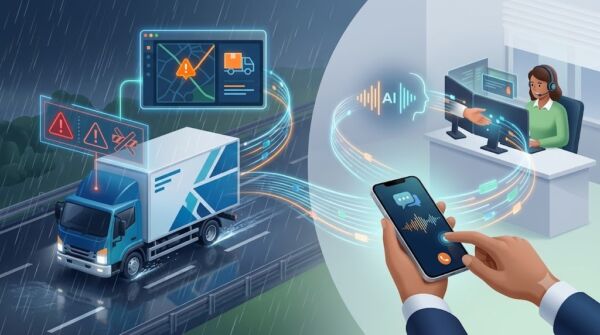
Delays aren’t all the same, and treating them like they are is a mistake. Customs holds need a different message than a vehicle breakdown. A route diversion because of monsoon flooding near Mumbai needs something else entirely, often an apology plus a revised ETA, not just a status update.
A well-built voice automation setup with branching logic tells these apart and routes the call accordingly. Minor delay, informational tone. Genuine disruption and escalation triggers.
Escalation handoff isn’t optional, full stop. Any voice system running in logistics needs a clean path to a human agent the second a situation goes past what the bot can resolve. Skip that step, and customers get stuck looping through a script that was never built to handle their actual problem, which does more damage than no call at all.
6. Inbound Query Handling for Shipment Status
Outbound calls only cover half of this. The other half walks in the door, customers calling to ask “where is my order,” and that volume spikes hard around sale seasons, and brutally around Diwali. Voice AI for Logistics increasingly covers this inbound side too: the system authenticates the caller against the shipment ID or registered number and gives a status update without pulling in a human agent at all.
It’s not a replacement for human support. It’s closer to a filter. It absorbs the repetitive 60–70% of “just checking” calls so the people on the floor can spend their time on shipments that actually need a person.
7. Vendor and Driver Coordination Calls
Shipment communication isn’t only about the customer on the receiving end. A huge amount of internal back-and-forth confirming pickup slots with vendors, checking whether a driver is available, and verifying a loading dock time happens over phone calls that are, frankly, just as repetitive as the customer-facing ones. Automating this frees dispatch teams from working through manual calling lists every single morning.
Driver-facing calls need to stay simple, though. Shorter scripts, plainer language. A long IVR-style menu doesn’t work for someone who’s driving; the interaction has to feel closer to a real, quick back-and-forth than a phone tree.
8. Post-Delivery Feedback and Dispute Prevention
A short feedback call placed a few hours after delivery does two jobs at once. It captures satisfaction data, sure, but more usefully, it catches disputes early, before they turn into formal complaints or chargeback claims. Companies running this step report catching a real share of delivery issues: wrong item, damaged packaging, a partial delivery, nobody flagged days before the customer would’ve bothered raising a ticket themselves.
9. Data Logging for Compliance and Audit Trails
Every call, outbound or inbound, leaves a record behind. For logistics companies working under GST e-way bill requirements and SLA-bound contracts with enterprise clients, having a timestamped, searchable log of every shipment-related call isn’t a nice-to-have. It’s what stands between a company and a disputed SLA breach with no way to prove otherwise. A Voice AI Platform that logs transcripts and outcomes against shipment IDs turns a pile of phone calls into an actual audit trail, something legal and compliance teams can pull up on demand, not something someone half-remembers from a call three weeks back.
What This Actually Takes to Work
None of the nine points above holds up on its own. They need integration; the voice layer has to sit on top of a TMS, a CRM, and ideally a WhatsApp or SMS fallback for the customers who just won’t pick up a call. Companies that bolt voice automation on as a standalone tool, disconnected from real shipment data, tend to get underwhelming results and then blame the technology. Usually, though, the technology isn’t the problem. The absence of a live data pipeline feeding it.
There’s a change management side to this too, and it gets skipped more often than it should. Dispatch and support teams need to actually trust the system before they’ll let it handle routine calls without hovering over it. That trust doesn’t show up overnight; it builds over a few months, usually after the automation has handled a stretch of low-stakes calls correctly, before anyone’s comfortable handing it something bigger.
Shipment communication has always been a volume problem wearing a customer service costume. Companies that treat it that way and build systems that scale communication the same way they’ve already scaled tracking and routing tend to see complaint volume drop first. Satisfaction scores catch up later, once the friction is actually gone. For most operations, that’s the real return here: not more people calling in happy, just far fewer calling in angry.