
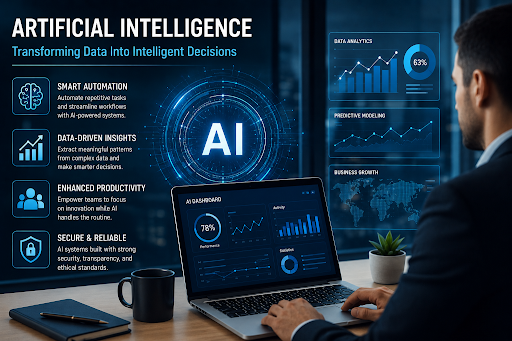
Artificial intelligence is rapidly becoming one of the most transformative technologies of the modern era. From automating repetitive tasks to improving complex decision-making, AI is influencing how businesses operate, compete, and innovate. Organizations of every size are investing in intelligent systems to improve efficiency, reduce operational costs, and create better experiences for customers.
The rise of cloud computing, machine learning, and advanced analytics has accelerated AI development over the last decade. Businesses no longer need massive infrastructure or highly specialized research teams to access powerful AI capabilities. Instead, affordable platforms and scalable services now allow startups, educational institutions, and enterprises to integrate intelligent systems into daily operations.
At the same time, global competition continues increasing across nearly every industry. Companies are under pressure to respond quickly to market changes, understand customer behavior more accurately, and identify opportunities before competitors do. Artificial intelligence offers the tools needed to manage these challenges effectively.
As organizations move deeper into the digital economy, AI is no longer viewed as an experimental technology. It is becoming a foundational component of modern business strategy.
The Evolution of Intelligent Automation
Automation has existed for decades, but traditional systems were limited to repetitive and rule-based tasks. Modern AI technologies can learn from data, recognize patterns, and improve performance over time. This evolution has expanded automation beyond manufacturing into areas such as healthcare, finance, education, logistics, and customer service.
AI-powered chatbots now handle customer inquiries around the clock, reducing wait times and improving service availability. Recommendation systems personalize digital experiences by analyzing user preferences and behavioral patterns. Predictive analytics help businesses forecast demand, identify risks, and optimize inventory management.
Organizations are also integrating AI into internal workflows to reduce manual effort and improve operational consistency. Intelligent scheduling tools, automated reporting systems, and smart data-processing platforms help employees focus on higher-value responsibilities rather than repetitive administrative tasks.
One particularly important area involves workflow analysis and process optimization. Businesses increasingly rely on task mining software to observe operational patterns, identify inefficiencies, and discover automation opportunities. By collecting and analyzing activity data from business processes, organizations can better understand how work is completed and where improvements can be implemented most effectively.
This level of operational visibility allows companies to streamline processes while maintaining productivity and service quality.
AI and Data-Driven Decision Making
Modern businesses generate enormous amounts of data every day. Customer interactions, digital transactions, website activity, operational metrics, and market trends all contribute to massive datasets that can provide valuable insights when analyzed correctly.
Artificial intelligence enables organizations to process this information far more efficiently than traditional methods. Machine learning algorithms can detect hidden patterns, identify correlations, and generate predictions that support strategic decision-making.
For example, retailers use AI to forecast consumer demand and optimize pricing strategies. Healthcare organizations apply predictive analytics to improve patient care and resource allocation. Financial institutions use intelligent systems to detect fraud and manage investment risks more effectively.
AI also enhances real-time decision-making capabilities. Instead of relying solely on historical reports, businesses can monitor live operational data and respond immediately to emerging situations. This agility is especially important in industries where market conditions change rapidly.
The growing importance of data science has encouraged companies to invest heavily in analytical talent and intelligent infrastructure. Organizations that effectively combine human expertise with AI-driven insights are often better positioned to adapt and compete in dynamic markets.
Competitive Strategy in the AI Era
Competition in the digital economy is increasingly influenced by speed, innovation, and information access. Businesses that can analyze market trends quickly and respond strategically gain significant advantages over slower competitors.
Artificial intelligence now plays a major role in competitive strategy development. AI systems can analyze industry trends, monitor customer sentiment, evaluate pricing strategies, and track emerging technologies with remarkable efficiency.
Many organizations are establishing a dedicated competitive intelligence program to gather and interpret market information more effectively. These programs help businesses understand competitor behavior, identify new opportunities, and anticipate changes in consumer demand. AI-driven analytics improve the accuracy and speed of this research by processing large volumes of public and internal data automatically.
Competitive intelligence is especially valuable in industries where innovation cycles move rapidly, such as technology, healthcare, and digital services. Companies that identify market shifts early can adapt products, marketing strategies, and operational priorities before competitors react.
At the same time, AI-generated insights support strategic planning by helping leadership teams evaluate risks, forecast industry trends, and allocate resources more effectively.
Human Collaboration with Artificial Intelligence
Despite concerns about automation replacing jobs, most organizations are discovering that AI works best when combined with human creativity and expertise. Rather than eliminating employees entirely, intelligent systems often enhance human capabilities by reducing repetitive workloads and improving access to information.
AI-powered collaboration tools now assist teams with scheduling, communication, project management, and document organization. Virtual assistants can summarize meetings, generate action items, and organize workflows automatically.
Creative industries are also benefiting from AI integration. Designers, marketers, writers, and software developers increasingly use AI systems to accelerate brainstorming, prototype ideas, and optimize production processes.
Education and workforce training are evolving as well. Professionals across industries now require at least a basic understanding of AI technologies and digital literacy. Universities and online learning platforms continue expanding programs focused on machine learning, data science, and automation skills.
Successful organizations recognize that employee adaptation is critical for long-term digital transformation. Companies investing in continuous learning and workforce development are more likely to achieve sustainable innovation.
Ethical Challenges and Responsible AI Development
While artificial intelligence offers enormous advantages, it also introduces important ethical and regulatory challenges. Businesses must address concerns related to privacy, transparency, bias, and accountability when implementing intelligent systems.
AI models learn from data, which means biased or incomplete datasets can produce unfair outcomes. Organizations must carefully evaluate training data and continuously monitor algorithm performance to reduce discriminatory risks.
Data privacy is another major issue. AI systems often rely on large amounts of personal and behavioral information, making cybersecurity and responsible data management essential priorities. Businesses that fail to protect user information risk damaging consumer trust and facing regulatory consequences.
Transparency is equally important. Customers and stakeholders increasingly want to understand how AI systems make decisions, especially in areas such as healthcare, finance, and recruitment. Explainable AI models are becoming more valuable because they improve accountability and trust.
Governments worldwide are also developing regulations to guide ethical AI use. Businesses that proactively establish responsible AI policies are likely to gain stronger reputations and reduce future compliance risks.
The Future of AI in Business
Artificial intelligence will continue evolving rapidly over the coming years. Future AI systems are expected to become more adaptive, personalized, and integrated into everyday business operations.
Organizations will likely rely more heavily on predictive analytics, intelligent automation, and AI-assisted decision-making. Personalized customer experiences will become increasingly sophisticated as machine learning models improve their ability to understand human behavior and preferences.
Emerging technologies such as generative AI, autonomous systems, and advanced robotics may further transform industries including manufacturing, healthcare, logistics, and education.
At the same time, businesses must maintain a balance between technological efficiency and human-centered values. Creativity, empathy, ethical reasoning, and strategic vision remain uniquely human strengths that cannot be fully replicated by machines.
The future of AI is not simply about replacing human work. It is about creating smarter systems that support innovation, improve productivity, and help organizations solve increasingly complex challenges.
Conclusion
Artificial intelligence is redefining how organizations operate, compete, and innovate in the digital age. From intelligent automation and advanced analytics to strategic planning and workflow optimization, AI technologies are transforming nearly every aspect of modern business.
Companies that embrace responsible AI development while investing in human collaboration and ethical governance will be best positioned for long-term success. As digital transformation continues accelerating worldwide, artificial intelligence will remain one of the most influential forces shaping the future of business and technology.