
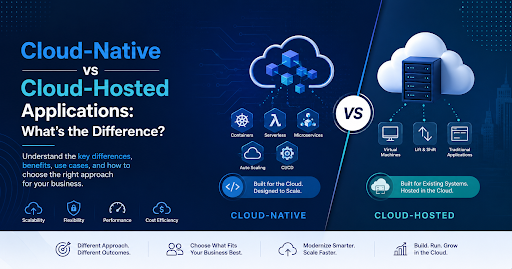
The cloud concept has successfully transformed the traditional way of building and running applications that are scalable and cost-efficient. But with technological advancement, the cloud comes with its own set of terminologies and businesses often look to leverage the power of the cloud effectively. There are two terms that often cause a mx up and often very confusing, that are., “cloud-native apps” and “cloud-hosted apps”. Learning there differences and unique approaches to using the cloud are essential for businesses that need to adopt AI, mirgate their legacy apps or modernize software development.
Whether you’re modernizing legacy systems or developing a brand-new digital product, selecting the right cloud strategy can improve operational efficiency while reducing infrastructure complexity. In this blog, we will provide you with key differences between cloud-native and cloud-hosted applications, their benefits, ideal use cases, and help you to determine which approach best aligns with your technology goals.
What Are Cloud-Hosted Applications?
Cloud-hosted applications are traditional software applications that are deployed on cloud infrastructure. Instead of running on on-premise servers, the application’s architecture remains largely unchanged. Here, the cloud hosting environment shifts from physical infrastructure to cloud platforms such as AWS, Microsoft Azure, or Google Cloud.
This approach is commonly known as a “lift-and-shift” migration because organizations move existing applications without significantly modifying their codebase. Businesses can quickly eliminate the need for expensive physical servers while benefiting from improved infrastructure reliability and remote accessibility.
For example, an enterprise resource planning (ERP) system originally running inside a company’s data center can be migrated to a cloud-based virtual machine without redesigning the application itself.
Cloud-hosted applications continue to function much like they did before migration. Although organizations gain advantages such as reduced hardware costs and easier infrastructure management, these applications generally cannot fully utilize advanced cloud capabilities like automatic scaling, container orchestration, or distributed microservices.
How Cloud-Hosted Applications Work
Cloud-hosted applications operate inside virtual machines provided by cloud service providers. Instead of relying on physical servers owned by the organization, computing resources such as storage, networking, and processing power are delivered through cloud infrastructure.
Since the application architecture remains largely intact, migration projects are typically faster and less expensive than rebuilding software from scratch. This makes cloud-hosted deployment an attractive option for businesses seeking immediate infrastructure modernization while minimizing disruption to daily operations.
Key Characteristics
Cloud-hosted applications retain their original architecture, often relying on monolithic application design. They generally require manual scaling, traditional software updates, and virtual machine management. Because they were not originally designed for cloud environments, they offer limited flexibility compared to modern cloud-native solutions.
What Are Cloud-Native Applications?
Cloud-native applications are specifically designed and developed to operate within cloud environments rather than being adapted from traditional infrastructure. They are built using modern architectural principles such as microservices, containers, Kubernetes orchestration, serverless computing, and continuous integration and deployment pipelines.
Unlike cloud-hosted applications, cloud-native software fully utilizes cloud capabilities to improve scalability, resilience, automation, and deployment speed.
Organizations developing modern digital platforms often partner with a cloud app development company to build cloud-native applications that can automatically scale, recover from failures, and support continuous feature delivery without affecting overall system performance.
Core Technologies
Cloud-native applications rely on technologies like containers, Kubernetes, microservices, serverless functions, and DevOps automation. These technologies enable independent deployment of application components, making updates faster, improving resource utilization, and increasing overall system reliability.
Cloud-Native vs Cloud-Hosted Applications: Key Differences
Although both cloud-hosted and cloud-native applications operate on cloud infrastructure, they differ significantly in their architecture, deployment strategy, scalability, and long-term business value. Cloud-hosted applications focus on migrating existing software to the cloud with minimal modifications, whereas cloud-native applications are built from the ground up to leverage cloud technologies and automation.
| Feature | Cloud-Hosted Applications | Cloud-Native Applications |
| Architecture | Traditional monolithic architecture | Microservices-based architecture |
| Development Approach | Existing applications migrated to the cloud | Built specifically for cloud environments |
| Deployment | Virtual machines | Containers and Kubernetes |
| Scalability | Mostly manual or vertical scaling | Automatic horizontal scaling |
| Performance | Limited by legacy architecture | Optimized for cloud performance |
| Updates | Periodic software releases | Continuous integration and deployment |
| Maintenance | Higher maintenance effort | Easier service-level maintenance |
| Resource Utilization | Moderate efficiency | Highly optimized resource usage |
| Reliability | Moderate fault tolerance | High resilience and self-healing capabilities |
| Best Use Cases | Legacy business applications | Modern SaaS, enterprise, AI, and mobile applications |
Cloud-Native vs Cloud-Hosted: Which One Should Your Business Choose?
The right choice depends on your organization’s current technology landscape, business objectives, budget, and long-term growth strategy.
Businesses that rely heavily on legacy software and require rapid infrastructure modernization often benefit from cloud-hosted applications. This approach minimizes redevelopment costs while allowing organizations to improve reliability, security, and operational efficiency through cloud infrastructure.
On the other hand, organizations launching new digital products or planning long-term digital transformation should consider cloud-native architecture. Its ability to support continuous innovation, automatic scaling, and faster deployment cycles makes it ideal for rapidly growing businesses operating in competitive markets.
Ultimately, the decision should be guided by application complexity, expected traffic growth, operational requirements, compliance obligations, and future expansion plans rather than short-term infrastructure considerations.
Best Practices for Moving to Cloud-Native Architecture
Migrating to a cloud-native architecture is more than simply moving applications to the cloud; it requires a strategic approach that aligns technology with business objectives. Here are the proven best practices that you need to follow to minimize migration risks, improve application performance, and strengthen security.
- Assess your existing applications: Evaluate your current application portfolio to identify which workloads are ready for cloud-native modernization and which are better suited to remain cloud-hosted.
- Choose the right migration strategy: Select an approach such as lift-and-shift, re-platforming, refactoring, or complete redevelopment based on your application’s complexity, business goals, and budget.
- Adopt containers and microservices gradually: Modernize applications in phases instead of migrating everything at once. This minimizes risks, simplifies implementation, and allows development teams to build expertise with cloud-native technologies.
- Implement DevOps and CI/CD pipelines: Automate software development, testing, and deployment processes to accelerate releases, improve collaboration, and ensure continuous delivery without disrupting business operations.
- Continuously monitor and optimize: Regularly track application performance, security, infrastructure costs, and resource utilization to identify optimization opportunities and maintain long-term efficiency.
- Prioritize security and governance: Establish strong access controls, compliance policies, monitoring, and governance frameworks to protect cloud environments while maintaining regulatory requirements.
- Build for scalability and resilience: Design applications that can automatically scale based on demand and recover quickly from failures to ensure high availability and a consistent user experience.
By following these best practices, businesses can transition to cloud-native architecture more efficiently while maximizing scalability, operational agility, and the long-term value of their cloud investments.
Conclusion
Cloud-hosted and cloud-native applications both offer valuable advantages, but they address different business needs. Cloud-hosted applications provide a faster and more economical way to modernize existing systems by moving them to cloud infrastructure with minimal architectural changes. In contrast, cloud-native applications are designed specifically for cloud environments, enabling greater scalability, resilience, flexibility, and continuous innovation.
Choosing between these approaches depends on factors such as your existing infrastructure, business objectives, budget, and future growth plans. Organizations focused on long-term digital transformation should carefully assess their application portfolio before making architectural decisions. Partnering with experts offering cloud migration services can simplify the transition, reduce migration risks, and help businesses build secure, scalable, and future-ready cloud solutions that deliver lasting value.