
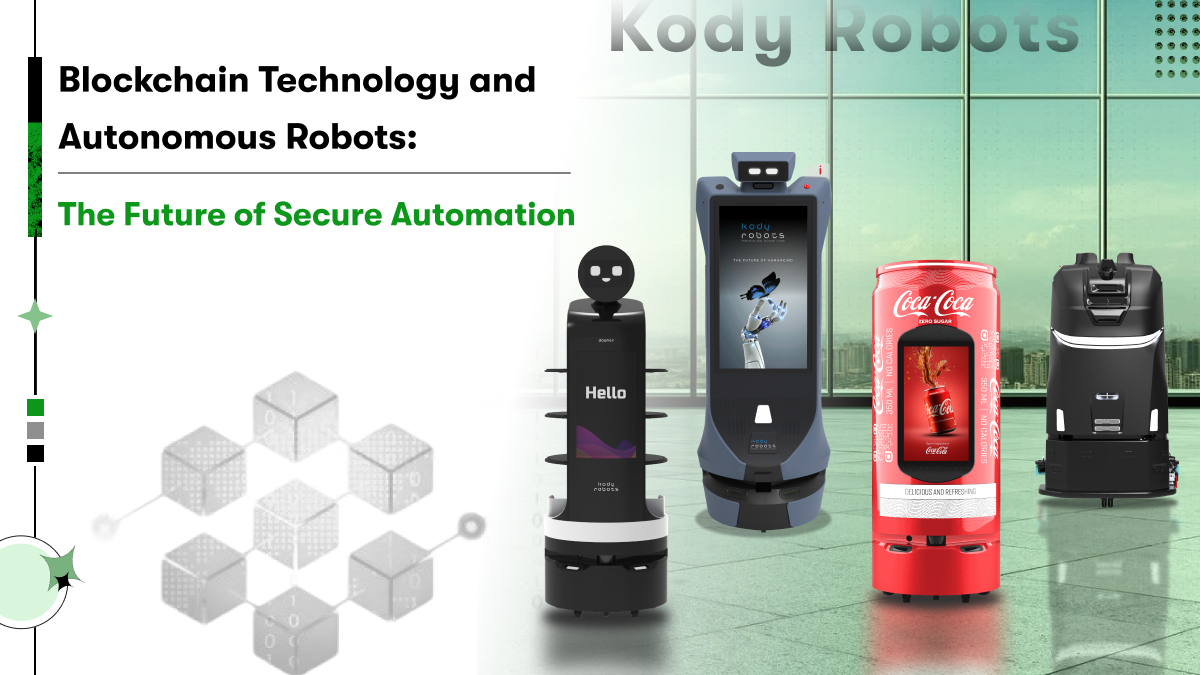
Autonomous robots are becoming part of real business operations across malls, airports, events, warehouses, hotels, resorts, factories, hospitals, and public spaces. These robots can move, clean, serve, advertise, guide, patrol, transport items, and support teams across high-footfall environments. As adoption increases, one question becomes more important: how can businesses make robot operations more secure, transparent, and trustworthy?
That is where blockchain technology enters the conversation.
Blockchain can support autonomous robot ecosystems by creating secure records, trusted task logs, tamper-resistant data trails, and clearer accountability across connected operations. The goal is not to make every robot system blockchain-based immediately. The goal is to understand how blockchain can become a future trust layer for Autonomous Robots and business automation.
For a Robotics Company in India or a Robotics Manufacturing Company in India, this topic is highly relevant. Businesses are no longer asking only whether robots can perform tasks. Businesses are also asking whether robot activity can be verified, protected, tracked, and trusted.
Kody Robots fits this wider automation conversation as Indian businesses explore more advanced and secure robotics-led operations.
Key Takeaways
- Autonomous Robots are becoming important across malls, airports, hotels, warehouses, events, and public environments.
- Blockchain can support secure automation through tamper-resistant logs, verified task records, and stronger operational transparency.
- Autonomous Robotics Solutions need strong trust systems as robots become more connected and business-critical.
- Blockchain can help future robot fleets manage identity, access control, maintenance history, service records, and operational accountability.
- A Robotics Company in India can use secure automation thinking to support industries that need safer and more reliable robotic deployment.
- The future will likely combine robotics, AI, IoT, cloud systems, cybersecurity, and blockchain-based verification.
Why Secure Automation Matters?
Automation is moving from controlled factory environments into public and commercial spaces. Robots are now being considered for shopping malls, airports, hotels, warehouses, corporate parks, hospitals, events, and smart-city environments. These locations are dynamic, crowded, and sensitive.
As robot usage grows, businesses must think beyond movement and performance. Security becomes central.
A robot may collect operational data. A robot may follow assigned routes. A robot may interact with visitors. A robot may perform cleaning tasks. A robot may serve food. A robot may patrol an area. A robot may support warehouse movement.
Each task creates a question:
- Who assigned the task?
- When was the task completed?
- Was the robot operating in the correct zone?
- Was the maintenance record updated?
- Was the robot accessed by an authorized user?
- Was the activity log changed later?
- Can the business prove what happened?
Blockchain can help answer these questions by creating stronger records and trust layers for autonomous systems.
What Blockchain Means for Robotics?
Blockchain is a digital record system where information can be stored in a way that is difficult to alter without detection. In simple terms, blockchain can help create trusted logs of activity.
For robotics, blockchain can be used as a support layer for:
- Robot identity verification
- Task history records
- Maintenance logs
- Access permissions
- Fleet activity tracking
- Service-level accountability
- Data integrity
- Robot-to-system communication records
- Asset ownership records
- Audit trails
This does not mean every robot action must happen on blockchain. That would be unnecessary and inefficient in many cases. The practical approach is to use blockchain where trust, verification, accountability, and tamper resistance matter most.
Why Autonomous Robots Need Trust Layers?
Autonomous robots work inside environments where trust is essential. A mall owner must trust that a cleaning robot completed the assigned route. An airport team must trust that a patrol robot followed the defined zone. A hotel manager must trust that a serving robot was maintained properly. A warehouse operator must trust that robot movement data has not been altered.
As robots become part of daily operations, trust cannot depend only on verbal updates or manual logs. Businesses need stronger digital accountability.
A trust layer can support:
- Verified task completion
- Clear robot usage history
- Secure access control
- Better compliance documentation
- Reduced dispute risk
- Stronger maintenance planning
- Better operational visibility
Blockchain can support this trust layer by making key records harder to manipulate.
Blockchain and Robot Identity
Every autonomous robot in a fleet needs a clear identity. In a large organization, dozens or hundreds of robots may work across different locations. Each robot may have a different role, route, maintenance schedule, access level, and service history.
Blockchain can help create a secure digital identity for each robot.
A robot identity record may include:
- Robot ID
- Ownership details
- Deployment location
- Service history
- Maintenance events
- Authorized access records
- Software update logs
- Task category
- Operating permissions
This can help businesses manage robot fleets more responsibly. A secure identity layer becomes important when robots work across multiple branches, customer sites, warehouses, airports, or commercial spaces.
Blockchain and Task Verification
Autonomous robots perform assigned tasks. A cleaning robot may complete a floor route. A serving robot may move items to a delivery point. A warehouse robot may move goods between zones. A patrol robot may complete a monitoring round.
Task verification matters because businesses need proof that work happened.
Blockchain can support verified task records by storing important activity logs in a tamper-resistant way. This can help managers review task completion without depending only on manual confirmation.
For example:
- A mall can verify cleaning route completion.
- An airport can verify patrol activity.
- A warehouse can verify movement history.
- A hotel can verify service robot usage.
- An event venue can verify robot advertising campaign activity.
This creates stronger operational confidence.
Blockchain and Maintenance Records
Maintenance is critical for every robot fleet. A poorly maintained robot can create downtime, safety issues, and poor user experience. Businesses need clear records of servicing, inspections, updates, and part changes.
Blockchain can support maintenance transparency by creating a reliable record of service history.
A blockchain-backed maintenance record can include:
- Service date
- Maintenance action
- Technician verification
- Part replacement history
- Software update records
- Inspection logs
- Warranty-related records
- Issue resolution status
This can be useful for customers, service teams, manufacturers, and facility managers. A reliable maintenance trail helps businesses reduce confusion and improve long-term robot management.
Blockchain and Access Control
Autonomous robots should not be accessible to everyone. Different people may need different levels of access. A facility manager may monitor tasks. A technician may access maintenance settings. An admin may assign routes. A vendor may view service logs. A customer may receive performance reports.
Blockchain can support access control by recording permissions and access events more securely.
This can help answer:
- Who accessed the robot system?
- What changes were made?
- When did the access happen?
- Was the person authorized?
- Was a setting changed after deployment?
For businesses operating robots in sensitive environments, access transparency can become very important.
Blockchain and Autonomous Robotics Solutions
Autonomous Robotics Solutions are becoming more connected. Robots may communicate with dashboards, sensors, building systems, cloud platforms, digital maps, payment systems, customer apps, or maintenance platforms.
The more connected the system becomes, the more important data security becomes.
Blockchain can support autonomous robotics solutions by strengthening:
- Data trust
- Robot identity
- Activity logs
- Device accountability
- Fleet records
- Maintenance transparency
- Permission control
- Operational auditability
Blockchain should not be treated as a magic solution for every security problem. Cybersecurity still needs encryption, secure software, access control, monitoring, and compliance planning. Blockchain adds value where trusted records and tamper resistance are important.
Use Case 1 Secure Robotics in Malls
Malls are high-footfall environments with cleaning robots, advertising robots, navigation robots, serving robots, and patrol robots. Such robots may support visitors, brands, tenants, housekeeping teams, and security teams.
Autonomous Robots for Malls can benefit from secure task records and operational accountability.
Blockchain can support mall robotics by recording:
- Cleaning route completion
- Advertising campaign activity
- Patrol movement logs
- Robot maintenance history
- Tenant campaign records
- Access permissions
- Service usage history
For mall owners, this can create clearer visibility across daily operations. For tenants and advertisers, verified campaign activity can improve confidence. For facility teams, task records can support better planning.
Use Case 2 Secure Robotics in Airports
Airports need secure and reliable systems because passenger movement, security, facility maintenance, and commercial operations are all sensitive. Robots in airports may support serving, cleaning, advertising, navigation, and patrol workflows.
Autonomous Robots for Airports can benefit from stronger digital accountability.
Blockchain can support airport robotics by recording:
- Patrol route verification
- Cleaning task history
- Authorized route changes
- Robot access events
- Maintenance updates
- Service activity logs
- Airport zone permissions
This can help airport teams maintain stronger operational confidence. Airports need systems that can be reviewed, audited, and trusted.
Use Case 3 Secure Robotics in Events
Events, exhibitions, conventions, conferences, and product launches often use temporary setups. Robots may support advertising, visitor engagement, navigation, serving, or brand activation.
Autonomous Robots for Events can benefit from secure campaign and activity tracking.
Blockchain can support event robotics by recording:
- Campaign run times
- Sponsor visibility logs
- Robot route activity
- Booth promotion schedules
- Lead-generation touchpoint records
- Access permissions
- Service usage history
For event organizers, this can improve sponsor reporting. For brands, verified activity records can support better campaign accountability.
Use Case 4 Secure Robotics in Warehouses
Warehouses need accuracy, efficiency, and operational control. Robots in warehouses may support material movement, cleaning, inventory flow, or security checks.
Autonomous Robots for Warehouses can benefit strongly from secure records because warehouse operations depend on traceability.
Blockchain can support warehouse robotics by recording:
- Goods movement logs
- Robot task assignments
- Zone access records
- Maintenance history
- Operator permissions
- Workflow completion
- Exception reports
This can help warehouse managers improve trust in automation and reduce disputes around movement history or task completion.
Use Case 5 Secure Robotics in Hotels and Resorts
Hotels and resorts depend on guest experience, service quality, cleanliness, and operational coordination. Robots may support serving, cleaning, navigation, and facility operations.
Autonomous Robots for Hotels and Resorts can benefit from secure automation records.
Blockchain can support hospitality robotics by recording:
- Service task history
- Maintenance logs
- Food delivery support records
- Cleaning route completion
- Event service usage
- Robot access permissions
- Guest-area route updates
For hotel managers, this can help improve service accountability and maintenance planning. For premium venues, verified operational records can support better quality control.
Why India Needs Secure Robotics Thinking?
India is seeing growing interest in robotics across retail, healthcare, hospitality, logistics, smart infrastructure, airports, malls, and industrial spaces. As adoption grows, businesses will need robotics partners that understand not only hardware and software, but also trust, security, and long-term operational reliability.
A Robotics Company in India should think about secure automation from the beginning. A robot is not only a machine. A robot is part of a larger digital ecosystem.
A Robotics Manufacturing Company in India can create stronger business value by considering:
- Secure software architecture
- Reliable hardware design
- Serviceability
- Data protection
- Access control
- Fleet management
- Maintenance transparency
- Audit readiness
- Scalable deployment
Blockchain may become one part of this larger trust framework.
Benefits of Blockchain for Autonomous Robots
Better accountability
Businesses can verify robot tasks and activity history more confidently.
Stronger maintenance trust
Maintenance logs become easier to review and harder to manipulate.
Better access transparency
Organizations can see who accessed robot systems and when.
Better audit readiness
Verified records can support compliance, reporting, and internal reviews.
Better fleet management
Robot identity, service history, and usage logs can become more structured.
Better customer confidence
Clients may trust robot operations more when activity records are transparent and secure.
Better dispute resolution
Verified logs can help resolve disagreements about task completion, service activity, or maintenance status.
Challenges of Blockchain in Robotics
Blockchain can support secure automation, but adoption must be realistic. Not every robot function needs blockchain. Poor implementation can add complexity without real value.
Common challenges include:
Integration complexity
Blockchain must connect properly with robot software, dashboards, and operational systems.
Data volume
Robots generate large amounts of data. Not every data point should be stored on blockchain.
Cost and performance
Businesses must balance security benefits with speed, cost, and system performance.
Privacy concerns
Sensitive operational or user data must be protected carefully.
User understanding
Managers and operators need simple tools, not complicated blockchain interfaces.
Practical use case selection
Blockchain should be used only where trusted records and verification matter.
A good strategy is selective blockchain use, not blockchain for everything.
Future of Blockchain and Autonomous Robotics
The future of secure automation will likely combine multiple technologies. Blockchain may work with AI, IoT, cloud dashboards, cybersecurity systems, digital twins, and fleet management platforms.
Future robot ecosystems may include:
- Secure robot identity
- Verified task logs
- Smart maintenance records
- Automated service contracts
- Trusted fleet dashboards
- Cross-location robot tracking
- Secure robot-to-system communication
- Auditable compliance records
- Verified performance reporting
This future will matter most in industries where robots perform high-value, high-frequency, or safety-sensitive tasks.
What Businesses Should Evaluate?
Businesses exploring blockchain-enabled robotics should evaluate the use case carefully.
Operational risk
Does the robot perform tasks where verified records matter?
Data sensitivity
Does the robot handle sensitive operational, customer, or security information?
Fleet size
Larger fleets benefit more from structured identity and task records.
Compliance needs
Some industries may require stronger audit trails.
Integration readiness
Existing systems must support secure data exchange.
ROI logic
Blockchain should reduce risk, improve trust, or create measurable accountability.
User simplicity
The system should be easy for managers and teams to use.
Why Kody Robots Fits the Secure Automation Conversation?
Kody Robots fits the secure automation conversation because autonomous robots are moving into environments where reliability, traceability, and operational accountability matter. As businesses adopt robots across malls, airports, hotels, events, warehouses, and public spaces, security and trust will become more important.
The company’s role in the robotics ecosystem can grow stronger when autonomous systems are supported by responsible software, reliable hardware, secure data practices, and future-ready automation thinking.
Blockchain is one possible trust layer in that future.
Conclusion
Autonomous Robots are becoming important across modern business environments. Malls, airports, events, warehouses, hotels, resorts, and industrial spaces are all exploring robotics to improve operations, service, cleaning, advertising, patrol, and movement.
As adoption grows, secure automation will become essential. Blockchain technology can support this future by helping create trusted robot identities, verified task records, secure maintenance logs, access transparency, and stronger operational accountability.
For a Robotics Company in India or a Robotics Manufacturing Company in India, the future will not only depend on building robots that move and perform tasks. The future will depend on building robotics ecosystems that businesses can trust.
Kody Robots is part of this wider movement toward smarter, safer, and more secure autonomous robotics solutions.