
Meghna spent last Thursday on calls. Not interviews, just screening calls. Sixty-three of them, for a single field sales opening at her company’s Pune branch. She spoke to people who’d already joined somewhere else, people who couldn’t relocate, people whose salary expectations were double the budget, and one person who genuinely didn’t remember applying.
By 6:30 PM, she had seven names worth passing forward.
Seven. From sixty-three calls.
That’s not a bad day. That’s what high-volume recruitment looks like in India right now, in practically every sector, running mass hiring in BFSI, logistics, D2C, telecom, and retail. The volume is real. The shortlist is tiny. And the gap between the two is almost entirely made up of repetitive, low-judgment work that burns through recruiter hours at a rate that doesn’t make sense anymore.
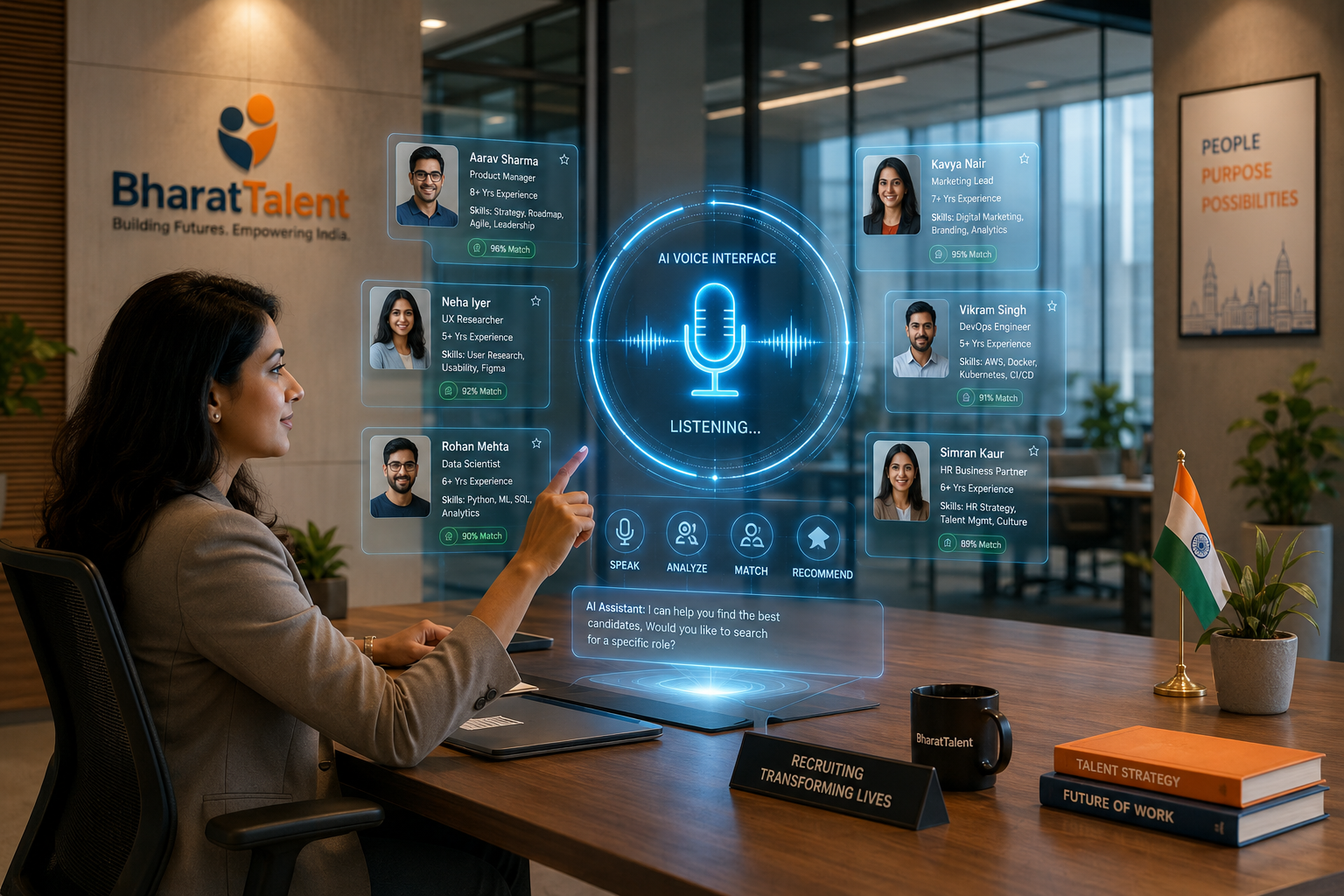
Voice AI for recruitment is the first technology that actually addresses this specific problem. Not resume parsing, not chatbots, not better job boards. A voice agent that talks to candidates actually talks to them and does the screening before a human recruiter ever picks up the phone.
What This Technology Is (And What It Isn’t)
People hear “AI in hiring” and immediately picture one of two things: a robot rejecting resumes, or some dystopian automated interview that makes candidates feel like they’re applying for a government ID. Neither is accurate.
Voice AI for Recruitment is an AI agent that makes outbound calls to candidates and holds a real, two-way screening conversation. Not a recorded message. Not a menu system. The agent listens to what the candidate actually says and responds to it, asks follow-up questions, adjusts if something doesn’t add up, and moves through a structured set of topics that the hiring team defines in advance.
Here’s what a typical call actually covers:
- Current role, experience, and why they’re looking to move
- Practical qualifiers notice period, expected salary, location flexibility, shift availability
- A few role-specific questions (for a collections role, maybe how they handle objections; for a customer support role, how they’ve dealt with an angry caller)
- Language and communication assessment fluency, clarity, and how they structure a thought under mild pressure
And it does this in whatever language the candidate is most comfortable in. Hindi. Gujarati. Marathi. English. Sometimes a mix of two, which is how most people in this country actually speak when they’re comfortable.
By the time the call ends, the system has a transcript, a score against the criteria the hiring team set, and a summary ready for whoever’s reviewing the shortlist.
Why Screening Is Where Recruitment Actually Breaks Down
Nobody talks about this directly, but the math of high-volume hiring is genuinely broken.
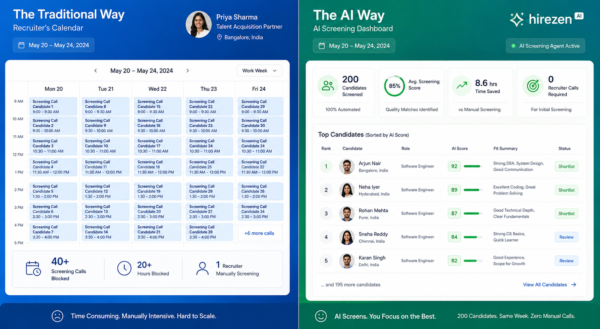
A focused recruiter making back-to-back screening calls, assuming actual conversations, not voicemails, can realistically get through 35 to 45 candidates in a day. Maybe 50 on a really dialled-in day with no other responsibilities pulling at them.
Now think about a logistics company hiring for 12 simultaneous delivery coordinator roles. Or a fintech running a 300-person expansion of their collections team. Or an insurance firm doing a regional agent drive across Gujarat and Rajasthan at the same time. Applications in the hundreds. Sometimes thousands. The math doesn’t close. It can’t close with human effort alone.
But beyond volume, three other problems don’t get discussed enough:
Consistency is basically a polite myth. A recruiter’s fifth screening call at 9:15 AM is not the same quality as their forty-second call at 5:45 PM on a Friday. Questions get shorter. Follow-ups get skipped. The rubric gets applied loosely because the recruiter is tired and has seventeen browser tabs open. It’s not a character flaw; it’s a human limitation. But it means the shortlist is partly a product of when in the day a candidate happened to call.
Speed is actually a competitive advantage nobody talks about. Good candidates, even fresher candidates, in Tier-2 markets have options. If your screening process takes five business days to reach someone who applied on Monday, and a competitor called them Tuesday, you’re hiring from a smaller pool than you think. The dropout from slow pipelines is a real loss that rarely shows up in any report.
Unconscious bias is structural, not individual. Name, accent, which city in India someone is calling from, whether they sound nervous in the first thirty seconds, these things influence screening outcomes even when the recruiter is genuinely trying to be fair. Voice AI for recruitment evaluates on the criteria that matter for the role, and only those. Not everything else.
The Actual Screening Flow: What Happens from Application to Shortlist
Theory is one thing. Walk through the actual sequence:
The moment an application comes in, the call gets triggered
No queue. No “we’ll be in touch.” The system initiates an outbound call or, if the candidate chose a preferred time slot, schedules for exactly that window. Applications submitted at 11 PM on a Sunday get screened before anyone reaches the office on Monday morning.
The conversation is designed to feel like a real call.
This is where a lot of early implementations got it wrong. Robotic, stilted voice agents that candidates recognized immediately and hung up on. The better systems, now the ones actually deployed at scale, are designed to hold a natural flow. The agent introduces itself honestly (candidates know they’re speaking with AI), explains the purpose of the call, and moves through the screening in a conversational way rather than a rigid question-by-question format.
If a candidate gives a vague answer to something important, the agent probes. “Could you tell me a little more about that?” If a candidate asks about the role or the location, the agent handles it.
Scoring and transcription happen in real time, invisibly.
While the conversation runs, the system is doing three things in parallel: transcribing the full call, tagging key information against whatever criteria the team defined, and building a score. Notice period fits the requirement tagged. Salary expectation is in the range tagged. Communication score, language fluency, and confidence were scored. All of it happens without any manual input.
The recruiter opens their dashboard to a different kind of job
Not 340 applications to dig through. Not a voicemail backlog. A ranked shortlist complete with call recording, full transcript, and an AI-generated summary of where each candidate stands against the criteria. The recruiter’s first actual conversation is with someone who already qualifies. That is a fundamentally different use of their time and expertise.
Why India Specifically Is Where This Makes Sense Right Now
Voice AI for recruitment isn’t a one-size-fits-all global product that happens to work in India, too. The pressures of the Indian enterprise hiring context are actually what make this technology most relevant.
Language is the obvious one. India doesn’t have one hiring language; it has dozens. A candidate in Surat applying for a field sales role covering the Saurashtra region is going to communicate more naturally, more confidently, and more accurately in Gujarati than in English. But most screening tools and most recruiting processes, honestly, force candidates into English by default. That’s a ceiling you’ve put on your own candidate pool. Multilingual voice AI removes it.
Tier-2 and Tier-3 reach is underestimated. Companies hiring for frontline roles, collections agents, or field staff are not finding those candidates in Mumbai and Bengaluru anymore. Rajkot, Vadodara, Nashik, Coimbatore, and Bhubaneswar, that’s where a big part of the talent for these roles actually lives. A phone-first, language-flexible screening process reaches them without requiring anyone to travel to an assessment center in the nearest metro.
And the recruiter bandwidth problem in Indian enterprises is not small. Most HR teams at growth-stage or mid-market companies here are running with a recruiter-to-open-role ratio that would horrify anyone who looked at it carefully. Adding screening volume without adding tools is not a strategy; it’s just a slower version of the same problem.
This is also exactly why companies already using a Voice AI Platform for customer-facing operations handling inbound queries, outbound follow-ups, and support conversations find it relatively straightforward to adapt the same infrastructure for their talent workflows. The conversational AI capability is already there.
What Makes an Implementation Actually Work
Plenty of companies have bought a voice AI screening tool and gotten mediocre results. The technology isn’t magic; the implementation is what determines whether it works.
Conversation design is where most teams underinvest. The quality of what the agent asks determines the quality of what it finds out. Generic, checkbox-style questions, “Do you have two years of experience? Yes or no?” produce nothing useful. Role-specific questions that actually probe the things predicting success in that particular job are what make the shortlist meaningful. This is a design problem, not a technology problem.
ATS integration is non-negotiable. If the AI screens beautifully and then someone has to manually copy candidate data into Darwinbox, Keka, or whatever system the team uses, you’ve moved the bottleneck, not removed it. Native integration that pushes scores, transcripts, and summaries directly into the hiring workflow is the only version that delivers actual time savings.
Being upfront with candidates is both the right thing and the practical thing. Candidates need to know they’re speaking with an AI. Some companies have tried to obscure this, but it backfires; candidates feel deceived, and in an era where employer brand travels fast on LinkedIn and Glassdoor, that’s a real business risk. Transparency here is not optional.
Multilingual depth is not the same as multilingual switching. An agent that can switch from English to Hindi but doesn’t understand conversational Hindi, how people actually speak it, with colloquialisms, code-switching, and regional phrasing, creates a worse experience than an English-only process. The bar for a real multilingual capability is higher than most vendors will tell you upfront.
What Actually Changes When Teams Use This
Three things shift consistently:
Time-to-screen compresses from days to hours. Same-day screening is real. Candidates who apply on Monday morning get a call before lunch. Shortlists are ready before the hiring manager’s weekly review, not two weeks after it.
Recruiter time doesn’t disappear; it redistributes. This is worth saying clearly because there’s anxiety around it. Recruiters don’t get replaced. They stop spending the majority of their day on repetitive outbound screening calls and start spending it on the work that actually requires human judgment, meaningful candidate conversations, offer negotiation, interview coordination, and building relationships with hiring managers. Better use of the same people.
Candidate experience improves because speed is a signal. A fast, organized response, even from an AI agent, tells candidates something about how the company operates. It signals that the organization is serious, responsive, and not going to leave them waiting three weeks for a callback. In competitive roles, that perception matters for who stays engaged in your pipeline.
Conclusion
Recruitment is, at its core, a human function. The moments that actually create good hiring outcomes, reading someone’s ambition in a conversation, making a judgment call on how they’ll fit into a specific team, building enough trust that a candidate chooses your offer over three others, none of that is going away, and none of it should.
But the road to those moments runs through a lot of work that doesn’t require any of those skills. Calling 340 people to find 40 worth talking to is not where recruiter expertise adds value. It’s logistics. And logistics, handled manually at scale, is what’s burning out HR teams and slowing down pipelines across India’s fastest-growing companies.
Voice AI for recruitment handles that road. It does the high-volume, repetitive, consistency-dependent work fast and at scale, so the human recruiters can show up where they actually matter. For Indian enterprises dealing with real language diversity, real volume pressure, and real constraints on HR bandwidth, this isn’t a future experiment. It’s a practical answer to a problem that has been getting worse every hiring cycle, and a genuine shift in what it looks like to build a modern talent function.