
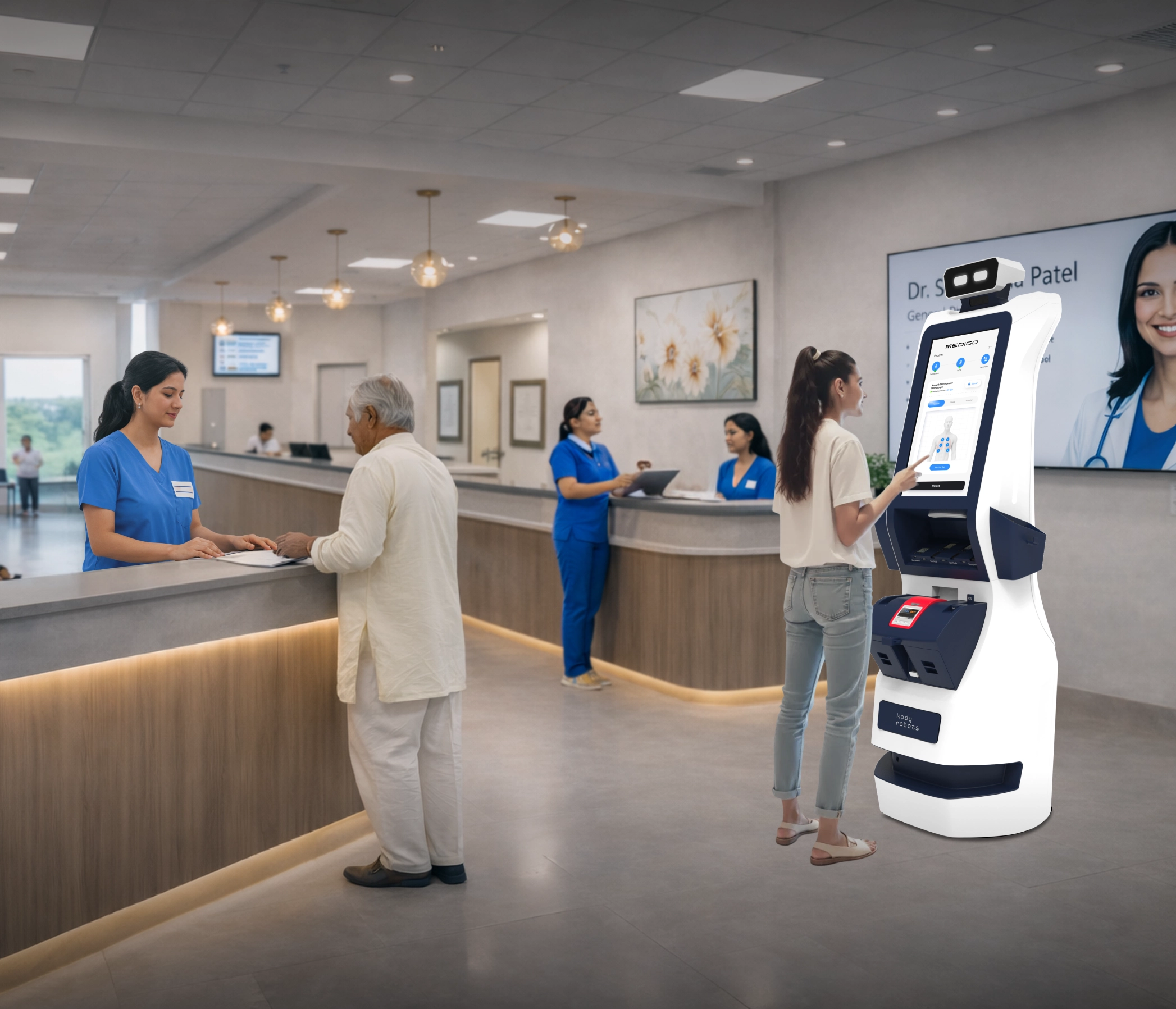
India’s healthcare system needs faster, easier, and more accessible screening support. Hospitals, clinics, corporate offices, schools, factories, community health centers, and public health programs often face the same challenge. People need basic health checks, but access, time, staff availability, and awareness can become barriers.
A Healthcare Screening Robot can help reduce these barriers by making first-level health screening more structured and more convenient. The goal is not to replace doctors, nurses, or medical professionals. The goal is to support screening workflows, improve health awareness, and help people take preventive healthcare more seriously.
Medigo built by Kody Robots fits this need as a healthcare screening solution for India. It can support organizations that want to bring screening closer to people and create a more practical preventive healthcare model.
Key Takeaways
- A Healthcare Screening Robot supports faster first-level health checks in hospitals, workplaces, schools, factories, PHCs, and public spaces.
- An AI-powered medical robot can help organize screening workflows and support better health awareness.
- A Healthcare Robot in India should improve access, reduce screening friction, and support medical teams.
- A health screening robot in India is useful where people delay routine checks due to time, distance, or limited access.
- Medigo by Kody Robots can support preventive healthcare programs across Indian organizations and communities.
- The strongest value comes when screening robots work alongside qualified healthcare professionals.
What Is a Healthcare Screening Robot?
A Healthcare Screening Robot is a technology-enabled system designed to support basic health screening and wellness checks. It helps users complete guided screening steps and receive organized health information.
A Health Screening Robot like Medigo by Kody Robots can support environments where regular screening is needed but traditional healthcare access may be difficult, slow, or event-based.
Such environments may include:
- Hospitals
- Clinics
- Corporate offices
- Corporate parks
- Factories
- Schools and colleges
- Primary Health Centers
- Community health centers
- Residential communities
- Public health camps
- Large institutions
The purpose is to make screening more accessible. When people can check basic health indicators more easily, preventive care becomes more realistic.
Why India Needs Better Health Screening Access?
India has a large and diverse population with different healthcare needs. People in metro cities may have access to hospitals but still delay checkups due to time pressure. People in rural areas may delay checks because healthcare facilities are far away. Employees may skip screening because office schedules are demanding. Students may not receive regular wellness checks. Factory workers may need periodic health monitoring but lack easy access.
A health screening robot in India can support this gap by placing screening access closer to people.
Screening access matters because many health issues develop gradually. People may not notice early signs until symptoms become serious. Regular screening can help improve awareness and encourage timely consultation.
A Healthcare Screening Robot does not diagnose or treat patients. It supports the first step: screening, awareness, and referral readiness.
Why AI-Powered Medical Robots Are Becoming Important?
An AI-powered medical robot can support healthcare workflows by making screening more guided, organized, and user-friendly. AI in healthcare should be used responsibly. The purpose should be to assist screening and workflow support, not replace clinical judgment.
In a healthcare screening setup, AI-powered support can help with:
- Guided user interaction
- Structured screening flow
- Health data organization
- Report generation support
- Risk awareness prompts
- Workflow assistance
- Patient education support
- Follow-up direction support
Medical responsibility must remain clear. Doctors and qualified healthcare professionals should interpret results, diagnose conditions, and decide treatment. A robot can support screening, but human medical expertise remains essential.
How Medigo Supports Preventive Healthcare?
Medigo Robot by Kody Robots can be positioned as a practical Healthcare Screening Robot for Indian organizations that want to improve preventive care access. It can help create a screening point where people complete basic checks more conveniently.
Medigo can support:
- Employee health screening
- Student wellness programs
- Community health drives
- Public health camps
- Factory workforce screening
- PHC and clinic support
- Corporate wellness programs
- First-level screening before consultation
- Digital health report workflows
Preventive healthcare becomes stronger when screening is easy to access. If people need to travel far, book appointments, or wait for annual camps, many will delay checks. A screening robot can help reduce that friction.
Healthcare Robot in India for Workplaces
Workplaces are one of the strongest use cases for healthcare screening automation. Many employees spend long hours at desks, in meetings, on factory floors, or across operational shifts. Routine health checks often get delayed because work schedules take priority.
A Healthcare Robot in India can support workplace wellness by creating an on-site screening access point. Corporate offices, IT parks, business parks, factories, and industrial campuses can use Medigo to make employee health checks easier.
Workplace benefits include:
- Faster employee screening
- Better wellness participation
- Reduced dependency on annual camps
- Improved preventive health awareness
- Digital report support
- Easier HR wellness planning
- Better employee care positioning
A corporate wellness program should not feel like a one-day activity. A screening robot can make workplace healthcare more consistent.
Healthcare Screening Robot for Schools and Colleges
Educational institutions also need better health screening access. Schools, colleges, universities, and hostels manage large student populations. Students may face lifestyle-related issues, stress, fatigue, poor sleep, posture concerns, and general wellness challenges.
A Healthcare Screening Robot can support student and staff wellness programs by making basic screening easier inside campus environments.
Possible use cases include:
- Student wellness checks
- Staff health screening
- Annual campus health drives
- Hostel wellness support
- Sports fitness screening support
- Preventive health awareness programs
- Early referral guidance
A robot should not replace doctors or school health staff. It should support screening and help institutions identify when further medical consultation may be needed.
Healthcare Screening Robot for PHCs and Community Health
Primary Health Centers and community health programs are critical in India. Many people depend on local healthcare infrastructure for first-level guidance. However, PHCs and community centers may face high patient load, limited staff, and manual screening pressure.
A Healthcare Screening Robot can support PHCs and community health centers by helping with basic screening workflows. It can help healthcare workers manage patient flow more efficiently.
PHC and community use cases include:
- First-level screening
- Health camp support
- Rural health outreach
- Senior citizen screening
- Preventive care programs
- Referral preparation
- Public health awareness
- Digital reporting support
This can help healthcare workers focus more on consultation, patient counseling, and referral decisions.
Healthcare Screening Robot for Factories and Industrial Workforces
Factories and industrial campuses need structured workforce health programs. Workers may operate in shifts, handle physical tasks, or work in demanding environments. Regular health screening can support workforce safety and wellbeing.
Medigo can support industrial healthcare programs by creating a screening access point inside the workplace.
Factory use cases include:
- Worker health screening
- Shift-based wellness checks
- Occupational health programs
- Preventive care support
- Health camp automation
- Employee report generation
- First-level referral support
For factory management, a health screening robot can support compliance-oriented wellness planning and employee care initiatives.
Benefits of Healthcare Screening Robots
Better access
Screening becomes available closer to people in offices, schools, factories, PHCs, and community locations.
Faster first-level checks
People can complete basic screening without long travel or complex scheduling.
Better preventive care
Regular screening encourages people to notice health concerns earlier.
Better health awareness
Users receive more structured information about personal health indicators.
Better workflow support
Healthcare workers and HR teams can manage screening programs more efficiently.
Better digital reporting
Digital reports can reduce dependency on scattered paper-based records.
Better scalability
Organizations can deploy screening access across multiple locations and programs.
Benefits for Healthcare Providers
Healthcare providers can use screening robots to support patient intake and preventive care workflows.
Benefits include:
- More organized screening data
- Faster pre-consultation checks
- Better patient flow
- Reduced manual screening pressure
- Support for health camps
- Easier follow-up planning
- Better referral readiness
The robot can help improve workflow, but qualified professionals remain responsible for care decisions.
Benefits for Organizations
Organizations across India can use Medigo to improve wellness programs and employee or community care.
Organizations can benefit through:
- Better participation in health checks
- Stronger preventive wellness programs
- Improved employee care image
- Reduced coordination burden
- More structured screening activity
- Better support for large campuses
- Easier health awareness campaigns
For HR teams, schools, factories, and community health administrators, screening robots can make healthcare programs easier to run.
Privacy and Responsible Use Matter
Healthcare data is sensitive. Any Healthcare Screening Robot should be used with clear privacy standards. Users should understand how reports are created, who can access data, and how consent is managed.
Organizations should define:
- User consent process
- Data access rules
- Report ownership
- Privacy controls
- Medical follow-up process
- Data security standards
- Responsible reporting policies
Trust is essential. People will use healthcare screening systems only when privacy and dignity are protected.
What Buyers Should Evaluate Before Adoption
A Healthcare Screening Robot should be selected based on practical needs.
Use case
The buyer should define whether the robot will support workplace screening, PHCs, schools, factories, public health programs, or clinics.
Ease of use
The system should be simple for people with different digital comfort levels.
Screening workflow
The process should be clear from start to report generation.
Medical oversight
Doctors or healthcare professionals should remain part of the care pathway.
Location fit
The robot should fit into available spaces such as wellness rooms, lobbies, medical rooms, or health centers.
Support and maintenance
Training, service, and uptime affect long-term value.
Scalability
Large organizations should evaluate whether the model can support multiple sites.
Common Mistakes to Avoid
Treating the robot as a doctor
A screening robot supports basic checks and awareness. Diagnosis and treatment remain medical responsibilities.
Deploying without workflow planning
Organizations should define how users register, complete screening, receive reports, and get follow-up guidance.
Ignoring privacy
Health data must be handled responsibly.
Using the robot only during events
Regular use creates stronger value than occasional demonstrations.
Skipping staff training
Teams should know how to guide users and manage the system.
Failing to connect screening with follow-up
Screening is useful when users know the next step.
Why Kody Robots Fits Healthcare Screening Automation
Kody Robots is a robotics company in India fits the healthcare automation conversation through Medigo by Kody Robots, a screening-led solution for preventive healthcare environments. India needs healthcare access models that can support hospitals, workplaces, PHCs, factories, schools, and public health programs.
Medigo can help bring screening closer to people and support a more structured health check workflow. The value lies in easier access, better awareness, digital reporting, and stronger preventive care support.
Future of Healthcare Screening Robots in India
The future of healthcare in India will include more connected, preventive, and accessible screening models. Hospitals and clinics will remain central, but first-level healthcare access must also move closer to communities, workplaces, and institutions.
A Healthcare Screening Robot can become part of this future by supporting:
- Preventive healthcare
- Telemedicine-linked workflows
- Workplace wellness
- Public health screening
- PHC support
- Community health camps
- Digital report ecosystems
- Early health awareness
The best future will be hybrid. Technology will support screening, while doctors and healthcare workers will continue guiding care.
Conclusion
A Healthcare Screening Robot can help India improve access to first-level health checks and preventive care. People often delay routine screening because of time, distance, workload, or lack of awareness. Medigo by Kody Robots can help reduce that gap by bringing screening closer to workplaces, schools, factories, PHCs, clinics, and community health programs.
An AI-powered medical robot should support healthcare professionals, not replace them. When used responsibly, Medigo can improve screening workflows, digital reporting, awareness, and referral readiness.
For Indian organizations ready to make healthcare screening more accessible and structured, Medigo offers a practical step toward smarter preventive healthcare.