
Healthcare professionals are spending an alarming amount of time on administrative tasks instead of patient care. Studies consistently show that physicians often dedicate hours each day to documenting patient encounters, updating electronic health records (EHRs), and managing clinical notes. This growing documentation burden contributes to physician burnout, reduced productivity, and ultimately impacts the quality of patient care.
This challenge has created a significant opportunity for healthcare technology innovation. Enter AI medical scribes—intelligent applications powered by artificial intelligence, natural language processing (NLP), and speech recognition technologies that can automatically capture, transcribe, and summarize doctor-patient conversations into structured clinical documentation.
As hospitals, clinics, telehealth providers, and healthcare startups increasingly adopt AI-powered solutions, demand for AI medical scribe app development has surged. However, one of the most common questions organizations ask before starting a project is: How much does an AI medical scribe app cost to develop?
The answer isn’t straightforward because development costs vary significantly depending on factors such as features, AI complexity, compliance requirements, integrations, and deployment models. Understanding these cost drivers is essential for making informed investment decisions and planning a successful healthcare technology strategy.
In this comprehensive guide, we’ll break down the AI medical scribe app development cost, explore the key factors influencing pricing, examine feature-specific expenses, and provide practical insights into budgeting for your project. Whether you’re a healthcare startup, hospital administrator, or digital health entrepreneur, this article will help you better understand what goes into building a modern AI-powered medical documentation solution.
Understanding AI Medical Scribe App Development and Its Business Value
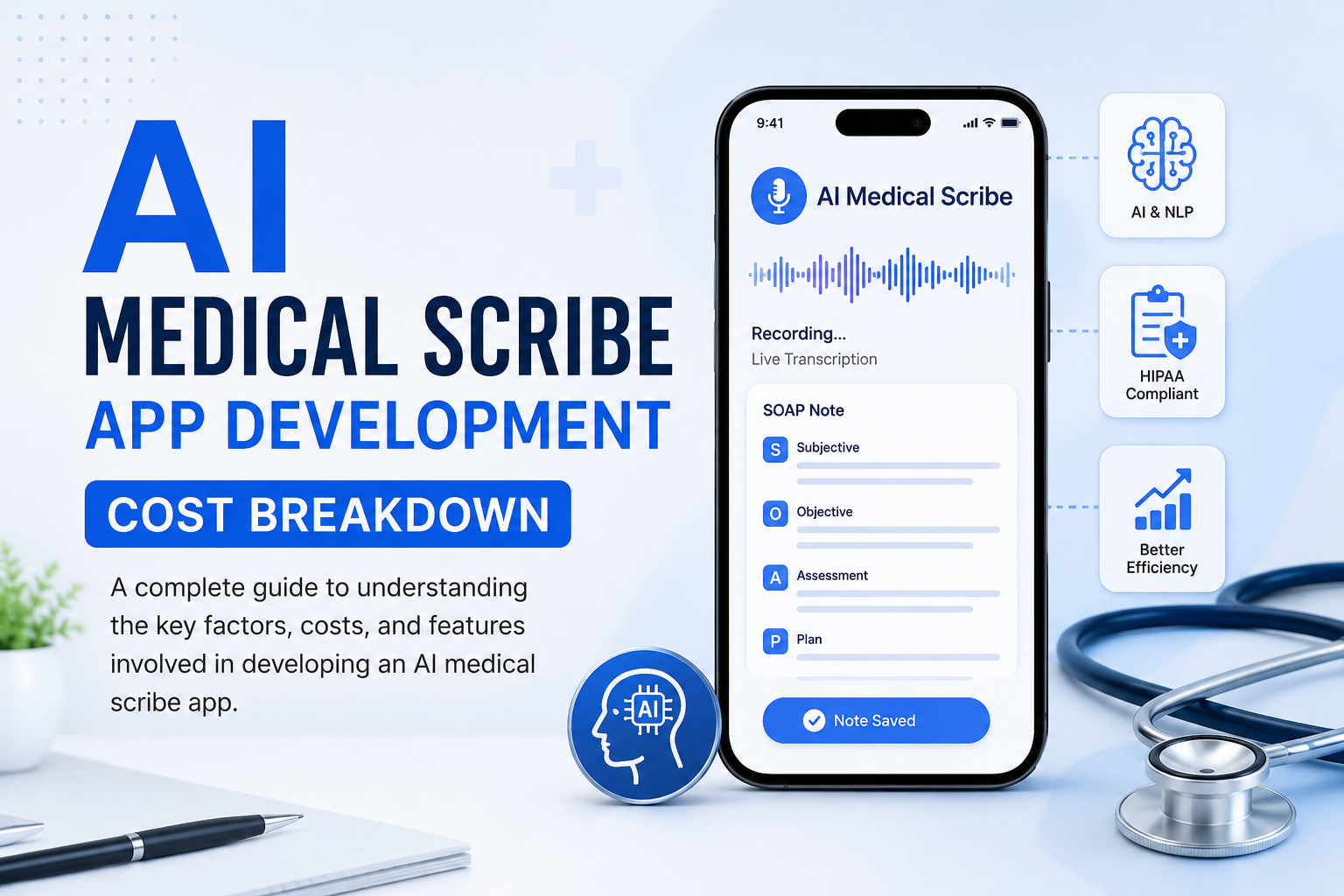
AI medical scribes are designed to automate one of healthcare’s most time-consuming processes: clinical documentation. These applications listen to physician-patient interactions, interpret medical terminology, extract relevant information, and generate structured notes that can be directly integrated into electronic health record systems.
Unlike traditional dictation software, modern AI medical scribes go far beyond simple transcription. They leverage machine learning, natural language understanding, and contextual analysis to identify symptoms, diagnoses, medications, treatment plans, and follow-up recommendations. This allows clinicians to focus more on patient engagement rather than administrative tasks.
How AI Medical Scribes Work
The technology typically follows a multi-step workflow. First, speech recognition engines convert conversations into text. Next, NLP algorithms analyze the dialogue and identify clinically relevant information. AI models then organize the extracted data into standardized formats such as SOAP notes, progress notes, or specialty-specific documentation templates.
Many advanced solutions also include real-time documentation assistance, voice commands, automated coding suggestions, and clinical decision support features. These capabilities significantly enhance operational efficiency while reducing documentation errors.
Why Healthcare Organizations Are Investing
Healthcare providers increasingly recognize the value of AI-driven documentation systems. The primary benefits include:
- Reduced physician burnout through documentation automation.
- Improved clinical accuracy and consistency.
- Increased patient interaction time.
- Faster record completion and workflow optimization.
- Enhanced operational efficiency and revenue cycle management.
As healthcare organizations continue prioritizing digital transformation, investment in AI-powered documentation solutions is expected to accelerate across hospitals, clinics, telemedicine platforms, and private practices.
AI Medical Scribe App Development Cost Breakdown by Development Stage
One of the biggest misconceptions about healthcare app development is that costs are determined solely by coding. In reality, the overall AI medical scribe app development cost includes multiple stages, each requiring specialized expertise and resources.
Discovery and Planning Phase
Every successful healthcare application begins with thorough research and planning. During this stage, development teams analyze business objectives, user requirements, compliance obligations, workflow processes, and technical architecture.
This phase typically includes:
- Market research
- Product strategy
- User journey mapping
- Compliance assessment
- Technical feasibility studies
For most projects, the discovery phase can account for 5%–10% of the total project budget.
UI/UX Design and Prototyping
Healthcare applications require intuitive interfaces that simplify workflows for physicians and clinical staff. Design teams create wireframes, user flows, interactive prototypes, and accessibility-focused experiences.
Because clinicians operate in high-pressure environments, usability plays a crucial role in adoption rates. Investing in quality healthcare-focused UX design often reduces training requirements and improves long-term engagement.
AI Model Development and Training
This is often the most expensive component of AI medical scribe app development.
AI engineers must develop and train models capable of:
- Speech recognition
- Medical terminology interpretation
- Clinical note generation
- Contextual understanding
- Specialty-specific documentation
Training healthcare-specific AI models requires access to large datasets, annotation processes, validation testing, and ongoing optimization.
Depending on complexity, AI development can represent 30%–50% of the total project budget.
Testing and Deployment
Healthcare applications require extensive testing to ensure performance, security, compliance, and clinical accuracy.
Testing typically covers:
- Functional testing
- Security testing
- HIPAA compliance validation
- EHR integration testing
- Performance optimization
Deployment costs vary based on cloud infrastructure requirements and scalability needs.
Key Factors That Influence AI Medical Scribe App Development Cost
No two AI medical scribe solutions are identical. Several variables can dramatically impact overall development expenses.
Feature Complexity
The number and sophistication of features directly influence development costs.
Basic applications may include:
- Voice recording
- Speech-to-text conversion
- Clinical note generation
Advanced solutions may offer:
- Real-time transcription
- Multi-language support
- AI-generated summaries
- Clinical coding recommendations
- Automated EHR updates
- Telehealth integration
Naturally, advanced functionality requires greater development effort and larger budgets.
Healthcare Compliance Requirements
Healthcare software operates in one of the world’s most regulated industries.
Compliance standards often include:
- HIPAA
- HITECH
- GDPR
- SOC 2
- HL7
- FHIR
Implementing secure data handling, encryption protocols, access controls, audit logs, and compliance monitoring significantly affects development timelines and costs.
Integration Requirements
Most healthcare providers already use electronic health record systems such as Epic, Cerner, Allscripts, or Athenahealth.
Building seamless integrations with these platforms often requires:
- API development
- Data mapping
- Workflow customization
- Interoperability testing
Integration complexity frequently adds substantial costs to the project.
Healthcare Compliance Requirements
Compliance requirements are among the biggest cost drivers in HIPAA compliant AI scribe platform development. Features such as encrypted data storage, secure APIs, role-based access controls, audit logs, and compliance monitoring require additional development effort and testing.
AI Accuracy and Customization
A generic transcription engine costs far less than a highly customized AI solution trained for specific medical specialties.
For example:
- Cardiology
- Dermatology
- Oncology
- Psychiatry
- Orthopedics
Each specialty requires unique vocabulary, workflows, and documentation standards.
Higher accuracy expectations typically lead to increased AI training investments.
Cost Estimates Based on App Complexity and Features
When evaluating budgets, organizations should understand the relationship between functionality and development costs.
Basic AI Medical Scribe Application
A minimum viable product (MVP) may include:
- Voice capture
- Basic speech-to-text functionality
- Simple note generation
- User authentication
- Cloud storage
Estimated Cost Range:
$30,000–$70,000
These solutions are often suitable for startups validating market demand.
Mid-Level AI Medical Scribe Platform
A more advanced solution may include:
- NLP-based note structuring
- EHR integration
- Multi-user support
- Analytics dashboards
- HIPAA compliance features
Estimated Cost Range:
$70,000–$180,000
This category is commonly chosen by growing healthcare technology companies.
Enterprise-Grade AI Medical Scribe Solution
Enterprise systems often include:
- Real-time AI documentation
- Advanced machine learning models
- Multi-specialty support
- Telehealth integrations
- Clinical coding assistance
- Predictive analytics
- Enterprise security frameworks
Estimated Cost Range:
$180,000–$500,000+
Large healthcare networks and enterprise providers typically invest in these highly scalable platforms.
Ongoing Maintenance and Operational Costs
Development is only part of the investment.
Organizations must also budget for:
- Cloud hosting
- AI model retraining
- Security updates
- Compliance monitoring
- Technical support
- Infrastructure scaling
Annual maintenance generally ranges between 15% and 25% of the original development cost.
How to Optimize AI Medical Scribe App Development Costs Without Sacrificing Quality
Many healthcare organizations assume that reducing costs means compromising quality. In reality, strategic planning can significantly improve cost efficiency while maintaining performance and compliance standards.
One of the most effective approaches is starting with a focused MVP. Rather than launching every possible feature at once, businesses can prioritize core functionalities such as speech recognition, clinical note generation, and EHR connectivity. Additional capabilities can then be introduced based on user feedback and market demand.
Another cost-saving strategy involves partnering with an experienced AI development company that specializes in healthcare technology. Established providers often possess reusable frameworks, pre-built integrations, healthcare compliance expertise, and trained AI resources that accelerate development while minimizing risk.
Organizations should also leverage cloud-based infrastructure instead of investing heavily in on-premise systems. Cloud environments offer flexibility, scalability, security, and predictable operational costs, making them particularly attractive for healthcare startups and growing enterprises.
Finally, selecting modern development architectures such as microservices and API-first platforms enables future expansion without requiring expensive system overhauls. This approach reduces long-term ownership costs while supporting innovation and scalability.
Choosing the Right Development Partner
When evaluating vendors, consider:
- Healthcare industry experience
- AI and machine learning expertise
- Compliance knowledge
- Portfolio of healthcare projects
- EHR integration capabilities
- Long-term support services
A qualified AI development company can often help businesses avoid costly mistakes and accelerate time-to-market.
Conclusion
The healthcare industry is rapidly embracing intelligent automation, and AI-powered medical documentation is at the forefront of this transformation. By reducing administrative burdens, improving documentation accuracy, and enhancing clinician productivity, AI medical scribes are becoming essential tools for modern healthcare organizations.
For organizations exploring AI medical scribe app development, project costs can range from approximately $30,000 for a basic MVP to well over $500,000 for enterprise-grade platforms with advanced AI capabilities. The right approach depends on your business goals, target users, regulatory requirements, and growth strategy.
As demand for AI-driven healthcare solutions continues to rise, investing in a thoughtfully designed medical scribe platform can deliver substantial operational and financial benefits. Working with an experienced AI development company ensures access to the technical expertise, healthcare knowledge, and implementation support needed to build a solution that drives long-term success.