
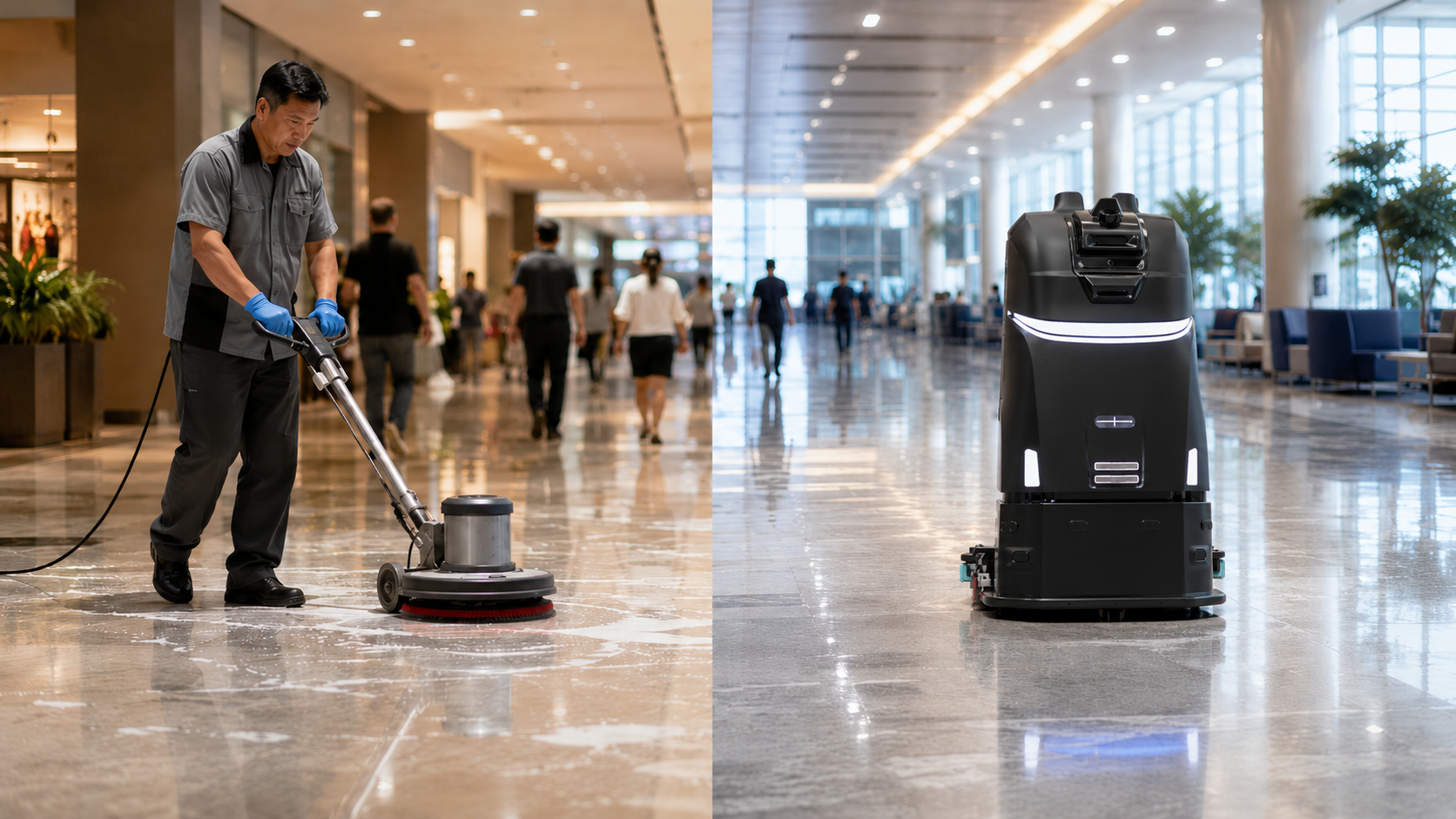

Large facilities are judged by how clean, safe, and operationally disciplined the environment feels. Airports, warehouses, hotels, resorts, malls, hospitals, factories, and public buildings all face the same pressure. Floors need frequent cleaning, teams need predictable coverage, and leaders need a model that does not collapse during peak activity.
A manual floor scrubber can still support many cleaning operations. The challenge begins when a facility grows larger, footfall rises, and floor cleaning becomes a repeated operational burden. A heavy-duty cleaning robot gives businesses a stronger way to manage routine floor care across large, busy environments.
The shift toward cleaning automation is not happening in isolation. Future Market Insights estimates the cleaning robot market at USD 14.8 billion in 2025 and projects the market to reach USD 96.8 billion by 2035, with a 20.6% CAGR during the forecast period. The same source also notes that professional cleaning robots lead the type segment with a 57.3% market share, while floor-cleaning robots lead the product segment with a 61.5% share.
For C-level leaders, airport management, warehouse management, and hotel and resort operators, the question is clear. Should floor cleaning continue to depend mostly on manual equipment, or does an autonomous cleaning robot create stronger long-term value?
Vulcan by Kody Robots fits the commercial discussion as a practical robotic floor-cleaning solution for businesses that need stronger cleaning consistency, better staff allocation, and scalable facility maintenance.
Key Takeaways
- A heavy-duty cleaning robot helps large facilities improve routine floor-cleaning consistency.
- Manual scrubbers still work, but manual equipment depends heavily on operator availability, shift discipline, and repeated physical effort.
- An autonomous cleaning robot supports large-area cleaning through planned routes and repeatable schedules.
- Airports, warehouses, hotels, resorts, malls, factories, and public facilities gain value when floor cleaning becomes more structured.
- Cleaning robot adoption is supported by rising automation demand, labor cost pressure, hygiene awareness, and better AI and sensor-based navigation.
- Vulcan by Kody Robots fits businesses that want a stronger robotic cleaning model for high-footfall environments.
Why Floor Cleaning Has Become a Boardroom Issue
Floor cleaning may look like a facility-level task, but poor cleaning affects business performance. A dirty airport terminal reduces passenger confidence. A dusty warehouse floor weakens site discipline. A poorly maintained hotel lobby damages guest perception. A stained resort walkway reduces premium appeal. A neglected factory floor can affect safety culture.
Senior leaders now view cleaning through a wider lens:
- brand reputation
- hygiene expectations
- safety readiness
- labor productivity
- operational consistency
- audit preparedness
- customer experience
A facility can invest heavily in architecture, interiors, automation, and service quality, but unclean floors can still create a weak impression. That is why floor cleaning deserves strategic attention.
A heavy-duty cleaning robot helps leaders move from reactive cleaning to planned cleaning. The difference matters because large facilities do not need one-time cleanliness. Large facilities need repeated, visible, and reliable floor maintenance across long operating hours.
Manual Floor Scrubbers: Where They Still Work
Manual floor scrubbers remain useful in many settings. Smaller facilities, low-traffic zones, irregular spaces, and detail-heavy cleaning tasks often need human control. Manual equipment also works well for spot cleaning, difficult corners, unexpected spills, and areas where human judgment is required.
Manual floor scrubbers offer:
- direct operator control
- flexibility for unusual spaces
- lower initial equipment complexity
- usefulness for small or irregular cleaning zones
- strong value in detail-focused cleaning
A manual model works best when the facility is compact, cleaning needs are limited, and the team can maintain consistent coverage without strain.
The problem appears when a business relies on manual scrubbers for large, repetitive, high-frequency floor-cleaning work. Under those conditions, manual cleaning can become expensive, inconsistent, and physically demanding.
Where Manual Floor Scrubbers Create Operational Gaps
Manual equipment depends on people. That dependence brings flexibility, but also variation. Large facilities often struggle with the same issues.
Operator availability affects output
A manual scrubber cannot clean without a trained person operating the machine. Shift gaps, absenteeism, fatigue, and peak workload can reduce cleaning consistency.
Large areas consume many staff hours
Airports, warehouses, hotels, resorts, malls, and factories may need repeated floor coverage across wide spaces. Manual cleaning across such areas consumes time that staff could use for higher-value tasks.
Cleaning quality can vary by shift
One operator may clean thoroughly, while another may miss corners, delay routes, or rush through large zones. Facility leaders often struggle to maintain uniform cleaning quality across teams.
Peak periods create pressure
High-footfall facilities need cleaning most when the site is busiest. Manual teams may already be overloaded with spills, washrooms, waste, guest requests, and inspections.
Reporting and accountability are harder
Manual cleaning often depends on logs, supervision, and spot checks. Real cleaning coverage may be difficult to verify consistently.
Manual scrubbers are useful tools, but a manual-only strategy can limit a facility’s ability to scale cleaning discipline.
Robotic Floor Scrubbers: What Changes
A robotic floor scrubber introduces automation into routine floor care. An autonomous cleaning robot can follow planned routes, support scheduled cleaning cycles, and handle repetitive floor-cleaning work with more consistency.
A heavy-duty cleaning robot works best when cleaning needs are:
- frequent
- large-area
- route-based
- predictable
- operationally important
- visible to customers or workers
The robot does not remove the need for facility staff. The robot supports the routine layer of cleaning. People still manage detailed work, exceptions, inspections, spills, edges, and customer-facing service needs.
A strong robotic model creates a smarter division of work. Robots handle repetition. People handle judgment.
Manual vs Robotic Floor Scrubbers
| Factor | Manual Floor Scrubber | Heavy-Duty Cleaning Robot |
|---|---|---|
| Operation | Requires continuous human operation | Supports autonomous route-based cleaning |
| Consistency | Varies by operator and shift | More repeatable with planned schedules |
| Labor demand | Higher for large areas | Reduces repetitive manual workload |
| Best use | Small zones, spot cleaning, irregular spaces | Large floors, routine cleaning, high-footfall spaces |
| Accountability | Depends on supervision and logs | Easier to structure around planned routes |
| Scalability | More locations need more operators | Easier to scale routine coverage with automation |
| Staff focus | Staff remain tied to machine operation | Staff can focus on inspection and exception handling |
The right model is often not manual versus robot in absolute terms. A stronger model combines both. Manual tools support detail and response. Robotic tools support large-area routine cleaning.
Why a Heavy-Duty Cleaning Robot Fits Airports
Airport cleaning demands high consistency. Check-in halls, concourses, gates, arrival zones, baggage areas, and retail corridors face constant passenger movement. Airport floors also carry luggage wheels, trolley marks, dust, food residue, and high visual scrutiny.
A heavy-duty cleaning robot helps airport management maintain cleaner public areas with less dependence on repeated manual scrubbing routes.
Airport leaders gain value through:
- cleaner terminal presentation
- better support across long operating hours
- reduced repetitive workload for facility teams
- stronger public-area hygiene perception
- better readiness during holiday and travel peaks
A passenger may not notice every operational system inside an airport, but clean floors create immediate confidence.
Why Warehouses Need Autonomous Cleaning
Warehouses rely on movement. People, pallets, forklifts, carts, and goods all depend on clear and maintained floor areas. Dust, debris, and residue can affect site discipline and operational readiness.
A heavy-duty cleaning robot supports warehouse management by handling repeated cleaning across:
- main aisles
- dispatch zones
- staging areas
- packing sections
- loading support lanes
- internal movement routes
Warehouses in India, the USA, Europe, and Canada are becoming larger and more process-driven. Cleaning automation fits that shift because broad floor maintenance is repeated daily.
Future Market Insights notes that cleaning robot adoption is supported by automation in commercial cleaning, rising labor costs, AI advancements, sensor-based navigation, and greater demand for time-saving solutions.
Why Hotels and Resorts Should Consider Robotic Scrubbers
Hotels and resorts operate in a guest-first environment. Clean floors influence lobby experience, banquet readiness, corridor presentation, dining area quality, and overall brand perception.
Manual cleaning teams remain essential for hospitality. Yet large guest-facing floors require repeated attention. A resort may have wide indoor spaces, event venues, lounges, corridors, and shared movement zones. A hotel may need frequent floor cleaning across lobbies, meeting floors, restaurants, and public corridors.
An autonomous cleaning robot can help hotel and resort management maintain visible cleanliness without pulling staff away from guest-sensitive work.
The biggest gains include:
- improved public-area presentation
- better staff allocation
- stronger cleaning consistency
- cleaner banquet and event zones
- better guest confidence in hygiene standards
A premium property needs cleaning systems that protect premium perception.
Why C-Level Leaders Should Care
A CEO, COO, CFO, or facility head should not evaluate a cleaning robot as a cleaning machine alone. A heavy-duty cleaning robot should be evaluated as an operational asset.
The business case connects to:
Labor productivity
Staff can spend less time on repeated machine operation and more time on inspection, supervision, spot response, and quality control.
Consistency
Automated route-based cleaning supports a more predictable maintenance standard.
Brand protection
Cleaner public spaces protect the reputation of airports, hotels, resorts, malls, warehouses, and corporate campuses.
Scalability
A growing facility needs cleaning systems that can scale without requiring every additional square foot to depend only on more manual effort.
Long-term cost control
Automation can reduce pressure from rising labor costs and repeated manual workload. FMI identifies labor cost pressure as one of the drivers behind cleaning robot market expansion.
Why the Market Is Moving Toward Autonomous Cleaning
The wider cleaning robot market shows a clear direction. Cleaning robots are gaining demand across residential and professional settings, with growth supported by hygiene awareness, automation demand, improved battery performance, AI, sensor navigation, and multi-surface cleaning development.
High-footfall facilities are strong candidates because cleaning demand is:
- visible
- repetitive
- labor-intensive
- difficult to pause
- tied to customer trust
- tied to operational standards
Professional cleaning robots are especially relevant for commercial facilities such as airports, offices, hospitals, and retail outlets where hygiene standards and cost efficiency are important.
Why Vulcan Fits the Manual vs Robotic Cleaning Conversation
Vulcan by Kody Robots fits the conversation because businesses need practical robotic floor-cleaning support for demanding environments. Facility leaders are not looking for a showpiece. They need a cleaning system that supports large-area maintenance, staff efficiency, and routine cleaning discipline.
A business may consider Vulcan when the cleaning environment includes:
- large public floors
- high footfall
- repeated cleaning routes
- long operating hours
- pressure on housekeeping teams
- need for stronger cleaning consistency
- multiple zones requiring routine coverage
Vulcan should be evaluated as part of a larger facility strategy. Manual teams remain important. Manual scrubbers remain useful. Robotic cleaning adds a stronger routine-cleaning layer for large and repeated tasks.
What Businesses Should Evaluate Before Buying
A robotic cleaning decision should be based on fit, not excitement.
Floor size
Larger facilities usually gain stronger value from automation because repeated manual cleaning takes more time.
Cleaning frequency
Frequent cleaning needs improve the business case for a robot.
Route clarity
Wide, open, and repeatable cleaning paths support stronger robotic performance.
Staff workflow
The robot should support teams, not create confusion. Facility managers should define who supervises the robot and how cleaning schedules are managed.
Surface type
Leaders should check whether target areas match the cleaning needs and environment.
Support model
Training, setup, service, maintenance, and route planning affect long-term outcomes.
ROI horizon
A robot should be judged across months and years of repeated use, not as a one-time purchase.
ROI Logic for a Heavy-Duty Cleaning Robot
The ROI of a heavy-duty cleaning robot comes from repeated operational value.
Reduced repetitive labor demand
Staff spend less time operating cleaning equipment across broad zones.
Better cleaning coverage
Planned routes support more consistent cleaning across large spaces.
Better staff productivity
Facility teams can focus on exceptions, inspections, and quality control.
Stronger customer experience
Clean floors improve how guests, passengers, employees, and clients perceive the facility.
Better scale
A robotic system helps businesses manage larger areas without increasing manual cleaning pressure at the same rate.
Better operational discipline
A planned cleaning model improves accountability and routine maintenance quality.
For airports, warehouses, hotels, and resorts, ROI grows when the robot is used daily across high-value zones.
The Best Model Is Hybrid
The strongest facility cleaning strategy is not manual-only or robot-only. The strongest model combines human intelligence with robotic consistency.
Manual teams handle:
- spills
- corners
- edges
- washrooms
- detailed checks
- supervision
- customer-sensitive response
Robots handle:
- repeated routes
- large floors
- planned schedules
- routine scrubbing
- long-duration cleaning cycles
A hybrid model helps businesses avoid the weaknesses of both extremes. Staff remain in control. Robots handle the repetition.
Conclusion
Manual floor scrubbers still serve an important role, but high-footfall facilities now need a stronger cleaning model. Airports, warehouses, hotels, resorts, factories, malls, and public spaces face cleaning demands that are too frequent, visible, and labor-intensive to depend only on manual equipment.
A heavy-duty cleaning robot gives businesses a more scalable way to manage routine floor care. An autonomous cleaning robot supports consistency, staff productivity, brand presentation, and long-term operational discipline. Market growth projections also show that cleaning automation is becoming a serious business category, not a passing trend.
Vulcan by Kody Robots fits the shift toward smarter facility maintenance for leaders in India, the USA, Europe, and Canada. For businesses ready to improve cleaning consistency and reduce repeated manual workload, the next move is clear.
Buy an autonomous cleaning robot and build a cleaner, more efficient facility operation.