
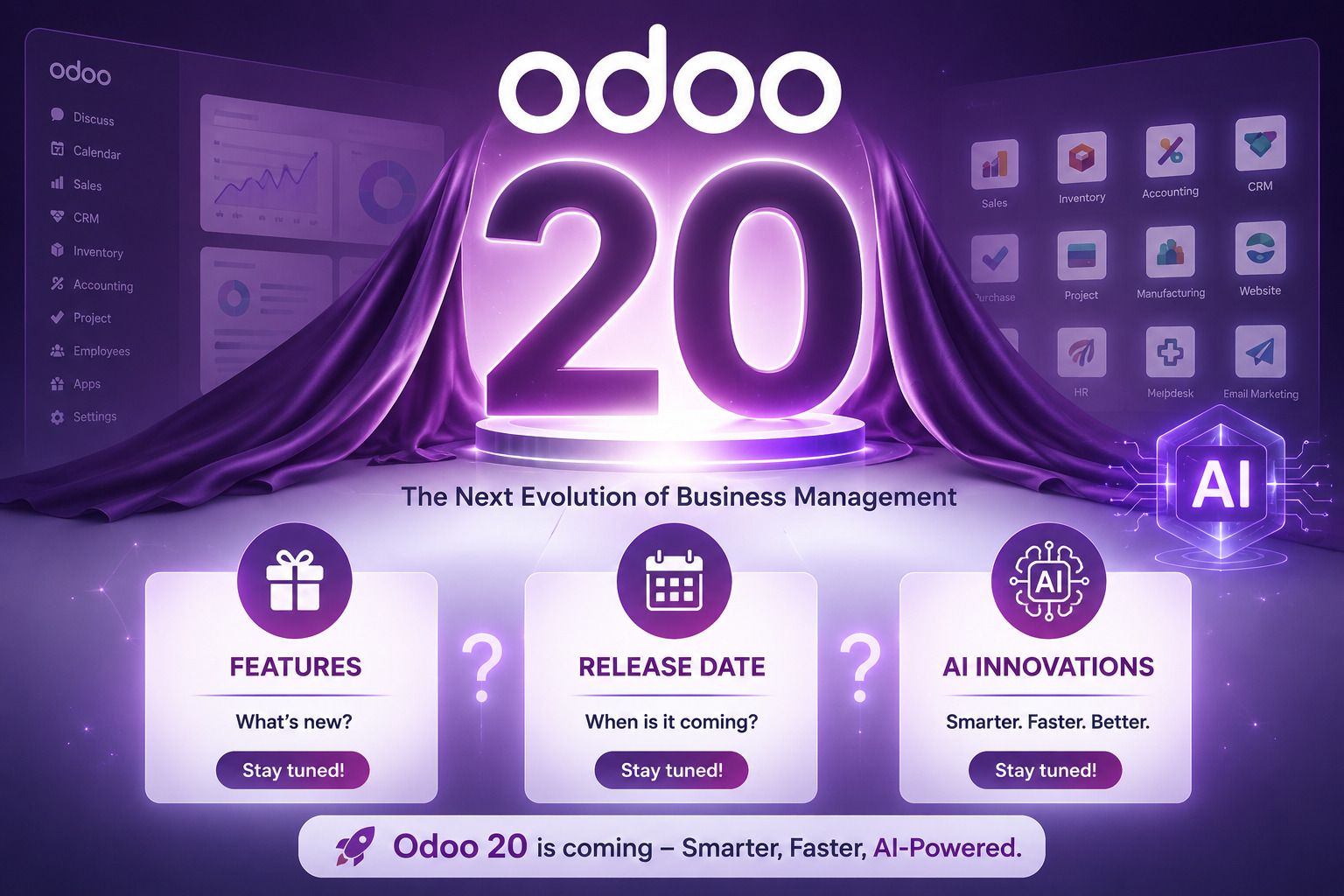
The ERP industry is changing rapidly in 2026, and businesses are expecting software that does more than basic management tasks. Companies now want intelligent automation, faster workflows, smarter reporting, and systems that can actively support business decisions.
This is exactly why the upcoming release of Odoo 20 is getting so much attention worldwide.
Odoo 20 is expected to become one of the biggest ERP updates in recent years because of its strong focus on AI powered automation, performance improvements, and connected business experiences.
Many industry experts are already describing it as a major step toward autonomous ERP systems that work proactively instead of waiting for manual actions.
In this blog, we will explore the expected Odoo 20 release date, upcoming features, AI innovations, and why this version could redefine ERP for modern businesses.
Odoo 20 Release Date
Odoo 20 is expected to be officially unveiled during Odoo Experience 2026, which will take place from September 24 to September 26, 2026, at Brussels Expo in Belgium.
The event is expected to attract more than 45,000 attendees along with hundreds of exhibitors, talks, workshops, and master classes.
As with previous versions, the official keynote presentation will likely be delivered by Fabien Pinckaers, who traditionally introduces major product innovations during the annual event.
Odoo follows a yearly release cycle, usually launching a new major version every September or October.
The previous version, Odoo 19, was released in September 2025 and introduced AI driven workflows, improved ecommerce features, and more than 100 new industry modules.
Why Odoo 20 Is Creating So Much Buzz
Odoo has been growing rapidly over the last few years.
By mid 2025, the platform had reportedly crossed 15 million users globally, growing from around 13 million users in 2024. This represents nearly 15% year over year growth.
Today, millions of businesses across more than 175 countries use Odoo for operations including:
- Accounting
- CRM
- Inventory
- Ecommerce
- Manufacturing
- HR
- Marketing automation
But Odoo 20 is attracting attention because it is expected to move ERP systems beyond simple automation toward AI assisted operational intelligence.
The idea is shifting from:
“ERP software you use”
to
“ERP software that works for you.”
AI Innovations Expected in Odoo 20
One of the biggest highlights of Odoo 20 will likely be its AI first approach.
The platform is expected to introduce deeper AI integration across multiple modules and workflows.
Agentic AI and Autonomous ERP
Traditional AI systems usually respond only when users ask questions or trigger actions manually.
Odoo 20 is expected to move toward agentic AI, where intelligent systems can perform tasks autonomously based on operational conditions.
For example:
- Automatically generating purchase orders when stock levels drop
- Routing leads to sales teams automatically
- Suggesting workflow improvements
- Triggering reminders and approvals
- Predicting operational bottlenecks
This represents a major shift from passive ERP systems to proactive business automation.
Embedded AI Across Modules
AI functionality is expected to become more deeply integrated into:
- CRM
- Sales
- Inventory
- Accounting
- Reporting
- Customer management
Instead of acting as separate tools, AI features may work directly inside daily workflows.
This can help businesses reduce repetitive manual work and improve decision making speed.
Smarter Automation and Recommendations
Odoo 20 is also expected to provide more intelligent automation recommendations.
For example:
- Sales forecasting suggestions
- Inventory optimization alerts
- Customer follow up reminders
- Workflow efficiency insights
- Financial reconciliation assistance
These capabilities could significantly improve operational productivity for businesses using ERP systems daily.
Expected Odoo 20 Features by Module
While the final feature list will only be confirmed during the official launch, several improvements are already widely anticipated across different modules.
Accounting and Finance Improvements
Odoo 20 is expected to strengthen accounting capabilities with:
- Better financial reporting
- Improved audit tools
- Faster reconciliation workflows
- Enhanced compliance features
- Smarter automation inside accounting processes
Finance teams are increasingly looking for ERP systems that reduce manual accounting tasks while improving reporting accuracy.
Improved Mobile Experience
One major focus area is expected to be the mobile interface.
Businesses today need ERP access from anywhere, especially with remote and hybrid work environments becoming common.
Odoo 20 may introduce:
- Better mobile navigation
- Faster interface responsiveness
- Improved mobile dashboards
- Easier approval workflows on mobile devices
This could improve usability significantly for field teams and business owners.
Better Performance and Scalability
Enterprise scalability is expected to become another important improvement area.
As larger businesses adopt Odoo, performance optimization becomes increasingly important.
Expected improvements include:
- Faster loading speeds
- Better database optimization
- Improved handling of larger deployments
- Smoother integrations across applications
This could make Odoo more attractive for larger organizations in 2026.
More Connected Business Experience
Odoo has always focused on connected workflows between applications.
Odoo 20 is expected to improve this even further by creating a more seamless experience across modules.
For example:
- Better synchronization between sales and inventory
- Improved ecommerce integration
- Faster reporting across departments
- Unified customer and operational visibility
Businesses increasingly want centralized systems instead of disconnected tools.
Why Odoo 20 Matters for Businesses
Odoo 20 is important because ERP systems are no longer viewed as only operational tools.
Businesses now expect ERP platforms to help with:
- Automation
- Productivity
- Decision support
- Operational visibility
- Customer experience
- Scalability
This release reflects the broader shift happening across the ERP industry toward AI assisted business management.
For small and mid sized businesses especially, Odoo continues becoming an attractive alternative to traditional enterprise ERP systems because of its flexibility and lower implementation complexity.
An experienced odoo partner can also help businesses evaluate whether upgrading to Odoo 20 makes sense based on operational needs and long term ERP strategy.
Should Businesses Upgrade to Odoo 20?
Businesses currently using older Odoo versions may consider upgrading if they want:
- Better AI capabilities
- Improved mobile access
- Faster performance
- Enhanced automation
- Better scalability
- Modernized workflows
However, companies should evaluate upgrade planning carefully, especially if they use custom modules or integrations.
ERP upgrades should always be tested properly before deployment.
Final Thoughts
Odoo 20 is shaping up to be much more than a routine ERP update.
With expected innovations around AI powered automation, embedded intelligence, mobile usability, and enterprise scalability, the platform is moving toward a more autonomous ERP experience.
As businesses continue investing in automation and connected operations in 2026, Odoo 20 could play a major role in redefining how modern ERP systems support business growth.
The official release during Odoo Experience 2026 will likely provide a clearer picture of how these innovations will impact businesses worldwide.
FAQs
1. When will Odoo 20 officially release?
Odoo 20 is expected to be officially announced during Odoo Experience 2026, scheduled from September 24 to September 26, 2026, in Brussels, Belgium.
2. What are the biggest expected features in Odoo 20?
Some major expected features include AI powered automation, autonomous workflow agents, improved accounting tools, enhanced mobile experience, faster performance, and better integration across modules.
3. Should businesses upgrade immediately to Odoo 20?
Businesses should first evaluate compatibility with existing customizations, integrations, and workflows before upgrading. Proper testing and implementation planning are important for smooth ERP transitions.