

Modern hospitals are under constant pressure to deliver faster, safer, and more personalized patient care while managing increasingly complex operations behind the scenes. From patient admissions and doctor scheduling to billing, inventory, diagnostics, and compliance reporting, healthcare institutions handle enormous volumes of data every day. When these processes rely on disconnected systems or manual workflows, inefficiencies quickly begin to affect patient satisfaction, operational costs, and even clinical outcomes.
This is where hospital management software becomes essential. Healthcare providers across the world are investing heavily in digital systems that centralize operations, automate repetitive tasks, and improve communication across departments. As the healthcare industry continues evolving toward digital transformation, hospitals can no longer rely on outdated administrative methods if they want to remain competitive and patient-focused.
In this blog, you will learn what hospital management software is, how it works, the core modules involved, the technologies powering modern healthcare systems, and why hospitals are increasingly prioritizing intelligent digital infrastructure. Whether you are a healthcare entrepreneur, administrator, startup founder, or technology decision-maker, this guide will provide practical insights into how these systems are reshaping healthcare management.
What Is Hospital Management Software?
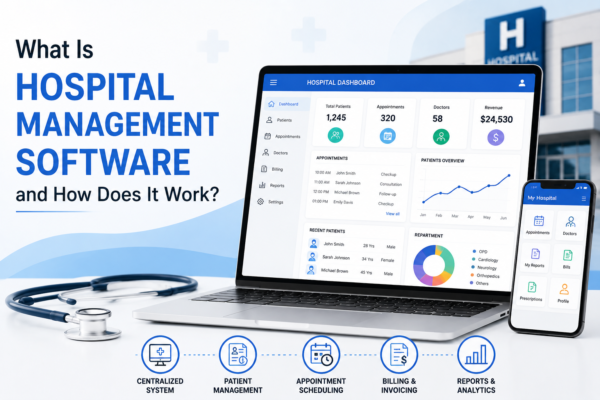
Hospital management software is a digital platform designed to streamline and automate the daily operations of hospitals, clinics, and healthcare organizations. It acts as a centralized ecosystem where medical professionals, administrators, patients, and support staff can access and manage critical healthcare information in real time.
Instead of relying on paperwork, spreadsheets, or disconnected software tools, hospitals use integrated management systems to handle everything from patient records and appointment scheduling to billing, pharmacy operations, diagnostics, and staff coordination. The goal is simple: improve efficiency while delivering better patient care.
Healthcare institutions often operate like complex ecosystems with multiple departments functioning simultaneously. A patient’s journey may involve registration, doctor consultation, lab tests, pharmacy interactions, insurance processing, billing, and post-treatment follow-ups. Without a unified system, communication gaps and delays become inevitable. Hospital management platforms solve this challenge by creating a connected digital environment where all departments work together seamlessly.
The growing demand for digital healthcare infrastructure has also increased interest in hospital management software development, especially among organizations seeking customized solutions tailored to their operational needs. Modern hospitals no longer want one-size-fits-all platforms. They prefer scalable systems that align with their workflows, compliance requirements, and patient engagement goals.
Another reason these systems have gained importance is the rise of data-driven healthcare. Hospitals now rely heavily on analytics to improve patient outcomes, optimize staffing, reduce operational costs, and forecast future healthcare demands. Advanced management software provides real-time dashboards and reporting tools that support smarter decision-making at every level.
How Does Hospital Management Software Work?
At its core, hospital management software functions as a centralized digital hub that connects multiple departments and processes through a single platform. Every activity within the hospital generates data, and the software captures, organizes, processes, and shares that data securely across authorized users.
When a patient visits a hospital, the system begins tracking their journey immediately. The patient’s personal information, appointment details, medical history, insurance data, diagnostic reports, prescriptions, and billing records are stored within the platform. Authorized healthcare professionals can access relevant information instantly, reducing delays and improving coordination.
Patient Registration and Appointment Management
The process usually starts with patient registration. Front-desk staff can create digital profiles containing demographics, contact information, insurance details, and medical history. Patients can also schedule appointments through mobile apps or online portals without visiting the hospital physically.
The system automatically manages appointment calendars, doctor availability, consultation timings, and patient queues. This minimizes scheduling conflicts and reduces waiting times significantly. Automated reminders through SMS, email, or app notifications also help reduce missed appointments.
Electronic Medical Records (EMR)
One of the most important components of hospital management software is electronic medical records. EMR systems allow doctors and healthcare professionals to store and access patient histories digitally.
Instead of handling paper files, physicians can review previous diagnoses, prescriptions, allergies, lab reports, imaging records, and treatment plans instantly. This improves diagnostic accuracy and enables faster clinical decisions.
Real-world healthcare environments benefit greatly from centralized medical records. For example, if a patient visits the emergency department, doctors can quickly access their medication history and allergies, reducing medical risks during urgent treatment.
Billing and Insurance Processing
Billing is another critical function automated by hospital management systems. The software generates invoices, manages payment records, tracks outstanding balances, and integrates with insurance providers.
Automated billing reduces administrative workload and minimizes calculation errors. Insurance claim processing also becomes more efficient because patient data, treatment codes, and payment records are already integrated within the system.
Hospitals that handle large patient volumes particularly benefit from automation because manual billing processes often lead to delays, inaccuracies, and revenue leakage.
Inventory and Pharmacy Management
Modern healthcare facilities manage thousands of medicines, medical devices, and consumables daily. Hospital software helps track inventory levels, medicine availability, expiration dates, supplier records, and procurement cycles.
Pharmacy modules ensure that prescribed medications are available while minimizing stock shortages and wastage. Automated inventory alerts help hospitals maintain operational continuity without overspending on unnecessary supplies.
Key Features of Modern Hospital Management Software
Today’s healthcare platforms go far beyond basic recordkeeping. Modern systems combine automation, cloud infrastructure, AI capabilities, and advanced analytics to create intelligent healthcare ecosystems.
Cloud-Based Accessibility
Cloud technology has transformed how hospitals operate. Instead of maintaining expensive on-premise servers, healthcare organizations can now access secure cloud-based systems from anywhere.
Doctors can review patient records remotely, administrators can monitor operations in real time, and patients can access their reports through mobile applications. Cloud infrastructure also improves scalability, allowing hospitals to expand services without rebuilding their entire digital ecosystem.
This flexibility became particularly important after the rapid rise of telemedicine and remote healthcare services.
AI and Predictive Analytics
Artificial intelligence is increasingly integrated into healthcare management platforms. AI-powered systems can analyze patient trends, predict hospital resource demands, identify high-risk patients, and assist with diagnosis support.
For example, predictive analytics can help hospitals forecast patient admission rates during seasonal outbreaks, enabling administrators to allocate staff and resources more effectively.
AI chatbots are also improving patient engagement by handling appointment scheduling, answering common questions, and providing basic healthcare guidance around the clock.
Telemedicine Integration
Telemedicine has become a core component of modern healthcare systems. Hospital management platforms now integrate video consultations, remote monitoring, digital prescriptions, and virtual follow-ups directly into the software ecosystem.
Patients can connect with doctors remotely while healthcare providers maintain access to centralized patient records. This creates a more convenient and accessible healthcare experience, especially for rural or underserved populations.
Advanced Security and Compliance
Healthcare organizations handle highly sensitive patient information, making cybersecurity a top priority. Modern hospital management systems use encryption, role-based access controls, multi-factor authentication, and secure cloud storage to protect data.
In recent years, there has also been growing interest in blockchain hospital software development because blockchain technology can enhance data transparency, security, and tamper-proof record management. Blockchain-based systems can help hospitals create immutable patient records while improving trust between healthcare providers and patients.
Compliance with regulations such as HIPAA, GDPR, and healthcare data protection laws is another major focus for healthcare technology providers.
Benefits of Hospital Management Software for Healthcare Organizations
The adoption of hospital management software delivers measurable benefits for healthcare providers, patients, and administrators alike. Beyond automation, these systems fundamentally improve how healthcare organizations operate and deliver services.
One of the biggest advantages is operational efficiency. Hospitals manage hundreds of interconnected activities daily, and automation eliminates many repetitive administrative tasks. Staff can spend less time handling paperwork and more time focusing on patient care.
Improved patient experience is another major benefit. Faster registration, shorter waiting times, digital prescriptions, online appointment booking, and better communication all contribute to higher patient satisfaction. In competitive healthcare markets, patient experience has become a major differentiator for healthcare providers.
Financial management also improves significantly with integrated software systems. Automated billing, insurance claim processing, inventory management, and financial reporting reduce revenue losses and improve transparency. Hospitals gain better visibility into operational costs and revenue streams, enabling smarter budgeting decisions.
From a clinical perspective, centralized patient data improves treatment accuracy and continuity of care. Doctors can collaborate more effectively across departments because patient information is instantly accessible. This reduces duplicate tests, medication conflicts, and communication gaps.
Healthcare analytics is another transformative benefit. Hospitals can analyze treatment outcomes, resource utilization, patient demographics, and operational performance through advanced reporting dashboards. These insights help organizations improve efficiency while making evidence-based strategic decisions.
The scalability of modern systems also supports long-term growth. As hospitals expand, add new departments, or introduce telemedicine services, software platforms can adapt without requiring complete operational restructuring.
Challenges Hospitals Face During Software Implementation
While hospital management software offers enormous advantages, implementation is not always straightforward. Healthcare organizations often face operational, technical, and financial challenges during digital transformation projects.
One common challenge is resistance to change. Healthcare staff accustomed to traditional workflows may initially struggle with adopting new technologies. Successful implementation requires proper training, onboarding, and continuous support to ensure smooth adoption across departments.
Data migration can also become complex, especially for hospitals transitioning from legacy systems. Migrating years of patient records, billing histories, and operational data requires careful planning to prevent information loss or disruptions.
Integration is another major concern. Hospitals often use multiple third-party tools for diagnostics, imaging, pharmacy management, and insurance processing. Ensuring compatibility between these systems requires experienced technical expertise and careful system architecture planning.
Cost is another important factor. Large-scale healthcare systems require significant investment in infrastructure, customization, cybersecurity, compliance, and maintenance. However, long-term operational savings often outweigh the initial implementation expenses.
This is why many healthcare providers partner with an experienced software development company that understands healthcare regulations, system integration, cloud architecture, and cybersecurity requirements. Choosing the right development partner can significantly reduce implementation risks while ensuring scalability and compliance.
Hospitals must also prioritize cybersecurity preparedness. As healthcare cyberattacks continue increasing globally, organizations need continuous monitoring, regular software updates, and proactive security protocols to protect sensitive patient data.
The Future of Hospital Management Software
The future of healthcare management is becoming increasingly intelligent, connected, and patient-centric. Emerging technologies such as artificial intelligence, IoT-enabled medical devices, blockchain, and predictive analytics are reshaping how hospitals operate.
AI-driven automation will continue reducing administrative burdens while improving diagnostics and operational forecasting. Remote patient monitoring through wearable devices will allow healthcare providers to track patient health in real time outside hospital environments.
Blockchain technology may also become more widely adopted for secure patient identity management, data sharing, and healthcare transparency. Meanwhile, cloud-native healthcare ecosystems will improve accessibility, scalability, and cross-platform collaboration.
Patient expectations are evolving as well. Modern healthcare consumers increasingly expect digital convenience similar to what they experience in banking, eCommerce, and social platforms. Hospitals that invest in advanced digital infrastructure will be better positioned to meet these expectations while improving operational efficiency.
Ultimately, hospital management software is no longer just an operational tool—it is becoming the foundation of modern healthcare delivery.
Conclusion
Hospital management software has transformed the healthcare industry by replacing fragmented workflows with intelligent, connected, and data-driven systems. From patient registration and electronic medical records to billing automation, telemedicine, and predictive analytics, these platforms help healthcare organizations operate more efficiently while delivering better patient experiences.
As healthcare demands continue growing, hospitals need scalable digital ecosystems capable of supporting operational efficiency, clinical accuracy, and secure data management. The integration of AI, cloud computing, blockchain, and advanced analytics is pushing healthcare technology into a new era where smarter systems directly contribute to better patient outcomes.
For healthcare organizations planning digital transformation initiatives, investing in the right hospital management platform is no longer optional, it is a strategic necessity for long-term growth, operational resilience, and patient-centered care.