
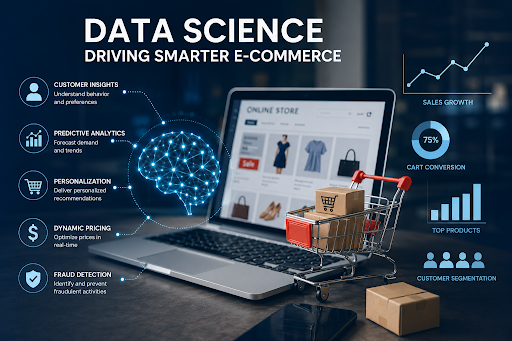
A decade ago, running an e-commerce business mostly meant having a decent website, reliable shipping, and good products. Today, that’s only the starting point.
Modern online shopping has become deeply connected to data. Every search, click, product view, and abandoned cart tells a story about customer behavior. The businesses growing fastest right now are the ones learning how to interpret those stories and act on them quickly.
This is where data science enters the picture.
While shoppers may never directly see the algorithms working behind the scenes, data science now influences almost every part of the e-commerce experience. It shapes product recommendations, email campaigns, pricing decisions, inventory planning, and even customer service interactions.
The interesting part is that many consumers don’t realize how much smarter online shopping has become over the past few years.
E-Commerce Is No Longer Guesswork
One of the biggest changes in online retail is the shift away from assumptions.
In the past, businesses often relied on instinct when making decisions. Store owners guessed which products would sell best, when customers would shop most often, or which promotions would work. Sometimes they were right. Many times they were not.
Today, companies can make decisions using actual behavioral data.
Instead of wondering why customers leave a website without buying, businesses can analyze where visitors drop off during the shopping process. Instead of launching random promotions, they can study which offers generate the highest conversion rates.
Data science allows brands to move from reacting to problems toward predicting them before they happen.
That’s a major advantage in a crowded market where customer attention disappears quickly.
Personalized Shopping Feels More Natural
Most people have experienced personalization without thinking much about it.
You browse a product online, and suddenly similar items begin appearing in ads or recommendation sections. Sometimes the suggestions are surprisingly accurate.
That’s not random.
E-commerce brands use machine learning models to understand browsing habits, product interests, and purchasing behavior. Over time, these systems learn what customers are likely to want next.
For example, someone researching luxury jewelry might later receive personalized suggestions for diamond rings based on previous searches or products they spent time viewing.
Good personalization does not feel invasive. It feels helpful.
Customers enjoy discovering products that actually match their interests instead of scrolling through hundreds of irrelevant listings. Businesses benefit because personalized recommendations often increase both conversion rates and average order values.
The best systems create the feeling that the platform understands the shopper without making the experience overly aggressive.
Smarter Inventory Means Fewer Problems
Inventory management is one of the least glamorous parts of e-commerce, but it’s also one of the most important.
Nothing frustrates customers more than discovering a product is out of stock after they decide to buy it. On the other hand, businesses lose money when warehouses are filled with products that are not selling.
Data science helps solve both problems.
Retailers can now predict demand patterns using historical sales, seasonal trends, and customer behavior. Instead of manually estimating how much inventory to order, businesses can use predictive models to make smarter forecasts.
This becomes especially useful during major shopping periods like holidays or seasonal launches.
A fashion retailer may notice that certain categories consistently surge during specific months. A beauty brand might discover that social media trends strongly affect demand for certain products.
The more data companies collect, the more accurate these predictions become.
Dynamic Pricing Is Everywhere
Most consumers have already encountered dynamic pricing, even if they didn’t realize it at the time.
Flight tickets, hotel bookings, and ride-sharing apps change prices constantly depending on demand. E-commerce businesses are increasingly doing the same thing.
Data science allows brands to adjust prices based on inventory levels, customer demand, competitor pricing, and buying behavior.
If a product suddenly becomes popular, prices may increase slightly. If sales slow down, discounts can appear automatically.
This flexibility helps businesses remain competitive without manually updating prices every day.
For shoppers, it often means seeing more relevant deals at the right moment. For companies, it helps protect profit margins while keeping products attractive to buyers.
The key is balance. Customers still want fair pricing, so the smartest retailers avoid making pricing changes feel manipulative.
Marketing Has Become Far More Precise
Digital marketing used to involve a lot of broad targeting and hopeful spending.
Now, companies can track nearly every stage of the customer journey. They know which ads generated clicks, which emails led to purchases, and which campaigns created repeat customers.
Data science helps marketers stop wasting money on audiences unlikely to convert.
Instead of showing the same advertisement to everyone, brands can create highly specific campaigns for different customer groups.
Someone casually browsing fashion accessories might receive very different messaging compared to someone actively researching engagement rings for an upcoming proposal.
These differences matter because customer intent matters.
Predictive analytics also helps marketers identify high-value customers early. Businesses can then focus retention efforts on shoppers most likely to become loyal repeat buyers.
In many ways, modern marketing is becoming less about reaching the largest audience and more about reaching the right audience.
Better Content Is Driven by Better Data
Content marketing remains one of the most valuable tools in e-commerce, but creating random blog posts no longer works the way it once did.
Brands now use analytics to understand exactly what audiences care about.
They can track which articles generate traffic, which videos increase engagement, and which product descriptions improve conversions. Over time, this information shapes smarter strategies.
For example, an online retailer might notice that educational buying guides perform better than promotional articles. Another company may discover that customers spend more time reading comparison-based posts before making purchases.
This data helps businesses create more useful content instead of simply publishing material for the sake of visibility.
It also improves SEO performance because businesses learn which search topics attract qualified traffic.
When done well, content becomes less about selling and more about helping customers make informed decisions.
Fraud Prevention Is Becoming More Advanced
As e-commerce grows, online fraud continues growing with it.
Businesses face challenges ranging from fake transactions to account takeovers and payment fraud. Manually identifying suspicious activity is almost impossible at scale.
Machine learning systems now help detect unusual behavior patterns automatically.
For example, if a customer suddenly logs in from a different country and attempts multiple high-value purchases within minutes, fraud detection systems may flag the activity immediately.
These systems become more accurate over time because they continuously learn from new data.
Industries handling sensitive transactions, especially financial services, have relied on predictive fraud detection for years. E-commerce companies are now adopting many of the same technologies to improve security and customer trust.
For shoppers, these systems mostly work invisibly in the background. But they play a major role in making online shopping safer.
Recommendation Systems Influence More Purchases Than People Realize
Some of the most profitable e-commerce sales happen through recommendations.
Customers may visit a site looking for one product but end up purchasing additional items because the recommendations feel relevant and timely.
This is not accidental.
Recommendation engines analyze customer behavior patterns across massive datasets. They identify relationships between products, customer interests, and browsing habits.
That’s why shoppers often see “You may also like” sections that feel surprisingly accurate.
Strong recommendation systems improve customer experience because they reduce the effort required to discover useful products.
For businesses, they increase average order value without relying entirely on aggressive advertising.
The Human Side Still Matters
Despite all the technology involved, successful e-commerce still depends heavily on human understanding.
Data science can reveal patterns, but businesses still need empathy, creativity, and strong customer experiences.
The brands growing fastest today are usually the ones combining smart analytics with authentic communication.
Customers want convenience and personalization, but they also want trust. They want fast websites, relevant recommendations, transparent policies, and responsive support.
Technology works best when it improves the customer experience instead of replacing the human side of it.
Final Thoughts
Data science is no longer something reserved for large tech companies. It has quietly become part of everyday e-commerce operations.
From personalized recommendations and predictive inventory planning to smarter marketing and fraud prevention, data-driven systems now influence nearly every online shopping experience.
What makes this shift interesting is how invisible it often feels to consumers. Most shoppers simply notice that digital experiences feel smoother, faster, and more relevant than they used to.
Behind the scenes, data science is doing much of the work.
As competition in e-commerce continues growing, businesses that understand their customers through data — while still maintaining a human touch — will likely have the strongest advantage moving forward.