
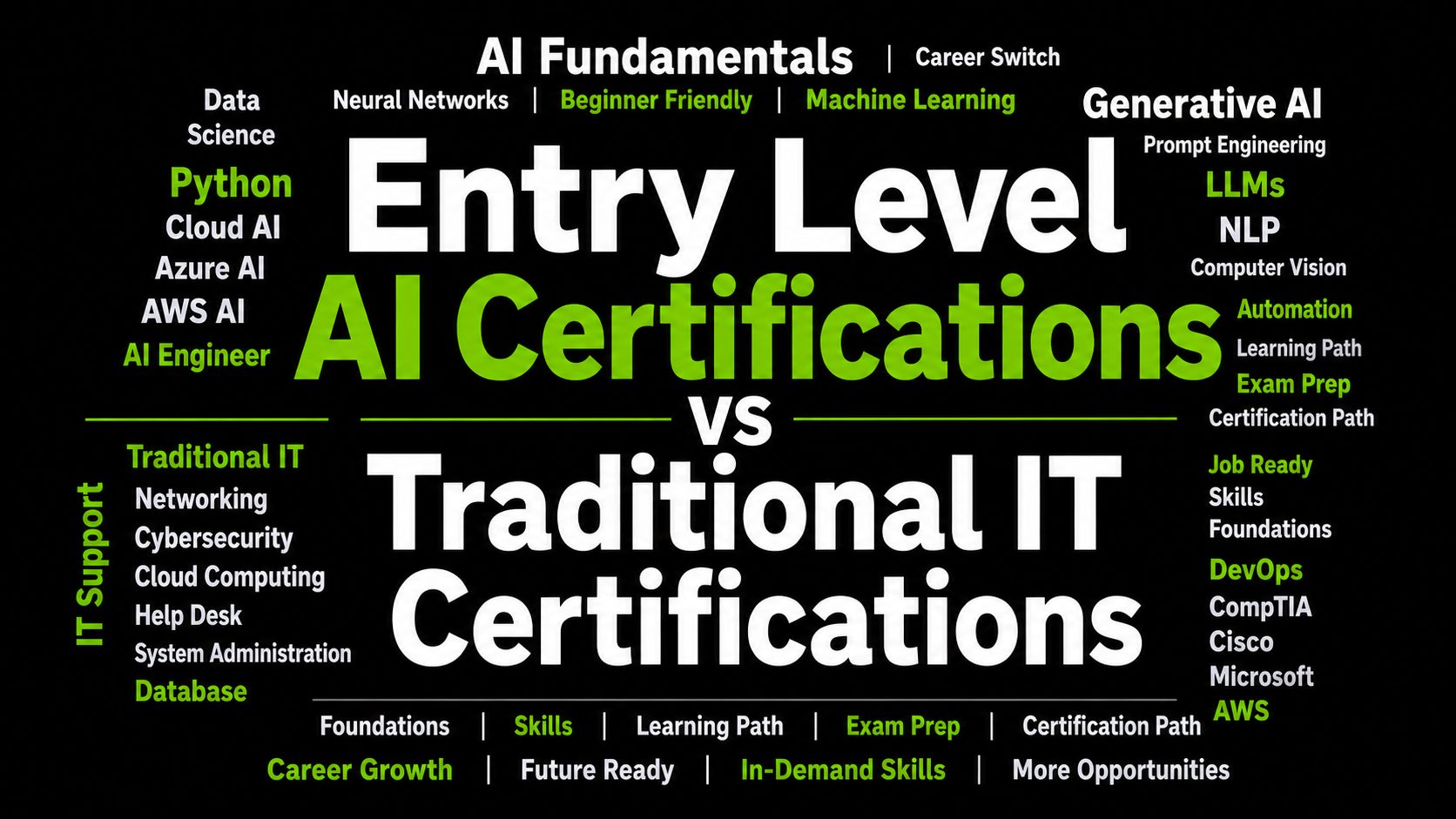
Career switching into tech looks different in 2026. A few years ago, many beginners started with help desk, networking, or basic cloud certifications. Today, AI has changed the conversation. New learners now ask whether they should begin with entry level AI certifications or follow the traditional IT certification route.
Both paths can work, but they serve different goals. Entry level AI certifications help you understand artificial intelligence, machine learning, generative AI, responsible AI, and business use cases. Traditional IT certifications teach core technical foundations such as hardware, networking, security, troubleshooting, cloud basics, and systems support.
The best choice depends on your target role. If you want to work close to AI tools, automation, cloud AI services, or business transformation, an AI certification may be a good start. If you want a stable technical foundation for IT support, cybersecurity, cloud, or infrastructure, traditional IT certifications may be stronger.
The New Career Switching Problem in 2026
Many beginners want to enter tech quickly, but they are confused by too many certification options. Some see AI as the fastest path because companies are adopting AI tools. Others worry that AI certifications may be too new or too broad.
Traditional IT certifications feel safer because employers already understand them. Certifications such as CompTIA A+, Network+, Security+, Microsoft fundamentals, AWS cloud foundations, and Cisco networking credentials have been used for years to support entry level career paths.
AI certifications are newer, but they are growing fast. For example, AWS Certified AI Practitioner validates foundational AI, machine learning, and generative AI knowledge, while Google Cloud’s Generative AI Leader certification is designed for people in any job role, even without hands-on technical experience. Microsoft’s Azure AI Fundamentals certification is also changing, with AI-900 retiring on June 30, 2026 and being replaced by AI-901.
This means career switchers need to think carefully. The question is not “Which certification is more popular?” The real question is “Which certification supports the job I want first?”
What Entry Level AI Certifications Teach
Entry level AI certifications usually focus on AI concepts rather than deep programming. They may cover machine learning basics, generative AI, foundation models, prompt design, responsible AI, cloud AI services, AI use cases, and business value.
These certifications are useful for people who want to understand how AI fits into modern work. They can help career switchers in roles such as AI support assistant, cloud AI learner, business analyst, automation coordinator, digital transformation assistant, junior AI product support, or non-technical AI adoption roles.
Common entry level AI certification topics include:
- What AI, machine learning, and generative AI mean
- How AI models are used in business
- Responsible AI and risk awareness
- Prompting and model output improvement
- Cloud AI tools and services
- Basic AI project planning
- AI use cases in customer service, security, analytics, and operations
These topics are valuable because many companies need people who can understand AI tools and explain them clearly. However, AI certification alone may not prove that you can troubleshoot networks, manage systems, secure devices, or support users.
What Traditional IT Certifications Teach
Traditional IT certifications focus on the technical base that supports most technology roles. They help candidates understand how computers, networks, operating systems, security controls, cloud services, and enterprise systems work.
For example, CompTIA A+ is described by CompTIA as an industry standard for starting an IT career, while Network+ focuses on troubleshooting, configuring, and managing networks. Security+ is positioned as a core cybersecurity certification that proves essential skills for security functions and IT security careers.
Traditional IT certifications are useful for roles such as:
- Help desk technician
- IT support specialist
- Junior network technician
- Junior systems administrator
- Cybersecurity beginner
- Cloud support associate
- Technical support analyst
These certifications may not sound as exciting as AI, but they build strong career stability. Most AI systems still depend on cloud infrastructure, networks, identity, data, security, and system administration. If you understand the base, you can move into AI later with stronger technical confidence.
AI Certifications vs Traditional IT Certifications
| Factor | Entry Level AI Certifications | Traditional IT Certifications |
|---|---|---|
| Best for | AI awareness, business AI, cloud AI basics | IT support, networking, cybersecurity, cloud foundations |
| Technical depth | Usually beginner to moderate | Stronger technical foundation |
| Career entry point | AI assistant, analyst, automation, AI support roles | Help desk, IT support, junior admin, security support |
| Employer familiarity | Growing fast | More established |
| Learning style | Concepts, use cases, responsible AI, tools | Troubleshooting, systems, networks, security |
| Best next step | Cloud AI, data, ML, automation | Cybersecurity, cloud, networking, systems |
| Main weakness | May be too broad alone | May not cover modern AI skills deeply |
This comparison shows that neither path is automatically better. AI certifications are useful for modern business and technology awareness. Traditional IT certifications are better for building the foundation employers expect in many technical roles.
Choose AI First If Your Goal Is AI-Related Work
An entry level AI certification may be the better first choice if you want to work in AI-related roles but do not want to start with hardware or networking.
This path can fit you if:
You are interested in generative AI tools.
You want to work with AI use cases in business.
You are aiming for cloud AI services.
You already have some non-technical professional experience.
You want to support AI adoption inside a company.
You are interested in prompt engineering, automation, or AI product support.
For example, someone with a marketing, operations, HR, finance, or business background may benefit from an AI certification because it connects their existing experience with new technology.
However, you should still learn basic IT concepts. AI tools do not work in isolation. They depend on data, cloud platforms, security controls, and user access.
If your interest is more focused on AI security, this AI Security Certifications 2026 video explains how cybersecurity and AI skills are coming together for future career paths.
Choose Traditional IT First If You Need a Strong Base
Traditional IT certifications may be the better first choice if you are completely new to technology and want a clear entry-level job path.
This path can fit you if:
You want your first technical job.
You are comfortable starting in support or operations.
You want to understand computers, networks, and security.
You plan to move into cloud or cybersecurity later.
You need a credential that employers already recognize for beginner roles.
A traditional route can be slower, but it is often more stable. It teaches you how technology works before you specialize. Many career switchers start with IT support, then move toward cloud, cybersecurity, data, DevOps, or AI operations.
This path also helps you avoid a common problem: learning AI terms without understanding the systems behind them.
The Smartest Choice: Combine Both Paths
For many career switchers in 2026, the best option is not AI versus traditional IT. The best option is a combined path.
A strong beginner path could look like this:
Start with a traditional IT foundation.
Add an entry level AI certification.
Choose a role direction.
Build small projects.
Practice interview questions.
Keep learning cloud, security, or data.
For example, you could begin with IT fundamentals or A+, then study AWS Certified AI Practitioner, Microsoft Azure AI Fundamentals, or Google Cloud Generative AI Leader. This gives you both base technical knowledge and AI awareness.
Another path could be Security+ plus an AI security-focused credential later. CompTIA already highlights SecAI+ as a certification for cybersecurity and tech professionals who need to secure AI systems and use AI responsibly in security operations. The combined path is powerful because AI is becoming part of every tech area, not a separate world.
AI is also changing how candidates prepare for certifications, especially through faster explanations, summaries, flashcards, and targeted revision. This Indie Hackers discussion explains how AI is making IT certification prep more interactive without replacing real practice: https://www.indiehackers.com/post/what-ai-is-actually-changing-in-it-certification-prep-4700f0c79e
What Employers May Prefer in 2026
Employers usually care about three things: skill, proof, and fit. A certification can help, but it does not replace practical ability.
For entry-level technical roles, employers may prefer traditional IT certifications because they show practical readiness for support, troubleshooting, systems, and security basics.
For business AI or cloud AI awareness roles, entry level AI certifications may stand out because they show that you understand modern AI use cases and responsible AI thinking.
For the strongest profile, combine certification with proof of work. Build simple projects, document what you learned, and show examples. A beginner AI project could be a chatbot workflow, prompt library, AI policy checklist, or cloud AI demo. A traditional IT project could be a home lab, network diagram, security checklist, or troubleshooting guide.
During revision, candidates can use Cert Empire as one practice source when they want exam-style questions after studying official objectives.
Final Recommendation
If your goal is your first hands-on technical job, choose traditional IT certifications first. They give you a stronger base and open more entry-level roles.
If you already have business experience and want to move toward AI adoption, automation, or cloud AI awareness, an entry level AI certification can be a smart first step.
If you want the safest career-switching strategy in 2026, combine both. Learn IT fundamentals, add AI knowledge, and build small practical projects. This gives you a profile that is both stable and modern.
AI may shape the future of tech, but traditional IT still supports that future. The best career switchers will understand both.
FAQs
1. Are entry level AI certifications good for beginners?
Yes, entry level AI certifications are useful for beginners who want to understand AI concepts, generative AI, responsible AI, and business use cases before choosing deeper technical training.
2. Are traditional IT certifications still worth it in 2026?
Yes, traditional IT certifications remain valuable because they build core skills in support, networking, cloud, security, and troubleshooting, which many entry-level technology jobs still require.
3. Should career switchers choose AI or IT certifications first?
Choose AI first if your target role is business AI or automation. Choose traditional IT first if you want a stronger technical foundation and entry-level support roles.
4. Can I get a tech job with only an AI certification?
It is possible for some AI support or business roles, but technical jobs usually require broader skills. Add projects, cloud basics, security awareness, or traditional IT knowledge.
5. What is the best certification path for career switching?
The best path combines IT fundamentals with AI knowledge. Start with basic technical skills, add an entry level AI certification, then build projects related to your target role.