
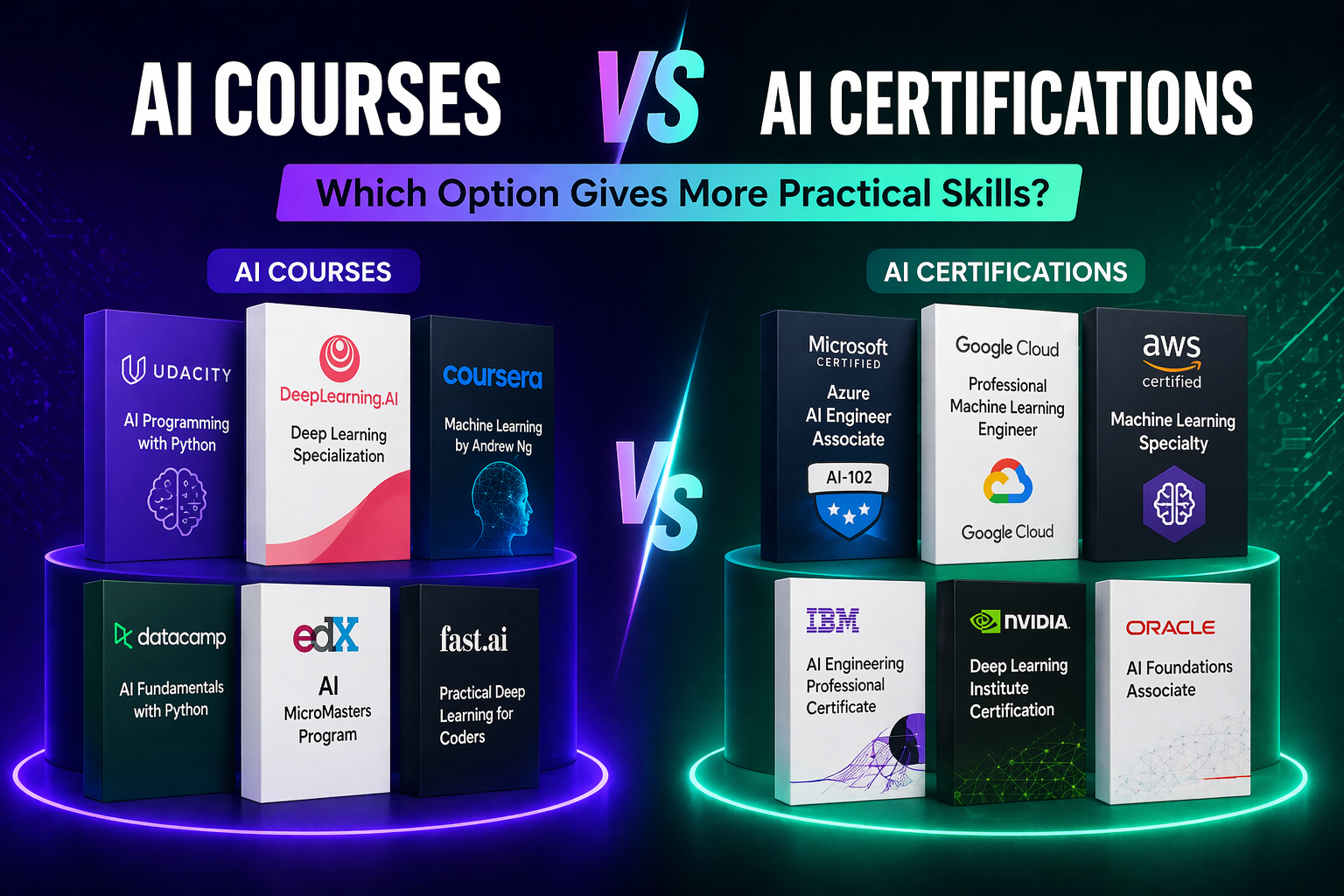
Artificial Intelligence is no longer a niche skill. In 2026, it is part of software development, cloud platforms, cybersecurity, data analytics, and even business operations. Because of this, many learners face a common dilemma:
Should you take AI courses or pursue AI certifications?
At first glance, both seem similar. Both promise learning, career growth, and better opportunities. But in reality, they serve different purposes. One focuses more on learning and building skills, while the other focuses more on validation and recognition.
The real question is not which one is better overall. It is which one gives you practical, job-ready skills.
What Are AI Courses
AI courses are structured learning programs designed to teach concepts, tools, and practical implementation of artificial intelligence.
These courses can include:
- Machine learning basics
- Deep learning concepts
- Python and AI libraries
- Model training and evaluation
- Real-world projects
AI courses are usually flexible. You can learn at your own pace, revisit content, and practice multiple times. Many courses also include hands-on labs and projects, which help in building real skills.
What Are AI Certifications
AI certifications are formal credentials that validate your knowledge and skills in artificial intelligence.
They are usually offered by:
- Cloud providers
- Professional organizations
- Technology companies
Certifications test:
- Your understanding of AI concepts
- Your ability to apply knowledge
- Your readiness for specific roles
Unlike courses, certifications are exam-focused. You study, intending to pass a structured test.
Key Difference: Learning vs Validation
The biggest difference between courses and certifications comes down to purpose.
AI courses are designed to help you learn and practice.
AI certifications are designed to prove what you know.
This means courses are often more flexible and exploratory, while certifications are more structured and goal-driven.
Practical Skills: Which One Builds More
When it comes to practical skills, AI courses usually provide more hands-on experience.
Courses often include:
- Projects
- Coding exercises
- Real datasets
- Experimentation
These elements help you understand how AI works in real scenarios.
Certifications, on the other hand, may include some practical elements, but they often focus more on:
- Concepts
- Use cases
- Decision-making
That does not mean certifications lack value. It simply means their focus is different.
Where Certifications Become Useful
Even though courses build more hands-on experience, certifications play an important role in career growth.
They help you:
- Validate your skills
- Stand out to employers
- Meet job requirements
- Build professional credibility
For example, an employer may not review every project you have done, but they will quickly recognize a certification.
When AI Courses Are the Better Choice
AI courses are the better option if your goal is to:
- Learn from scratch
- Build strong practical skills
- Understand coding and implementation
- Work on real projects
They are especially useful for beginners who need a structured introduction to AI concepts.
Courses also allow you to learn at your own pace, which makes them more comfortable for self-learners.
When AI Certifications Are the Better Choice
AI certifications are more useful if your goal is to:
- Validate your knowledge
- Apply for jobs
- Show proof of expertise
- Advance in your career
They are ideal for learners who already understand the basics and want to demonstrate their skills professionally.
Read on: Cisco 800-110 Exam Questions Breakdown: Domains and Practice Focus Areas
Best Strategy in 2026: Combine Both
The smartest approach is not choosing one over the other.
The best results come from combining both.
Start with AI courses to build your understanding and hands-on skills. Then move to certifications to validate what you have learned.
This approach gives you:
- Practical experience
- Recognized credentials
- Better career opportunities
How to Build a Strong AI Learning Path
A simple roadmap works best.
Step 1: Learn Fundamentals
Start with basic AI and machine learning concepts.
Step 2: Practice with Projects
Work on real problems and datasets.
Step 3: Understand Tools
Learn frameworks and platforms.
Step 4: Prepare for Certification
Once confident, move to certification exams.
Step 5: Practice Exam Questions
Focus on scenario-based questions.
Many learners use platforms like Cert Empire to practice exam-style questions and improve their understanding before attempting certification exams.
A quick watch on Cert Empire’s channel can clear all your confusion: 📍
Common Mistakes to Avoid
Many learners make mistakes that slow their progress.
One common mistake is jumping directly into certifications without understanding the basics. This makes exams difficult and reduces confidence.
Another mistake is taking too many courses without completing any. This leads to scattered knowledge.
Some learners also avoid projects, focusing only on theory. This limits practical skills.
Finally, ignoring certifications completely can make it harder to prove your abilities in the job market.
Career Perspective: What Employers Prefer
Employers in 2026 look for a combination of:
- Practical skills
- Real project experience
- Recognized certifications
A candidate with only certifications but no practical experience may struggle in interviews.
Similarly, a candidate with only projects but no recognized credentials may face challenges in initial screening.
The best candidates usually have both.
Closing Summary
AI courses and AI certifications are not competitors. They are two parts of the same learning journey.
Courses help you:
- Learn
- Practice
- Build skills
Certifications help you:
- Prove your knowledge
- Gain recognition
- Advance your career
If your goal is practical skills, start with courses. If your goal is career growth, add certifications.
In 2026, the most successful professionals are those who combine learning with validation.
FAQs
1. Do AI courses provide more practical skills than certifications?
Yes, AI courses usually provide more hands-on practice through projects and exercises, which helps in building real-world skills.
2. Are AI certifications worth it in 2026?
Yes, they are valuable because they validate your skills and help you stand out in the job market.
3. Can I get a job with only AI courses?
It is possible, but having certifications can improve your chances and credibility with employers.
4. What is the best way to learn AI?
The best approach is to start with courses for practical skills and then pursue certifications to validate your knowledge.
Up next: CompTIA A+ 220-1201 vs 220-1101 in 2026 | What’s Changed and Which One to Take